
1. Introduction
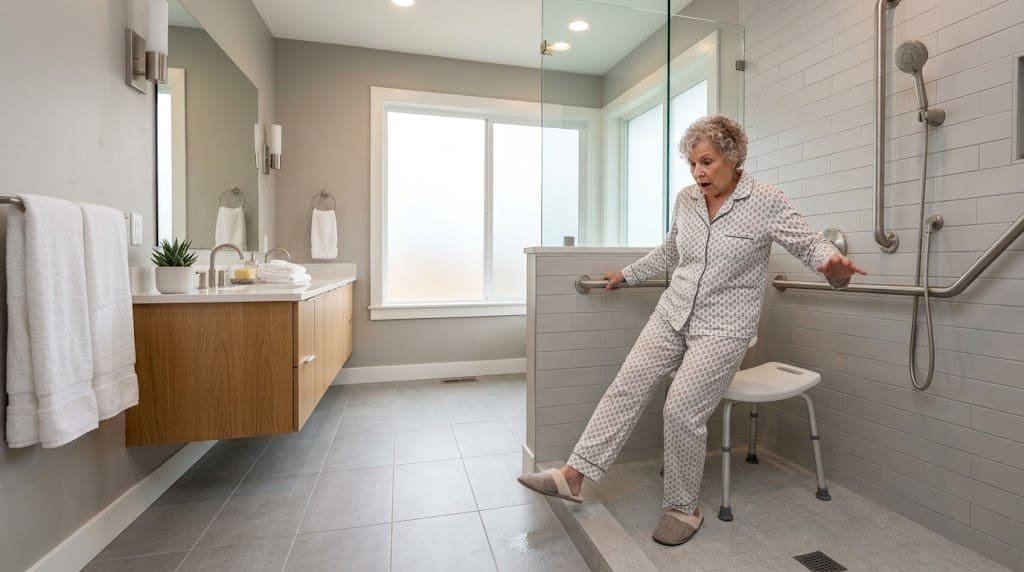
Bathroom slip and fall prevention starts with controlling the hazards that make this room difficult to navigate: wet or slippery surfaces, loose rugs, clutter, poor lighting, awkward transfers, and a lack of stable support. But preventing a bathroom fall is about more than keeping the shower floor dry.
A safer bathroom considers the entire routine—from walking into the room and getting onto the toilet to stepping into the shower, turning, reaching, bathing, drying, and walking back out. The right changes depend on the space and the person using it. Some bathrooms may need only simple adjustments, while others may benefit from grab bars, bathing seats, or larger accessibility changes.
Table of Contents
2. Why Bathroom Slips and Falls Happen
Bathroom falls usually result from a combination of environmental hazards and movements that challenge balance. Water and smooth surfaces can reduce traction, while clutter, poor lighting, difficult transfers, and awkward reaching can make it harder to stay stable.
Wet and slippery surfaces
Water is one of the most obvious bathroom fall hazards, particularly around the shower and bathtub. A wet floor can reduce traction between bare feet or footwear and the surface underneath. Soap residue can make the problem worse by leaving surfaces slick.
The risk is not limited to the inside of the shower or tub. Water can be tracked onto the floor when someone steps out, dries off, or reaches for a towel. Keeping wet areas controlled and using appropriate nonslip surfaces can reduce this source of risk. The National Institute on Aging recommends nonskid mats or strips on bathroom surfaces that may become wet.
Trip hazards and obstacles
Not every bathroom fall starts with slipping. A person can also trip over an object or lose balance when a foot catches on something unexpectedly.
Common examples include:
- Loose or unsecured rugs
- Mats that curl or bunch
- Clothes or towels left on the floor
- Cords crossing a walking path
- Toiletries or other objects left where someone walks
- Uneven thresholds or changes in floor level
The CDC recommends removing things that could cause a person to trip, while the NIA specifically advises against throw rugs and recommends keeping walking areas clear.
Balance and movement challenges
The bathroom can become especially challenging when ordinary movements require a person to shift their weight, stand on one leg, turn in a small space, or move from sitting to standing.
Examples include:
- Stepping over a bathtub wall
- Turning around inside a shower
- Sitting down or standing up from the toilet
- Reaching for soap or a towel
- Bending toward a low cabinet
- Drying off while standing on a wet surface
- Getting dressed after bathing
These movements can become more difficult when someone has reduced strength, balance problems, joint pain, vision problems, dizziness, or a mobility limitation. Current Mayo Clinic guidance emphasizes looking at the actual movements a person performs in the bathroom rather than relying on a one-size-fits-all safety setup.
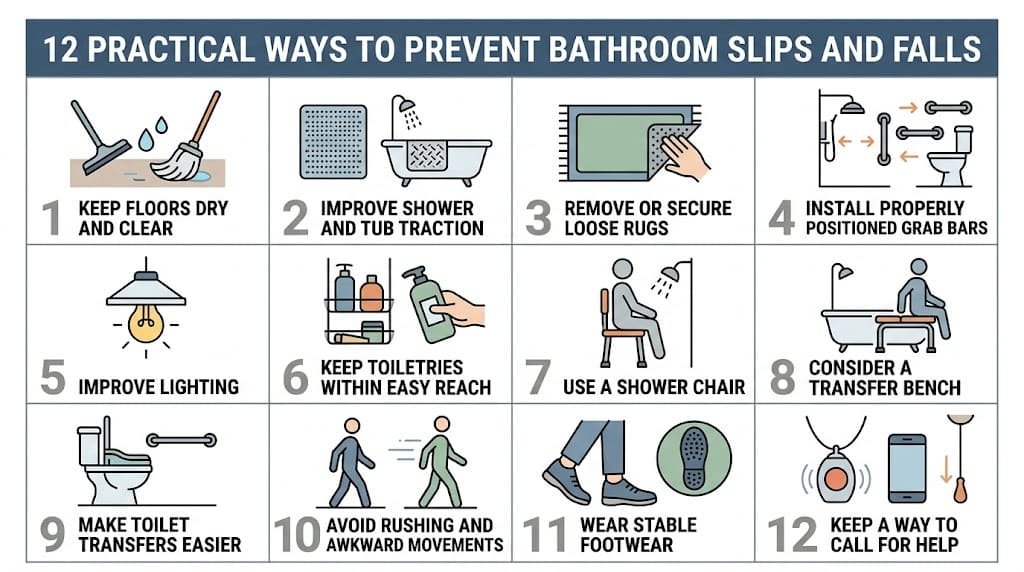
3. 12 Practical Ways to Prevent Bathroom Slips and Falls
There is no single product or modification that makes every bathroom safe. The most useful changes address the specific hazards and movements that create risk for the person using the room.
1. Keep bathroom floors dry and clear
Clean up standing water as soon as practical, particularly around the shower, bathtub, sink, and bathroom entrance. Keep the main walking path free of clothing, towels, containers, cords, and other objects.
A clear floor gives the person more room to walk and reduces the chance of a foot catching on something unexpectedly. It also makes it easier to see where the next step will land.
Avoid putting towels directly on the floor to absorb water. Instead, keep a towel within easy reach so the person does not have to walk across a wet surface to get one.
2. Improve traction in the shower or tub
The shower and bathtub need reliable traction because these surfaces can become wet and soapy.
Nonslip strips, decals, or an appropriate nonskid mat can help improve traction on surfaces that become wet. The NIA recommends nonskid mats or strips for wet bathroom surfaces.
The important point is that a safety surface should remain stable and flat. A loose mat that slides, folds, or bunches can introduce a different type of hazard.
3. Remove or secure loose bathroom rugs
Small decorative rugs may look harmless, but they can move when stepped on. A person can also catch a toe on a curled edge.
For fall prevention, consider whether a rug is actually necessary. The NIA recommends avoiding throw rugs as part of home fall prevention.
If a bathroom requires a mat for a specific purpose, it should remain flat and stable rather than shifting underfoot.
4. Install properly positioned grab bars
Grab bars can provide a stable handhold during movements such as entering a shower, stepping over a tub wall, sitting down, or standing up.
The CDC advises placing securely installed grab bars around tubs, showers, and toilets to provide stable support during bathroom movements.
Placement matters. A grab bar should support the movement that actually occurs at that location. A person who needs help stepping over a tub wall may need support in a different position from someone who needs assistance standing from a shower seat.
Do not assume a towel bar, shower door frame, or vanity is a suitable substitute for a grab bar. Those features may not be designed to support body weight.
5. Improve bathroom and nighttime lighting
Poor visibility can make water, objects, thresholds, and changes in floor level harder to see.
Use adequate, even lighting in the bathroom and along the route leading to it. A night light or motion-activated light can be particularly useful for nighttime trips when the room and surrounding hallway may otherwise be dark.
The CDC and NIA both recommend improving home lighting and using bathroom lighting or night lights as part of fall prevention.
6. Keep soap, towels, and toiletries within easy reach
Reaching too far can shift a person’s center of balance, especially when standing on a wet surface.
Keep frequently used items where they can be reached without excessive bending, twisting, or stretching. This may mean repositioning soap, shampoo, towels, or grooming products.
For someone who bathes while seated, the setup should also allow essential items to be reached from the seated position rather than requiring the person to stand unexpectedly.
7. Consider shower seating if standing becomes challenging
A shower chair can reduce the amount of time a person needs to stand on a wet surface. It can be useful when standing while bathing causes fatigue, instability, or difficulty maintaining balance.
A shower chair is generally suited to a walk-in shower where the person can enter safely and sit down. The specific chair should fit the available space and provide a stable base.
Mayo Clinic guidance notes that the choice of bathing seat depends on the shower or tub configuration, balance, and the amount of assistance needed.
A shower chair alone does not guarantee safer bathing. It should be paired with a secure approach, stable sitting and standing movements, and a safe way to get in and out of the shower.
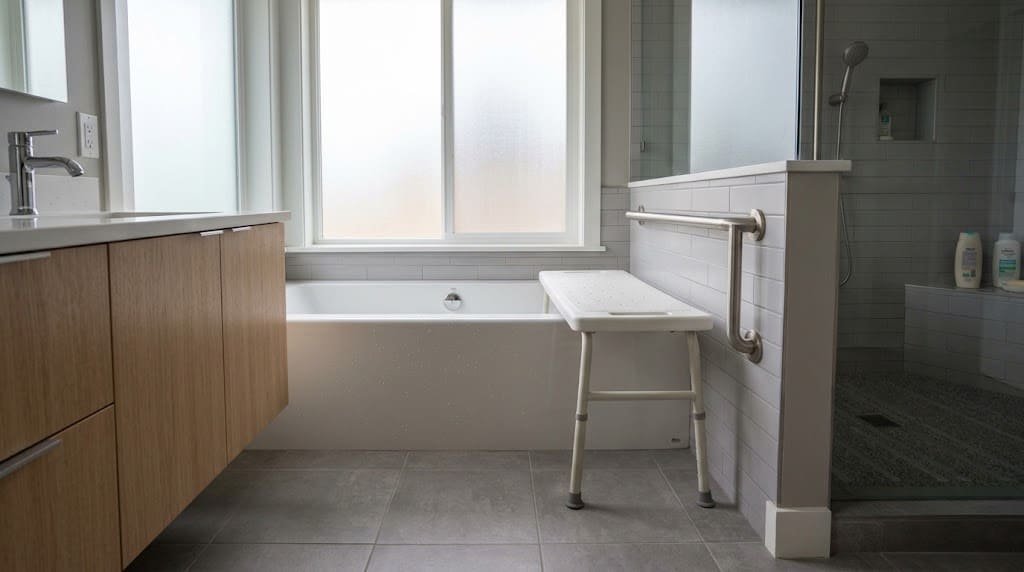
8. Consider a transfer bench for difficult tub entry
A bathtub can create a particularly challenging transfer because the person must get over the tub wall while maintaining balance.
A transfer bench can reduce the need to step over the wall while standing. Instead, the person can sit on the bench outside the tub and move across it before bringing the legs into the bathing area.
This type of equipment may be appropriate when stepping over the tub edge is difficult, unsafe, painful, or tiring. Mayo Clinic describes transfer benches as particularly useful for tub-shower combinations where the tub edge creates a significant transfer challenge.
9. Make getting on and off the toilet easier
The toilet is another location where balance can be challenged because the person must lower into a seated position and then stand again.
Keep the area around the toilet clear. If additional support is needed, appropriately installed grab bars or other suitable equipment may help with the transfer.
Toilet height can also affect how easily someone can sit and stand. However, a higher seat is not automatically better for everyone. The setup should allow stable foot contact and controlled movement.
For someone who struggles with toilet transfers, an occupational therapist or other qualified health professional can help determine which equipment and placement fit the person’s needs.
10. Reduce rushing and awkward movements
A safer bathroom routine involves more than simply adding safety equipment. Moving deliberately can also help reduce unnecessary balance challenges.
Avoid rushing to answer a phone, reach for an item, or get out of the shower. When possible, pause before changing position, particularly when moving from sitting to standing.
If an item is out of reach, it is usually safer to reposition the item or ask for assistance than to stretch, twist, or use an unstable object as a step.
11. Wear stable, appropriate footwear when needed
Footwear can affect traction and stability. Smooth socks, loose slippers, or footwear with worn soles may make movement less secure.
For people who need footwear in the bathroom, choose an option that fits securely and provides appropriate traction. The CDC recommends sturdy, properly fitting, nonslip footwear as part of fall prevention.
The appropriate choice can vary by person and situation, so footwear should not replace improvements to the bathroom itself.
12. Keep a way to call for help within reach when appropriate
For someone with a significant fall risk, having a phone or appropriate emergency-response device accessible can provide a way to request help after a fall or during an emergency.
This is especially relevant for someone who lives alone or has previously fallen. The NIA notes that emergency response systems can help people obtain assistance if they fall and need emergency help.
The goal is not to make someone dependent on an emergency device. It is to make sure help can be reached if a serious problem occurs.
4. How to Prevent Slipping in the Shower
Preventing slipping in the shower requires more than adding a mat. The goal is to improve traction, reduce unnecessary reaching, and provide stable support for the movements the person actually makes.
Improve traction on the shower floor
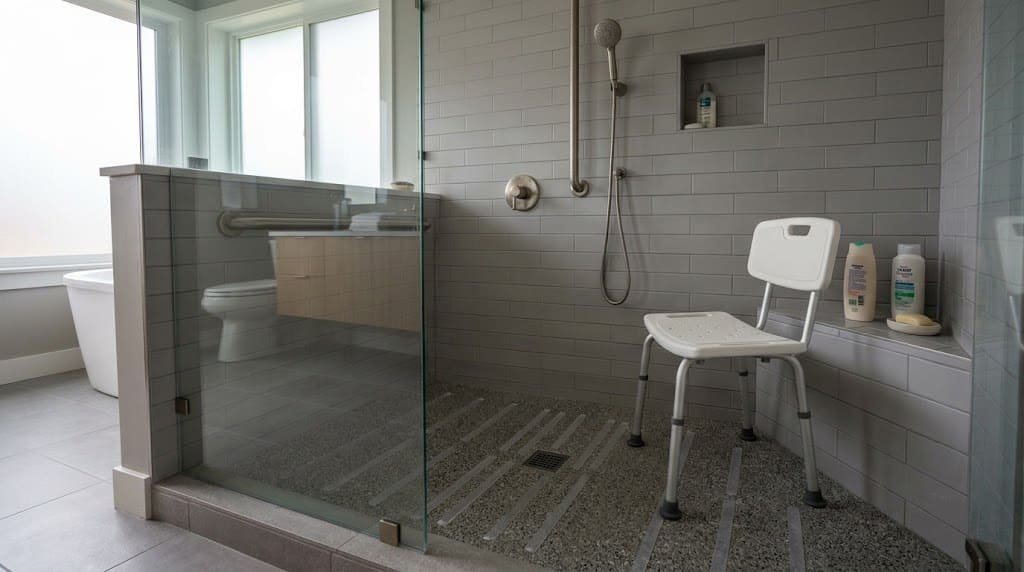
A shower floor should provide adequate traction when wet. Options may include:
- Nonslip strips or decals
- An appropriately designed nonskid shower mat
- A shower surface with suitable wet traction
The chosen solution should stay firmly in place and should not create a new trip hazard. The NIA advises using slip-resistant mats or adhesive strips in areas where water can make the surface slippery.
Keep the shower floor reasonably free of soap buildup as well. A surface that becomes coated with residue may be harder to navigate safely.
Keep soap and water from becoming hazards
Soap and water become more problematic when they force someone to make unnecessary movements.
Keep commonly used products within comfortable reach. Avoid placing frequently used items where a person must bend deeply, twist, or stretch across a wet shower floor.
Control water that escapes the shower area as well. Water tracked onto the bathroom floor can create a second slip hazard immediately outside the bathing area.
Add stable support where you enter, turn, and stand
The most effective support is placed where it can assist with the specific movements that are hardest to perform safely.
A person may need support when stepping into the shower, turning, sitting down, or standing up. Grab-bar placement should therefore be based on the person’s movement pattern and the configuration of the shower.
The CDC recommends grab bars in and around tubs and showers, while Mayo Clinic guidance emphasizes positioning support around actual transfer and movement points.
Never rely on a towel bar for support; use a securely installed grab bar designed to bear weight.
When a shower chair makes sense
A shower chair can be useful when standing for the entire shower is tiring or unstable. It allows the person to bathe while seated and can reduce the amount of time spent standing on a wet surface.
It is most useful when the person can enter and exit the shower safely and the chair itself fits securely within the shower.
If entering the shower is the primary problem, rather than standing during the shower, a different modification may be more appropriate.
5. How to Prevent Falls in a Bathtub
Bathtub slip prevention requires particular attention to the tub wall because entering and exiting can be more challenging than simply standing inside the tub.
Why stepping over a tub wall can be difficult
Stepping over a bathtub wall combines several balance demands at once:
one-leg balance + height difference + wet surface
One foot has to clear the tub while the other supports the body. The person then has to place the lifted foot onto a potentially wet surface and regain stable footing.
That movement can become more difficult with reduced strength, balance problems, joint limitations, dizziness, or other mobility challenges.
Use appropriate support for tub entry and exit
Stable support can help during the transition into and out of a tub. Depending on the bathroom and the person, this may include properly installed grab bars or other professionally recommended equipment.
The support should be positioned so it helps with the actual transfer rather than forcing the person to reach behind, twist, or pull from an awkward angle.
When to consider a transfer bench
A transfer bench can be worth considering when stepping over the tub wall while standing is unsafe or difficult.
Instead of stepping directly into the tub, the person sits down on the outside portion of the bench, moves across, and then brings the legs into the tub. This changes the movement from a standing step-over to a seated transfer.
Mayo Clinic identifies transfer benches as an option for tub-shower combinations where the tub edge presents a significant entry challenge.
The equipment still needs to fit the tub, provide stable support, and be appropriate for the person’s abilities.
Keep the floor outside the tub dry and stable
The area immediately outside the bathtub is part of the transfer zone. A person may step out of the tub with wet feet and then turn toward a towel or bathroom fixture.
Keep this area clear and address water that reaches the floor. Avoid loose mats that can slide or bunch when stepped on.
The safest setup is one that lets the person complete the entire transfer without needing to step onto an unstable surface.
6. Make the Toilet Area Safer
Bathroom fall prevention should include the toilet because sitting down and standing up can be challenging for someone with reduced lower-body strength, balance problems, or joint limitations.
Reduce the difficulty of sitting and standing
A person should be able to approach the toilet, turn, sit, and stand without navigating clutter or reaching for an unstable object.
The appropriate toilet height depends on the person. A raised toilet seat may help some people, but it should not be so high that the person’s feet cannot rest securely on the floor.
Add stable support where needed
Grab bars or other appropriate support equipment can assist with toilet transfers.
The CDC recommends installing grab bars next to the toilet as part of home fall prevention.
A towel rack or other fixture that was not designed for body-weight support should not be treated as a grab bar.
Keep the floor around the toilet clear
The space around the toilet should provide enough room for the person to approach, turn, sit, and stand safely.
Remove laundry, baskets, decorative objects, cords, and other items that interfere with movement.
For someone using a cane, walker, or wheelchair, the approach should also accommodate the device rather than forcing an awkward turn.
Improve visibility for nighttime use
Nighttime bathroom trips can be harder when the person has to navigate a dark bedroom, hallway, or bathroom.
A night light or motion-activated light can make the route easier to see without requiring someone to walk through the room in darkness. The NIA specifically recommends leaving a bathroom light on at night or using an automatic night light.
7. Improve Bathroom Lighting and the Path to the Bathroom
Bathroom safety does not begin at the bathroom door. For someone who gets up at night, the path from the bed to the bathroom is part of the fall-prevention environment.
Brighten dark areas around the bathroom
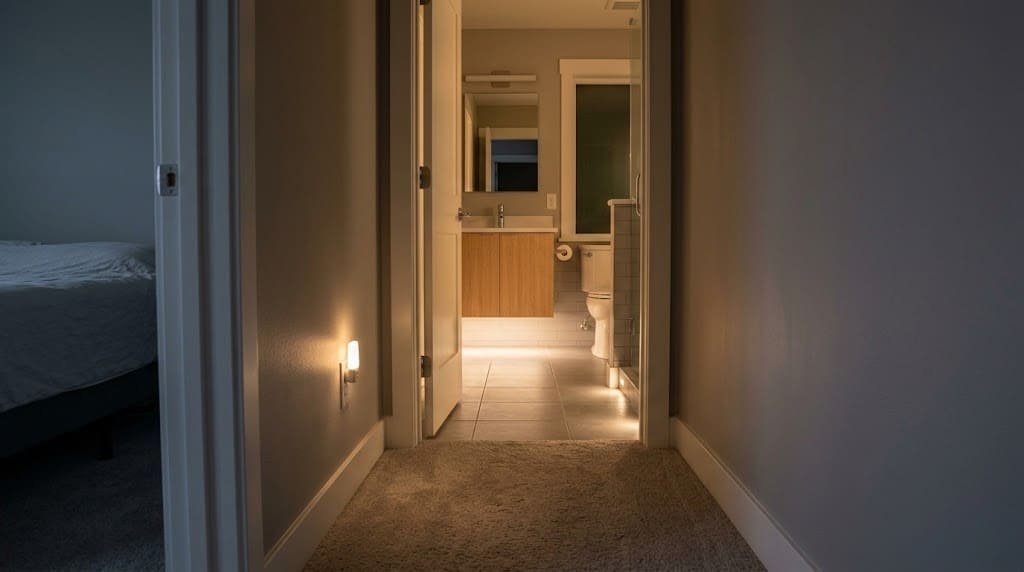
Use enough lighting to make the floor, bathroom entrance, and changes in level easy to see.
The goal is not simply maximum brightness. Lighting should provide clear, even visibility without creating confusing glare or dark areas.
The CDC recommends adding more or brighter lighting as part of home fall prevention.
Add nighttime lighting
A night light or motion-sensor light can illuminate the route without requiring a person to find and operate a switch in the dark.
Consider both the bathroom and the path leading to it. A brightly lit bathroom does not solve the problem if the hallway between the bedroom and bathroom remains dark.
Keep the bedroom-to-bathroom path clear
Remove shoes, clothing, cords, small furniture, and other objects that could become trip hazards.
The NIA recommends keeping walking areas tidy and keeping electrical cords away from walking paths.
This simple step can be particularly important at night when visibility is reduced and the person may be tired or not fully alert.
8. Bathroom Fall Prevention for Older Adults and People With Mobility Challenges
The same bathroom can present very different levels of risk for different people. A person who moves easily may have little difficulty with a standard tub, while someone with balance or mobility limitations may struggle with the same step.
When balance or muscle weakness changes the risk
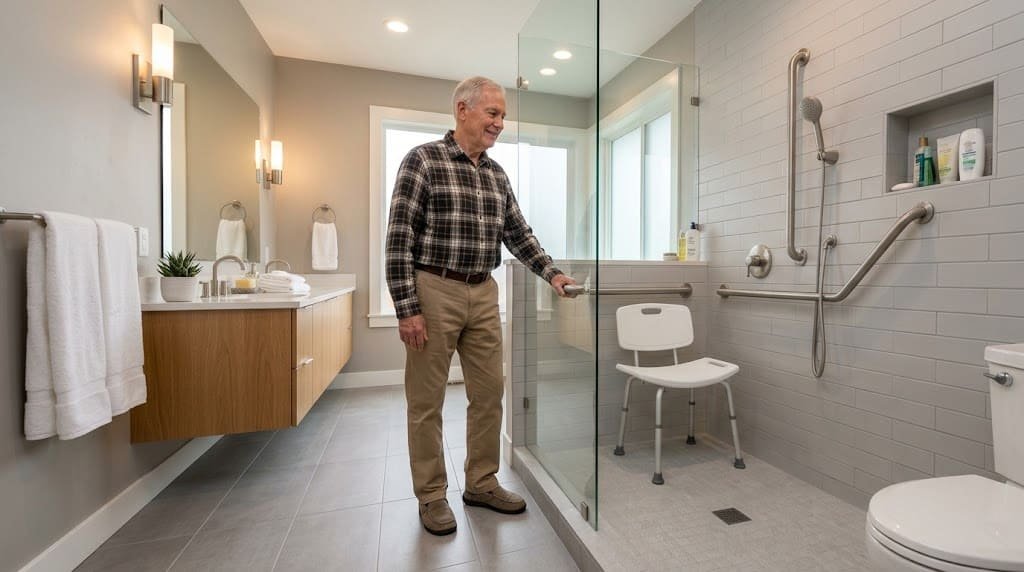
Reduced balance or strength can make ordinary bathroom movements more demanding.
For example, stepping over a tub wall requires the person to shift weight onto one leg and then regain balance after clearing the edge. Standing for several minutes in a wet shower can also become difficult if fatigue affects stability.
For older adults, fall prevention may also involve broader issues such as vision, medications, strength, and balance. The CDC and NIA recommend discussing fall risk and related health factors with a health care professional when appropriate.
When a shower chair or transfer bench may help
The right bathing aid depends on the movement that is difficult.
| Main challenge | Equipment that may be considered |
|---|---|
| Standing during a walk-in shower is difficult | Shower chair |
| Stepping over a tub wall is difficult | Transfer bench |
| Sitting or standing during bathing is unstable | Appropriate seating and stable support |
| Reaching while bathing is difficult | Handheld showerhead and better item placement |
These are general use cases, not universal prescriptions. The equipment needs to match the person’s bathroom, mobility, strength, and ability to transfer safely.
When professional assessment is appropriate
Consider a professional home-safety assessment when someone has already fallen, feels unsteady, has difficulty getting into or out of a tub, uses a mobility aid, or needs help with bathing or toileting.
An occupational therapist can evaluate how a person moves through the bathroom and help identify appropriate equipment, placement, and environmental changes. The NIA notes that an occupational therapist, physical therapist, or nurse may assess home safety after a fall and recommend changes to reduce fall risk.
Why grab-bar placement should match the person’s movements
A grab bar is useful only if it is positioned where the person can safely reach it during the movement that requires support.
For example, the ideal support for stepping into a tub may differ from the support needed to stand from a shower chair.
This is why grab-bar placement should be based on the person’s height, reach, strength, balance, and transfer pattern rather than simply copying a generic location.
9. A Simple Bathroom Slip and Fall Prevention Checklist
Use this checklist to walk through the bathroom and identify practical improvements.
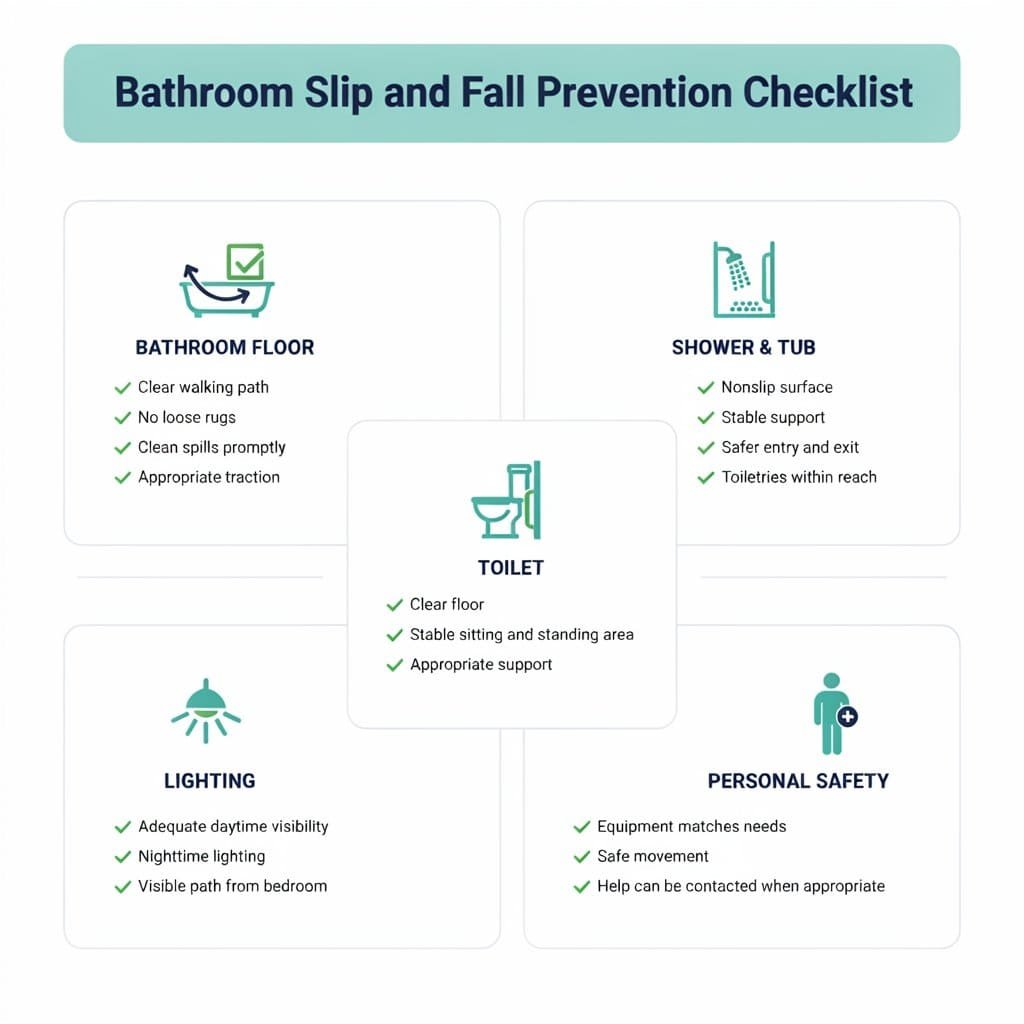
Bathroom floor
- No loose rugs or unstable mats
- Walking path is clear
- Spills and standing water are addressed promptly
- Wet surfaces have appropriate traction
Shower/tub
- Shower or tub surface provides appropriate traction
- Stable support is available where needed
- Entry and exit can be completed safely
- Soap, towels, and toiletries are within comfortable reach
Toilet
- Sitting and standing can be performed with control
- Appropriate support is available if needed
- Floor around the toilet is clear
Lighting
- Bathroom is adequately lit
- Night lighting is available
- Path from the bedroom to the bathroom is visible
Personal safety
- The person can move through the bathroom without unnecessary reaching or twisting
- Equipment matches the person’s abilities and bathroom layout
- A way to call for help is available when appropriate
This checklist follows the same basic principles reflected in CDC and NIA fall-prevention guidance: remove hazards, improve lighting, add appropriate bathroom support, and make wet surfaces safer.
10. What Should You Fix First? A Bathroom Fall-Risk Priority Guide
If a bathroom has several hazards, you do not necessarily need to change everything at once. Start with the problems that create the most immediate risk during normal movement.
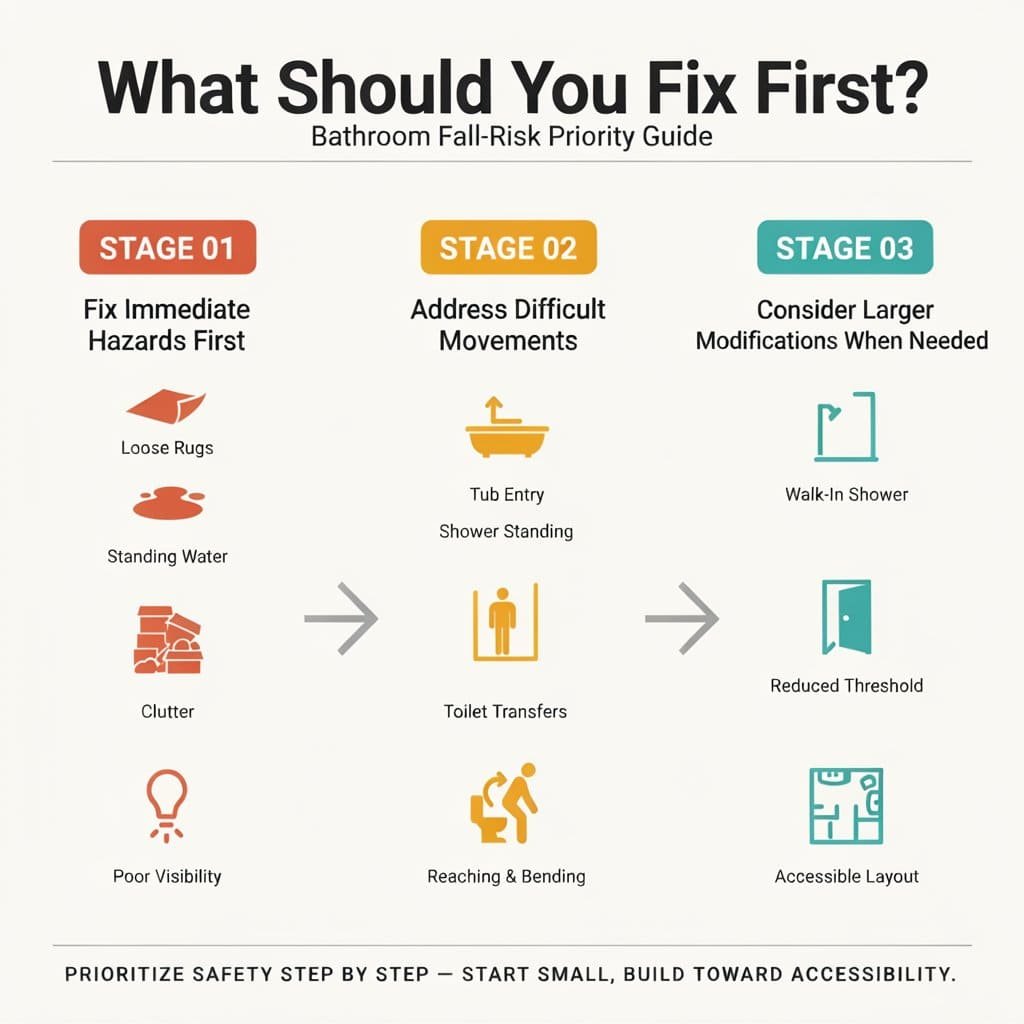
Fix immediate hazards first
Start by addressing hazards that can cause a slip or trip right away:
- Loose or unstable rugs
- Standing water
- Clutter on the floor
- Poor visibility
- Objects blocking the walking path
These changes are often simple and can improve the environment without remodeling.
Address difficult movements next
Once obvious hazards are controlled, look at movements that consistently create difficulty.
Ask:
- Is stepping into the tub difficult?
- Is standing in the shower tiring or unstable?
- Is getting on and off the toilet difficult?
- Does the person have to reach or bend awkwardly?
- Is turning in the bathroom difficult?
Then match the modification to the movement rather than automatically buying the same equipment for every bathroom.
Consider larger modifications only when necessary
Some bathrooms cannot be made sufficiently accessible through small changes alone.
Depending on the situation, larger modifications could include:
- Replacing a difficult tub arrangement with a more accessible shower
- Reducing a difficult entry threshold
- Reconfiguring the bathroom to provide more maneuvering space
- Making other accessibility changes suited to the person’s mobility needs
A larger modification should solve a clearly identified problem. It is not necessary to remodel a bathroom simply because a person wants to improve fall prevention.
| If the main problem is… | Start with… |
|---|---|
| Slippery floor | Improve traction |
| Loose rug | Remove it or use an appropriate stable alternative |
| Difficult shower standing | Consider appropriate seating |
| Difficult tub entry | Consider transfer support |
| Toilet transfers | Consider stable support or an appropriate height adjustment |
| Nighttime visibility | Improve pathway lighting |
| Reaching or bending | Reposition frequently used items |
11. Can You Prevent Bathroom Falls Without Remodeling?
Often, yes. Many useful bathroom safety changes do not require a full renovation.
Low-disruption changes
Start with simple modifications such as:
- Removing loose rugs and clutter
- Improving lighting
- Addressing wet-floor hazards
- Improving traction in the shower or tub
- Repositioning frequently used toiletries
- Adding appropriate grab bars
- Using suitable shower seating when needed
The CDC and NIA both recommend environmental changes such as removing trip hazards, improving lighting, using grab bars, and making wet bathroom surfaces safer.
When a larger bathroom modification may be worth considering
A larger change becomes more relevant when the bathroom’s basic layout repeatedly creates a difficult movement.
For example, if a person cannot safely step over a bathtub wall even with appropriate support, changing the bathing arrangement may address the underlying problem more effectively than adding more accessories around the tub.
The goal should be to remove or reduce the specific barrier—not to remodel simply for appearance.
12. What to Do if You Fall in the Bathroom
If you fall, the immediate priority is to avoid turning one fall into another.
Pause and assess yourself before trying to stand
Do not immediately rush to get up. Pause and assess whether you can move safely and whether you have significant pain, bleeding, weakness, or another obvious injury.
Trying to stand quickly on a wet bathroom floor can result in another fall. UCLA Health specifically cautions that people may fall again while attempting to get up after a bathroom fall.
Get help when you need it
If you cannot safely get up, feel seriously injured, or need emergency assistance, use your phone or emergency-response device if one is within reach.
If there is an immediate emergency, call 911.
If you can safely move and have only a minor fall, avoid using unstable bathroom fixtures for support. A properly installed grab bar or other stable support designed for that purpose is more appropriate.
When medical evaluation is important
Seek prompt medical attention after a head impact or when a fall causes significant pain, difficulty moving, or another concerning symptom. UCLA Health specifically advises immediate medical care after a head impact and medical evaluation for significant pain or movement problems following a fall.
If falls are becoming recurrent or you feel increasingly unsteady, discuss the problem with a health care professional. Repeated falls can be a reason to evaluate balance, vision, medications, mobility, and the home environment.
13. FAQs
How do you prevent slips in the bathroom?
Reduce the main sources of slipping by improving traction on wet surfaces, addressing standing water, removing unstable rugs, keeping walking areas clear, and improving lighting. In areas where balance or transfers are difficult, appropriately installed grab bars or suitable bathing equipment may also help.
How can you make your shower safer to avoid falls?
To prevent falls in the shower, improve traction, keep soap and frequently used items within comfortable reach, control water outside the shower, and add stable support where needed. A shower chair may be appropriate when standing during bathing is difficult or tiring.
What is the safest way to prevent slipping in a bathtub?
Start by addressing the tub’s wet surface and the difficulty of getting in and out. Nonslip surfaces can improve traction, while properly positioned grab bars or a transfer bench may help when tub entry and exit are difficult. The appropriate solution depends on the person’s mobility and the bathtub configuration.
Can a bath mat alone provide enough protection against slips and falls in the bathroom?
No. A bath mat addresses only one part of the problem, and an unstable mat can create a trip or slip hazard itself. Bathroom fall prevention should also consider wet surfaces, loose rugs, lighting, clutter, transfers, support, and the person’s mobility.
Do grab bars help prevent bathroom falls?
Grab bars can provide stable support during movements such as entering or exiting a tub or shower and sitting down or standing up near the toilet. They should be properly installed and positioned for the person’s actual movements. The CDC recommends grab bars in and around tubs or showers and next to toilets.
Is a shower chair useful for fall prevention?
A shower chair may help someone who has difficulty standing safely or comfortably throughout a shower. It can reduce the amount of time spent standing on a wet surface, but the person still needs a safe way to enter and exit the shower. The correct equipment depends on the bathroom layout and the person’s abilities.
Can bathroom falls be prevented without remodeling?
Often, yes. Removing trip hazards, improving lighting, improving traction, repositioning toiletries, installing appropriate grab bars, and using suitable bathing equipment can make a meaningful difference without a full bathroom remodel. Larger modifications may be appropriate when the existing layout creates a persistent transfer or accessibility problem.
14. Final Bathroom Safety Check
Effective bathroom slip and fall prevention does not depend on one product or one rule. The most useful approach is to look at how the person actually moves through the room and address the hazards that interfere with those movements.
Use this simple sequence:
Look → Remove → Improve traction → Add support → Improve visibility → Test the movement
Look for wet floors, loose rugs, clutter, difficult transfers, awkward reaching, and poor lighting. Remove hazards that can be eliminated. Improve traction where surfaces become wet. Add stable support when a person needs it. Improve visibility, especially at night. Then test the actual movement—entering the shower, stepping out of the tub, sitting on the toilet, standing up, and walking out.
A safer bathroom is not necessarily a completely remodeled bathroom. It is a bathroom where the surfaces, layout, lighting, support, and equipment work together to make everyday movements more controlled and predictable.
15. Conclusion
Bathroom slip and fall prevention starts with identifying what makes a particular bathroom difficult to use safely. Wet surfaces, loose rugs, clutter, poor lighting, difficult tub transfers, awkward reaching, and unstable movements can all contribute to risk.
Start with the simplest high-impact changes: clear the floor, address wet surfaces, improve traction, remove unstable rugs, improve lighting, and keep frequently used items within reach. Then consider grab bars, shower seating, transfer equipment, or larger accessibility changes when the person’s movements show a clear need for them.
Most importantly, do not treat every bathroom or every person the same. The safest setup is one that matches the room to the movements and abilities of the person using it.
Preventing slips and falls is one important part of creating a safer bathroom. For a broader look at common hazards, safety improvements, and practical precautions, see our complete guide to bathroom safety.
11 Comments