
1. Introduction
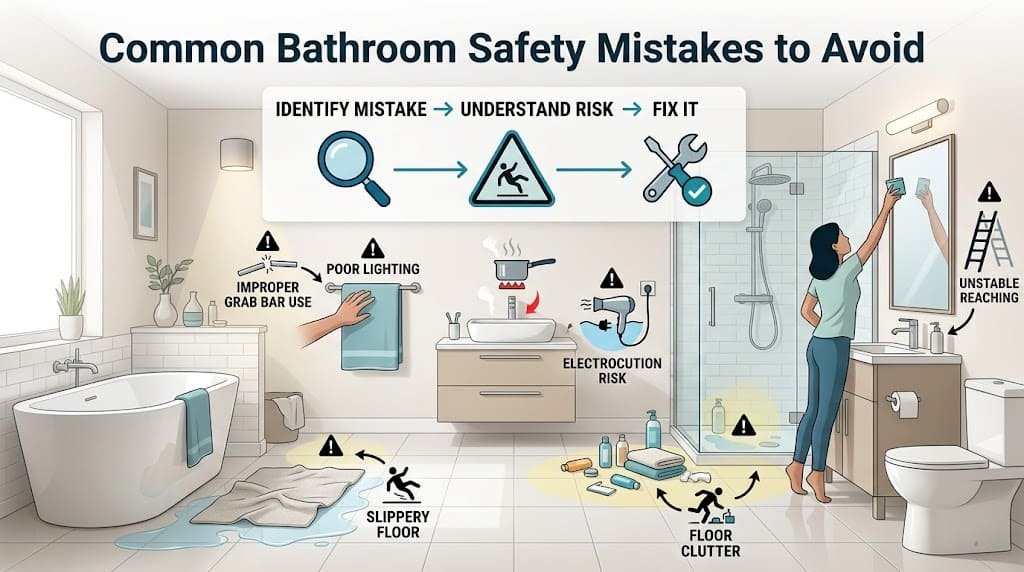
Many bathroom safety problems are not caused by one obvious hazard. They often develop from ordinary habits, poorly placed fixtures, slippery surfaces, inadequate lighting, or safety equipment that is used incorrectly. A bathroom can look clean and well maintained while still creating avoidable risks.
The most useful way to identify these problems is to look at how the bathroom is actually used: where someone walks, reaches, sits, stands, transfers, bathes, and moves at night. Then identify the mistake, understand the risk, correct it, and check whether the solution works in real use.
This guide covers common bathroom safety mistakes to avoid, including fall hazards, unsafe support, poor lighting, water temperature problems, electrical risks, clutter, toilet transfers, and overlooked needs of children and older adults. It also explains which problems deserve attention first and how to perform a quick safety check without duplicating a full bathroom inspection.
If you want to understand the broader approach to identifying and preventing bathroom hazards, see our complete guide to bathroom safety.
Table of Contents
2. Which Bathroom Safety Problems Are Most Common?
The most common bathroom safety mistakes involve conditions or behaviors that make slipping, falling, burns, electrical injury, or unsafe movement more likely. Common bathroom risks can arise from everyday oversights, such as allowing moisture or unstable floor coverings to remain, relying on fixtures that are not designed to provide support, or neglecting inadequate lighting. Other concerns include poor control of water temperature, keeping electrical devices too close to water, leaving objects in walking paths, and overlooking the specific safety requirements of the people who use the bathroom.
| Bathroom Safety Issue | Potential Danger | Safer Solution |
|---|---|---|
| Unsecured mats or area rugs | Can cause slipping or tripping | Remove them or fasten them securely so they cannot shift |
| Relying on towel bars for balance | May lead to a fall if the bar moves or gives way | Install grab bars designed and secured for support |
| Insufficient bathroom lighting | Makes it harder to see obstacles and increases fall risk | Brighten the bathroom and make the path to it visible at night |
| Water that is too hot | May result in painful scald injuries | Set, control, and test the water temperature before use |
| Electrical devices left beside water | Creates a risk of electrical shock | Disconnect appliances when finished and store them away from wet areas |
| Items left across walking areas | Creates obstacles that can cause trips | Keep floors and transfer areas open and easy to navigate |
The important point is that a safety problem is not always an obvious defect. Sometimes the mistake is using a normal bathroom feature in a way it was never intended to be used.
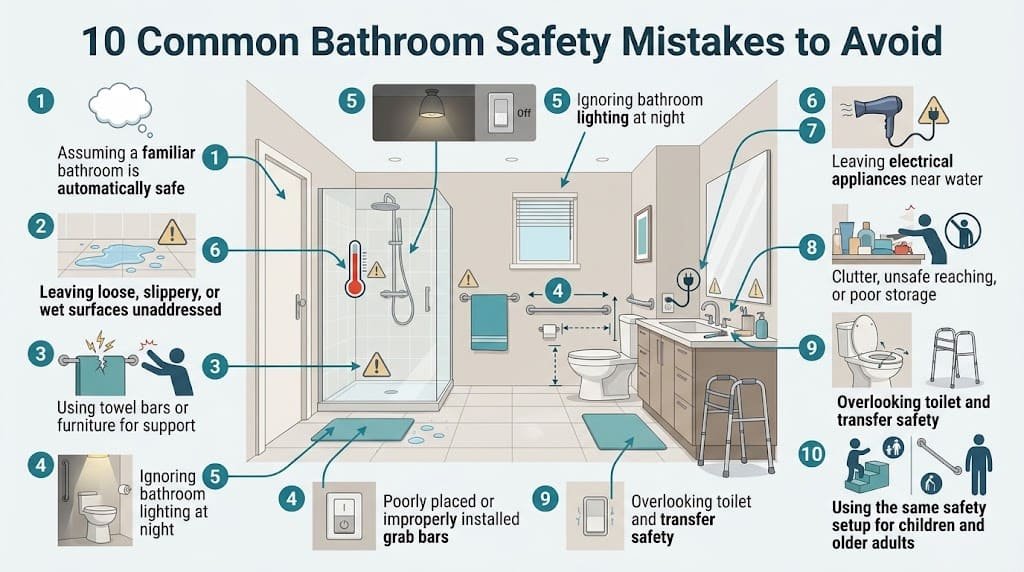
3. 10 Common Bathroom Safety Mistakes to Avoid
1. Assuming a Familiar Bathroom Is Automatically Safe
A bathroom that has been used safely for years can still contain hazards. Familiarity can make people stop noticing loose mats, awkward reaches, poor lighting, wet areas, or objects that are being used as makeshift support.
Normal routines can also hide risky movements. Someone may routinely step over a tub edge, reach across a wet floor for a towel, or stand on an unstable object to reach a cabinet. These actions can become habits precisely because nothing has gone wrong yet.
A more effective method is to evaluate the bathroom based on the way it is actually used in everyday routines. Watch the route into the room, the path to the shower and toilet, the movements required to sit and stand, and the way the bathroom is used at night.
2. Leaving Loose, Slippery, or Wet Surfaces Unaddressed
Wet bathroom floors and slippery surfaces are two of the most common conditions that can increase the risk of falls. Loose rugs, unsecured bath mats, standing water, soap residue, and transitions between wet and dry areas can all make movement less stable.
Having a bath mat does not automatically make the floor safe. A mat that shifts, bunches, or creates an awkward edge can introduce another trip hazard.
Keep surfaces as dry as practical, address water that collects outside the shower or tub, and choose floor coverings or traction solutions that remain stable during normal use. MedlinePlus recommends use slip-resistant flooring in the bathroom and make sure the floor just outside the tub or shower stays dry to help reduce the risk of slipping.
The aim is to provide a firm, dependable surface that supports safe movement and standing, rather than simply placing an item on the bathroom floor.
3. Using Towel Bars, Furniture, or Unrated Handles for Support
A towel bar may be located exactly where someone reaches during a slip, but that does not make it a grab bar. Towel racks and similar fixtures are not designed to provide body-weight support.
The same problem can occur with furniture, shower doors, sink fixtures, or other objects that appear sturdy but are not intended to catch a person’s weight. During a loss of balance, grabbing an unstable object can make the situation worse.
Choose grab bars that are designed specifically for bathroom support and have them firmly secured in the appropriate location. Avoid relying on towel racks for stability, as they are not designed to provide dependable support.
The practical rule is simple: If a person may instinctively grab it during a fall, it needs to be capable of providing appropriate support—or it should not be treated as one.
4. Installing Grab Bars Without Considering Placement or Installation
Installing grab bars alone does not guarantee safety; their location and stability must allow a person to use them with confidence and dependable support.
There are three different problems to consider:
- Missing support: There is no stable handhold where one is needed.
- Poorly positioned support: A grab bar exists, but it does not help with the movement being performed.
- Improperly secured support: The bar can move, loosen, or fail when someone relies on it.
Focus on where support is needed during everyday movements instead of judging safety by how many grab bars are installed. Shower entry, tub entry, movement inside the shower, and toilet transfers may require support in different locations.
If installation involves uncertainty about the wall structure or the appropriate mounting method, getting qualified help is safer than relying on assumptions. Avoid treating a suction-mounted or decorative handle as equivalent to a properly installed grab bar unless it is specifically designed and rated for the intended use.
5. Ignoring Bathroom Lighting—Especially at Night
Poor lighting can turn an otherwise manageable bathroom into a difficult environment, particularly when someone gets up during the night.
Look for dim areas, strong shadows, glare, hard-to-see floor transitions, and switches that are difficult to reach. Also consider the route between the bedroom and bathroom rather than evaluating only the bathroom itself.
A bathroom can have adequate overhead lighting and still have a poorly illuminated nighttime path.
Improve visibility where people walk, enter the shower, approach the toilet, and move around obstacles. A low-level nightlight or other suitable lighting can also help make the route easier to see without requiring a person to navigate in darkness.
CDC fall-prevention guidance includes attention to bathroom traction and lighting on the route to the bathroom.
6. Treating Water Temperature as Only a Comfort Issue
Water temperature is a safety issue, not simply a matter of personal preference. Water that is too hot can cause scalding, and sudden temperature changes can create an additional problem for someone who is already unsteady or vulnerable to burns.
For general household safety, MedlinePlus recommends setting the water heater to no more than 120°F (49°C). This is a water-heater setting, not a guarantee that every faucet or shower outlet will deliver water at exactly 120°F.
The temperature reaching a fixture can be affected by the plumbing system, controls, and other conditions. For that reason, do not assume that changing the heater setting alone eliminates every scalding risk.
Check the water before entering a bath or shower, pay attention to sudden temperature changes, and consider appropriate temperature-control or anti-scald measures when needed.
Important distinction
A 120°F water-heater setting is not the same thing as a 120°F faucet temperature. The temperature at the point of use can differ, so both the household setting and actual delivered water should be considered when addressing scald risk.
7. Leaving Electrical Appliances Plugged In Near Water
Bathrooms combine electricity with sinks, showers, tubs, wet hands, and damp surfaces, making electrical safety particularly important.
Common examples include hair dryers, curling irons, shavers, and other small appliances. Damaged cords or appliances placed where they can contact water create additional risks.
Do not use electrical appliances around water in a way that could allow the appliance, cord, or plug to become wet. Unplug small appliances when they are not being used and store them away from water.
Ground-fault circuit-interrupter, or GFCI, protection is also important in locations where electrical equipment may come into contact with water. GFCIs are designed to interrupt power when they detect a ground-fault condition.
If an appliance falls into water, do not reach into the water to retrieve it. Avoid contact and disconnect power safely before handling the situation.
8. Ignoring Clutter, Unsafe Reaching, and Poor Storage
Bathroom clutter can interfere with the simple movements people make every day. Bottles on the floor, towels in walking paths, and frequently used items placed too high or too low can force unnecessary bending, reaching, stepping, or twisting.
The risk becomes greater when someone tries to reach an item while standing on a wet surface or while already off balance.
Think of the sequence as:
Reach → loss of balance → unstable recovery → possible fall
Store frequently used items where they can be reached without awkward stretching or climbing. Keep floors and walking paths clear.
Never substitute a chair for a proper step stool. If something cannot be safely reached from the floor, move it to a more accessible location or use an appropriate, stable solution.
9. Overlooking Toilet and Transfer Safety
The toilet is a major transfer point in the bathroom, yet it is easy to overlook when evaluating overall safety.
An unstable or wobbly toilet should be addressed promptly rather than left unattended. Someone who has difficulty sitting down or standing up may also need more stable support around the toilet rather than relying on the sink, towel bar, or nearby furniture.
Consider whether the person using the bathroom can:
- approach the toilet safely;
- sit down without losing balance;
- stand without excessive strain;
- reach a stable support point when needed; and
- leave the toilet area without encountering an obstacle.
Toilet height can also affect transfers for someone who has difficulty bending or standing. The right setup depends on the individual and the bathroom, so avoid assuming that one toilet height or support arrangement is ideal for everyone.
Keep this assessment focused on safe movement rather than treating one particular toilet accessory as a universal solution.
10. Assuming Children and Older Adults Need the Same Safety Setup as Everyone Else
Bathroom safety should reflect the people who actually use the room. A setup that works reasonably well for a healthy adult may still be unsuitable for a young child, an older adult, or someone with limited mobility.
For children
Children require particular attention around water, heat, medications, chemicals, and electrical equipment.
Young children should not be left unattended during bathing. Bath seats or similar equipment should never be treated as a replacement for active supervision.
Keep medications and potentially harmful products inaccessible to children, control hot-water risks, and consider whether a child can reach or enter areas that should be restricted.
Electrical appliances should also be kept away from water and stored where children cannot easily access them.
For older adults or people with limited mobility
For an older adult or someone with limited mobility, the main concern may be the physical demands of getting into the shower, sitting down, standing up, turning, or reaching.
Look closely at:
- transfers;
- balance;
- nighttime bathroom trips;
- reaching for toiletries;
- shower seating needs; and
- the location and security of grab bars.
MedlinePlus identifies older adults and people with mobility limitations as groups that may need additional bathroom precautions.
The best setup is the one that supports the person’s actual movements and abilities rather than simply adding more equipment.
4. Bathroom Safety Mistakes That Often Happen After You “Fix” the Bathroom
Adding safety equipment is not the same as completing a safety improvement. A bathroom can still be difficult or unsafe to use if the equipment is poorly installed, damaged, misplaced, or creates new obstacles.
Installing a safety product but not checking whether it is secure
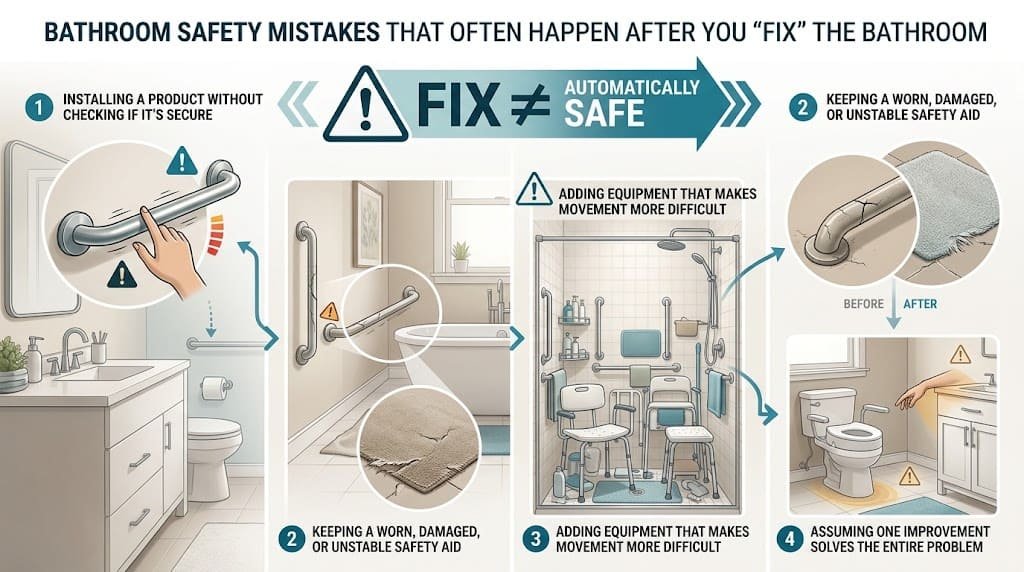
A grab bar, shower seat, raised toilet seat, or other aid should be checked according to its intended use and installation requirements. If it moves when someone relies on it, it should not simply be accepted as “good enough.”
Keeping a worn, damaged, or unstable safety aid
Safety equipment can become less useful as it wears out. Check mats for movement or deterioration, inspect supports for looseness, and replace damaged equipment rather than continuing to rely on it.
Adding equipment that makes movement more difficult
More equipment is not always better. A bathroom can become harder to navigate if an aid blocks a route, reduces usable space, creates a trip point, or interferes with transfers.
Before adding an item, consider where the person will walk, turn, sit, stand, and reach.
Assuming one safety improvement solves the entire problem
A grab bar does not correct a slippery floor. Better lighting does not address an unsafe water temperature. A bath mat does not replace supervision of a young child.
Bathroom safety works as a system. The useful question is not “Did I install a safety product?” But “ Is the bathroom actually safe to navigate from entry to exit?
5. Which Bathroom Safety Mistakes Should You Fix First?
If you find several problems at once, start with hazards that could cause immediate or serious harm rather than trying to improve everything simultaneously.
A practical order is:
1. Immediate fall hazards
Address wet or unstable walking surfaces, unreliable support, and difficult transfers.
2. Electrical hazards
Address damaged cords, unsafe appliance placement, and problems involving electricity and water.
3. Scalding hazards
Address excessive or unpredictable water temperature.
4. Child-access hazards
Pay attention to children’s bathing supervision, easy access to water, and the safe storage of medicines and cleaning products, while keeping electrical devices away from wet areas.
5. Visibility and movement problems
Improve poor lighting, clutter, and difficult nighttime routes.
6. Maintenance problems
Repair loose fixtures and replace damaged or unstable safety equipment.
This is a practical prioritization framework, not a clinical risk score. The right order can change depending on who uses the bathroom and what hazards are present.
For example, a household with a young child may need to address accessible water and supervision immediately, while a bathroom used by someone with significant mobility limitations may require a closer assessment of transfers and support.
6. A 5-Minute Bathroom Safety Mistake Check
Walk through the bathroom as if you were using it during a normal morning, shower, toilet visit, and nighttime trip. Then ask:
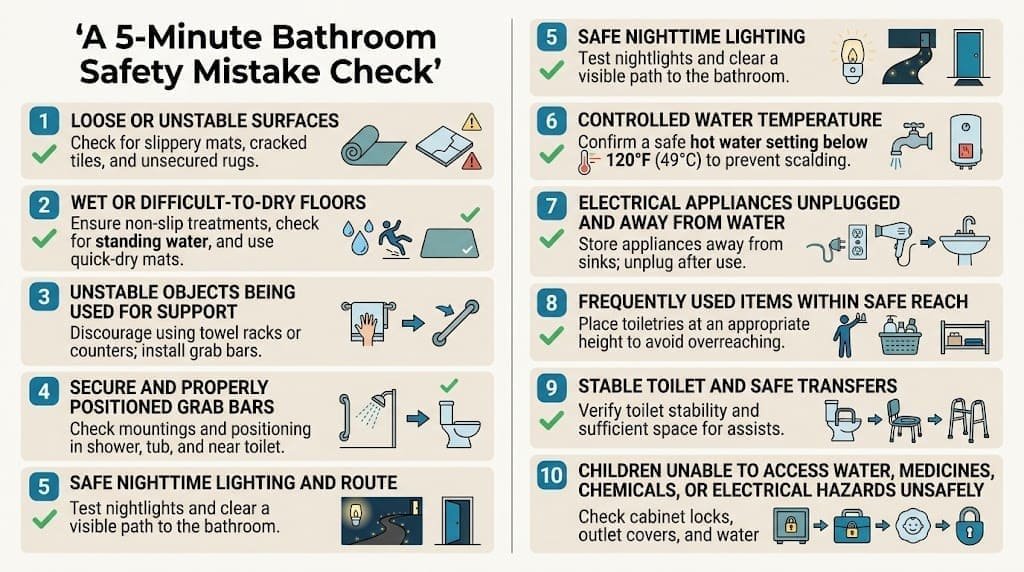
- Is anything loose underfoot?
- Is the floor wet or difficult to keep dry?
- Would someone instinctively grab a towel bar or another unstable object?
- Are grab bars secure and positioned where support is actually needed?
- Can the bathroom and route to it be used safely at night?
- Is the water temperature controlled?
- Are electrical appliances unplugged and kept away from water?
- Can frequently used items be reached without unsafe bending or stretching?
- Is the toilet stable?
- Could a child access water, medications, chemicals, or electrical appliances unsafely?
This quick check is designed to catch obvious mistakes, not replace a detailed home-safety assessment.
For a more complete room-by-room assessment, see the Bathroom Safety Checklist.
7. How to Avoid Common Bathroom Safety Mistakes Long Term
Bathroom safety should be reassessed when the way the room is used changes. A setup that works today may need adjustment after a household change, mobility change, or remodeling project.
Check the bathroom during real routines
Do not inspect only while standing still and looking around the room. Walk the normal route, enter and exit the shower, sit and stand from the toilet, reach for commonly used items, and consider what happens during a nighttime visit.
Different routines can reveal different problems.
Recheck safety equipment periodically
Pay attention to:
- grab bars;
- mats;
- shower seating;
- toilet supports; and
- electrical equipment.
Look for movement, damage, wear, or changes that could affect safe use. The goal is to make sure the solution continues to work as intended.
Reassess after changes in mobility or household needs
A safety review is especially useful after:
- an injury or recovery period;
- a change in mobility;
- an older adult’s needs changing;
- a child becoming more mobile;
- a new caregiver arrangement; or
- bathroom remodeling.
Safety should follow the needs of the people using the bathroom, not remain fixed simply because the room has always been arranged the same way.
8. FAQs
What is the most common bathroom safety mistake?
One of the most common problems is underestimating ordinary fall hazards, particularly wet or slippery surfaces, unsafe movement, and unreliable support. These risks are easy to overlook because they can be part of normal bathroom routines.
What should you never use as a grab bar?
Do not use a towel rack or another fixture that was not designed and securely installed to provide body-weight support. If someone needs support during a transfer or while entering the shower or tub, use an appropriate grab bar or other properly designed support.
What temperature should a bathroom water heater be set to?
For general household safety guidance, MedlinePlus recommends setting the water heater to no more than 120°F (49°C). The temperature at a faucet or shower outlet can differ from the heater setting, so the actual delivered water temperature also matters.
What bathroom safety mistakes are especially dangerous for children?
Important concerns include leaving a young child unattended during bathing, allowing access to water or hot water, keeping medications or hazardous products within reach, and leaving electrical appliances where a child can access them. Bath seats do not replace active supervision.
How often should you check bathroom safety?
Check the bathroom routinely and whenever something changes that could affect safe use. That includes changes in mobility, household members, bathroom equipment, or the room itself. A fixed inspection schedule is less useful than reassessing whenever the conditions or needs change.
9. Conclusion
The most effective way to avoid common bathroom safety mistakes is to look beyond individual products and examine how the bathroom is actually used. Wet surfaces, poor lighting, unreliable support, unsafe water temperature, electrical hazards, clutter, difficult transfers, and overlooked child or mobility needs can all create preventable risks.
Start with problems that could cause immediate harm, then improve the details that make everyday movement easier and safer. Check whether safety equipment is secure, appropriate, and still useful rather than assuming that simply having it is enough.
A safer bathroom is not the one with the most safety products. It is the one where people can enter, move, bathe, use the toilet, and leave without unnecessary obstacles or avoidable risks.
1 Comment