
1. Introduction
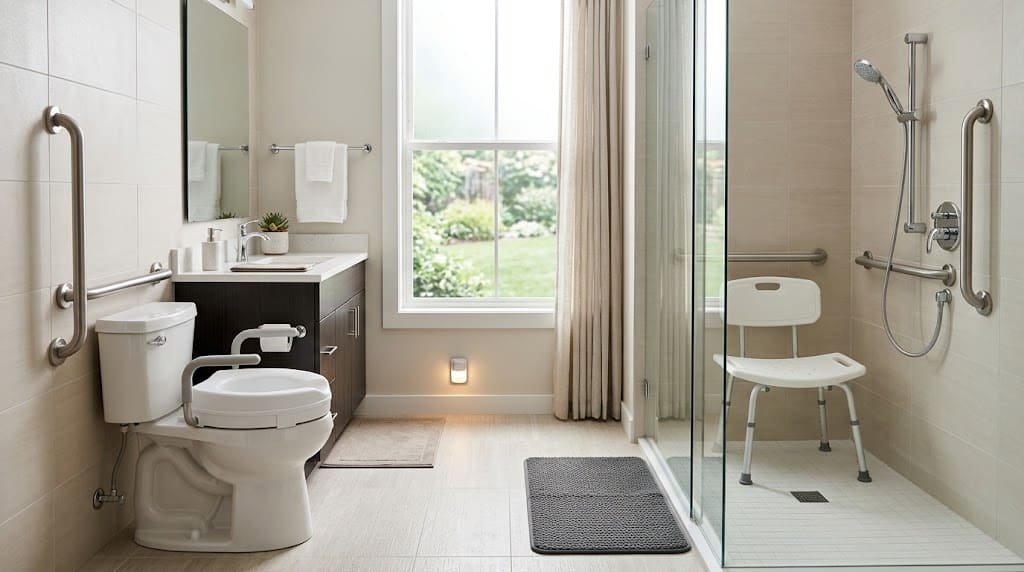
Bathrooms combine water, hard surfaces, tight spaces, and frequent sitting, standing, and stepping movements. That combination can make ordinary tasks more difficult and increase the consequences of a slip, loss of balance, or poorly controlled hot water.
Bathroom safety products are devices and equipment designed to reduce common bathroom hazards by improving traction, providing support, making transfers easier, improving visibility, or helping control water temperature. The right products depend on the person using the bathroom and the specific problem you are trying to solve.
For instance, a person who finds it difficult to remain standing while showering may need a stable shower chair, whereas someone who has difficulty getting up from the toilet may benefit from a raised toilet seat or toilet safety frame. If nighttime trips to the bathroom are the main concern, improving visibility with adequate lighting may be the more appropriate solution.
The aim is to add only the equipment that genuinely improves safety, rather than overcrowding the bathroom with unnecessary aids. It is to identify the main hazards first, then choose products that address those hazards safely and appropriately.
Bathroom safety products can address specific risks such as slips, falls, unsafe transfers, and poor visibility, but they work best as part of a broader safety plan. For a room-by-room approach to identifying and reducing common hazards, see our Complete Guide to Bathroom Safety.
Table of Contents
2. What Are Bathroom Safety Products?
Bathroom safety products are specialized aids or equipment intended to make common bathroom activities safer or easier. Unlike standard bathroom accessories, these products are chosen specifically to reduce a known safety hazard or make a particular bathroom task easier and more manageable.
Common bathroom safety functions include:
- Improving traction on wet surfaces
- Providing stable support during transfers
- Making bathing possible while seated
- Making it easier to sit down and stand up from a toilet
- Improving visibility at night
- Reducing exposure to excessively hot tap water
- Limiting unsafe access for young children
These products range from simple non-slip surfaces and bathroom night lights to grab bars, shower seating, transfer equipment, and specialized mobility aids.
Who Can Benefit From Bathroom Safety Products?
Bathroom safety equipment can be useful for many people, not only older adults. Potential users include:
- Older adults who have balance or mobility challenges
- People with temporary limitations after an injury or surgery
- People who have difficulty standing, sitting, or transferring
- Children who need additional environmental protections
- Caregivers helping someone use the bathroom more safely
- Anyone addressing a specific slip, fall, visibility, or scald hazard
The best approach is to match the product to the task and the user’s actual needs, rather than assuming everyone needs the same bathroom safety essentials.
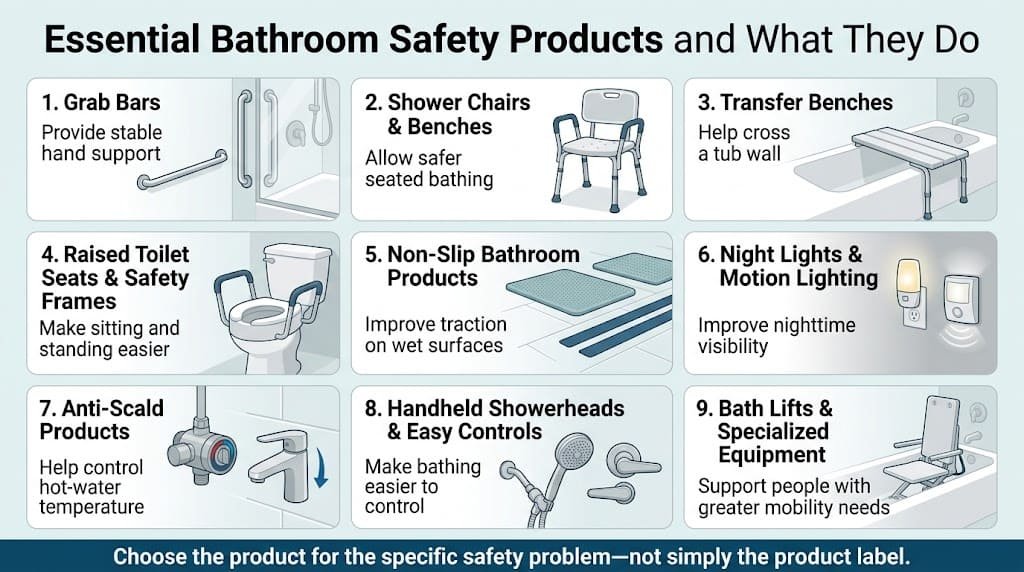
3. Essential Bathroom Safety Products and What They Do
The most useful products are the ones that address a clearly identified hazard. Before buying, ask what is making the bathroom difficult or unsafe to use.
Bathroom Grab Bars
Bathroom grab bars provide a stable handhold for people who need support while entering or exiting a tub or shower, transferring near the toilet, or maintaining balance during bathroom activities.
They can be useful:
- Inside or outside a tub or shower
- Near a toilet when sitting or standing is difficult
- At locations where a person needs support during a transfer
A grab bar should be securely installed according to the manufacturer’s requirements and the construction of the wall. A towel rack should never be treated as a substitute because it is not designed to support body weight. MedlinePlus specifically advises against using towel racks as grab bars.
It is also important to distinguish a properly installed grab bar from products marketed only for balance assistance. Do not assume that a suction-mounted or temporary bar can safely support body weight; use it only within its stated purpose and limitations.
Bathroom grab bars come in different styles and must be positioned and installed to suit the user’s needs. Read our complete guide to bathroom grab bars to learn about the different types, placement, height, positioning, and installation considerations.
Shower Chairs and Benches
A shower chair or bench allows a person to bathe while seated instead of standing for the entire shower. This can be useful when standing causes fatigue, balance is limited, or getting in and out of the shower requires additional support.
When choosing one, consider:
- Seat height
- Overall width and depth
- Available shower space
- Stability of the legs
- Weight capacity
- Whether armrests or a backrest would help
- Compatibility with the shower floor
A shower chair is different from a general bathroom stool. Stability, appropriate height, and suitability for wet conditions matter because the product is being used during a potentially slippery activity.
Transfer Benches
A transfer bench is designed for a different problem than a standard shower chair. It can help a person who has difficulty stepping over a high bathtub wall by allowing them to sit and move across the tub edge rather than stepping over it normally.
Before choosing a transfer bench, measure the tub and surrounding clearance. Consider where the user’s legs, feet, and mobility equipment need to move during the transfer.
The right equipment depends on the person’s ability to transfer independently. If someone cannot safely perform the movement, a product alone may not provide enough protection.
Choosing the right equipment is only one part of safer bathing. Our guide to bathing safety explains how to prepare the bathroom, check the water, and enter and exit the shower or bathtub more safely.
Raised Toilet Seats and Toilet Safety Frames
Raised toilet seats increase the height of the toilet, which can make sitting down and standing up easier for someone with limited strength, mobility, or range of motion.
A toilet safety frame or rail serves a somewhat different purpose by providing hand support during the transfer.
Depending on the user, one or both may be appropriate. Check:
- Toilet compatibility
- Seat height
- Available bathroom clearance
- Stability
- Weight capacity
- Whether arm support is needed
MedlinePlus identifies elevated toilet seats and toilet safety frames as options that can make bathroom use easier, particularly when someone has difficulty getting on and off a standard-height toilet.
Non-Slip Bathroom Products
Non-slip bathroom products can help improve traction where water makes surfaces slippery. Options include:
- Non-slip bath or shower mats
- Self-stick strips or treads
- Slip-resistant shower surfaces
- Non-skid mats placed outside the tub or shower
A safety mat should not create a new trip hazard. Keep it flat, appropriately sized, and secure, and follow the manufacturer’s instructions for the surface.
CDC’s home fall-prevention checklist recommends non-slip mats or self-stick strips for slippery tub or shower floors. MedlinePlus also recommends non-slip tub or shower surfaces and keeping the floor outside the bathing area dry.
Bathroom Night Lights and Motion Lighting
Bathroom night lights can improve visibility for people who use the bathroom after dark. They are particularly useful when the route between the bedroom and bathroom is poorly lit or when someone has difficulty seeing changes in floor level and other obstacles.
Consider lighting near:
- The bathroom entrance
- The path to the toilet
- Areas that remain dark when the main light is off
Motion-activated lighting can be convenient because it reduces the need to find a switch in the dark. However, lighting should complement—not replace—removing clutter, securing loose items, and addressing other physical hazards. CDC fall-prevention guidance recommends improving home lighting and notes motion-sensor lights as one option.
Anti-Scald Bathroom Products
Anti-scald bathroom products are intended to reduce the risk of burns from excessively hot tap water. Depending on the system, this may include temperature-limiting devices or appropriate controls at faucets and showers.
Water-heater temperature is another important part of scald prevention. The U.S. Consumer Product Safety Commission recommends lowering a residential water heater to 120°F to help reduce tap-water scalds.
Do not assume a particular anti-scald device will work correctly in every plumbing system. Follow the manufacturer’s installation and adjustment instructions, and use a qualified professional when the installation requires plumbing changes or when you are unsure how the system should be configured.
Handheld Showerheads and Easy-Use Controls
A handheld showerhead can make bathing more convenient for someone who showers while seated or has difficulty reaching a fixed showerhead. It can reduce the need to stretch or repeatedly reposition the body while bathing.
Easy-to-operate controls can also help people who have limited hand strength or dexterity. Depending on the user, lever-style controls may be easier to operate than small knobs.
These products are generally most useful when they solve a specific reach, control, or bathing-position problem rather than simply being added as extra accessories.
Bath Lifts, Commodes and Other Specialized Equipment
Some users need more specialized bathroom safety equipment than a standard shower chair or raised toilet seat can provide.
Examples include bath lifts and commode chairs. These may be considered when significant mobility limitations make conventional bathing or toilet transfers difficult.
Because specialized equipment needs to match the user’s abilities, bathroom layout, and transfer method, professional assessment can be appropriate when the correct equipment is unclear. MedlinePlus recommends considering an occupational or physical therapist when someone needs help determining what changes or equipment may make the home safer.
4. Which Bathroom Safety Products Help With Common Problems?
The easiest way to choose bathroom safety aids is to start with the problem rather than the product name.
| If the main problem is… | Consider… |
|---|---|
| Slippery shower or tub | Non-slip products and appropriate support |
| Difficulty standing while showering | Shower chair or bench |
| Difficulty crossing a tub wall | Transfer bench |
| Difficulty standing from the toilet | Raised toilet seat or toilet safety frame |
| Loss of balance near the toilet | Properly installed grab bar or appropriate frame |
| Poor nighttime visibility | Night light or motion lighting |
| Hot-water or scald concern | Anti-scald or temperature-control measures |
| Young child’s bathroom access | Appropriate locks/latches plus supervision |
| Significant mobility limitation | Specialized equipment and professional assessment |
This approach prevents a common mistake: buying a product because it appears on a generic bathroom safety list without first determining whether it addresses the user’s actual difficulty.
For example, a shower chair may help someone who cannot safely stand for a full shower, but it does not automatically solve an unsafe tub entrance. A transfer bench may be more appropriate when stepping over the tub wall is the primary problem.
5. Bathroom Safety Products for Seniors and Older Adults
For older adults, the most useful bathroom safety products often address balance, transfers, traction, visibility, and bathing support.
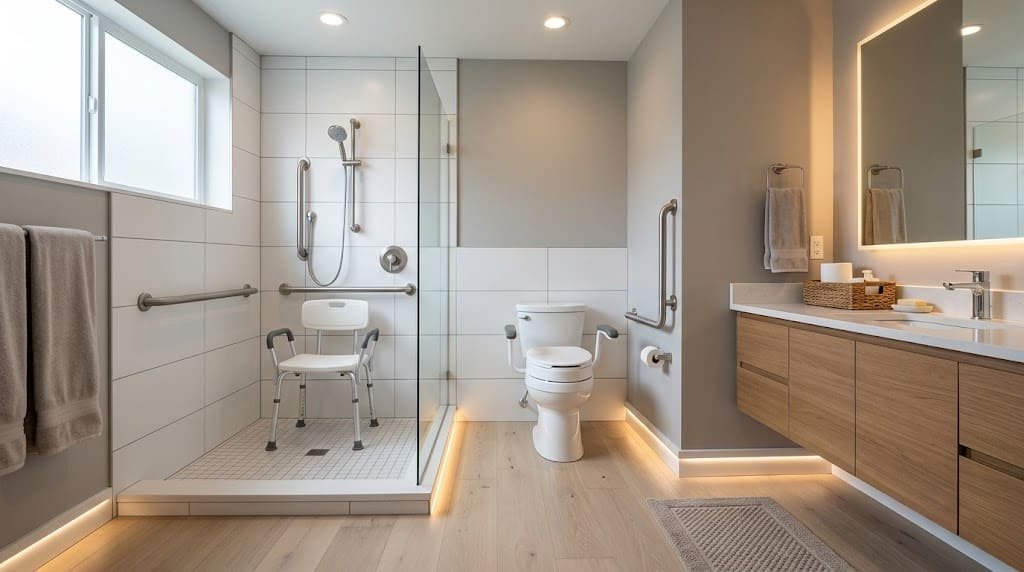
Common options include:
- Bathroom grab bars
- Shower chairs and benches
- Transfer benches
- Raised toilet seats
- Toilet safety frames
- Non-slip bathroom products
- Bathroom night lights
- Other equipment matched to individual mobility needs
CDC fall-prevention guidance recommends making the home safer by removing trip hazards, improving lighting, and installing grab bars inside and outside the tub or shower and next to the toilet.
The right combination depends on the person. Someone who walks independently but has difficulty standing from a low toilet may need different equipment from someone who uses a walker or wheelchair.
Prioritize Products Based on the Person’s Biggest Difficulty
Instead of buying every available aid, work through these questions:
- Can the person enter and exit the shower or tub safely?
- Can they stand safely while bathing?
- Can they sit down and rise from the toilet without losing balance?
- Can they clearly see the bathroom route at night?
- Are there specific balance, strength, or mobility limitations that require additional support?
This simple assessment helps prioritize the most important bathroom fall prevention equipment first.
6. Bathroom Safety Products for Children
Bathroom safety for children requires a different approach because products cannot replace supervision.
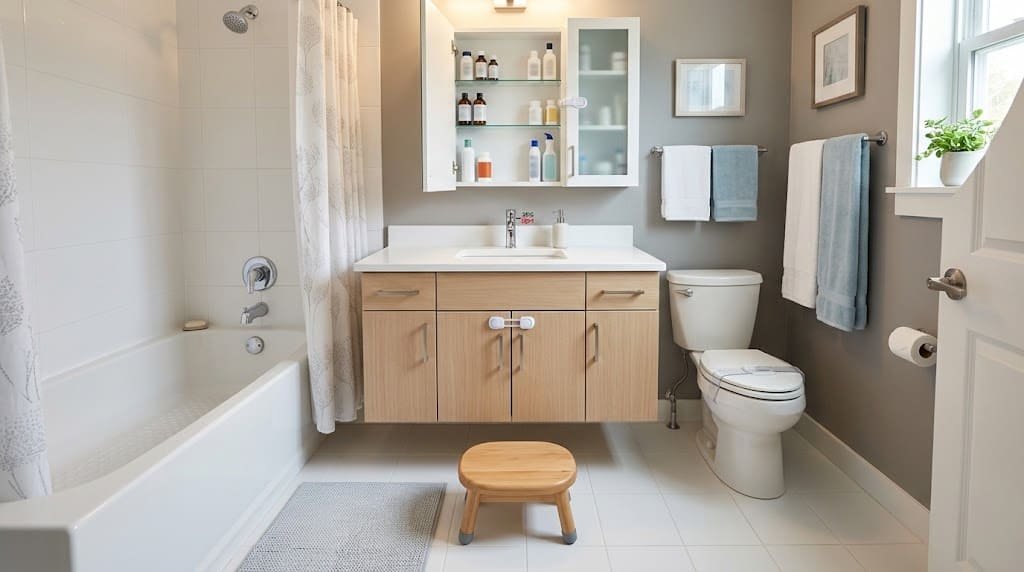
Useful products and protections can include:
- Toilet locks or latches where appropriate
- Cabinet safety latches
- Anti-scald measures
- Non-slip surfaces
- Secure storage for medications and cleaning products
- Appropriate bathroom access controls
Childproofing should focus on limiting access to hazards while keeping necessary adult access practical.
Products Do Not Replace Supervision
Young children should be closely supervised around bathwater. A bath seat or similar accessory should never be treated as a substitute for an attentive adult.
The CPSC advises constant supervision when a baby is bathing and recommends keeping medicines and hazardous household chemicals locked away and out of reach. It also recommends a water-heater setting of 120°F or lower and identifies anti-scald devices as an additional protection against burns.
The key principle is layers of protection: supervision, safe water temperature, controlled access, secure storage, and an environment with fewer slip and fall hazards.
7. How to Select the Right Bathroom Safety Equipment
Choosing bathroom safety equipment starts with identifying the specific problem. A product is only useful when it fits the user’s needs and the bathroom itself.
Start With the Hazard
Ask which issue needs attention first:
- Slipping
- Loss of balance
- Difficulty sitting or standing
- Difficulty entering or exiting a shower or tub
- Poor visibility
- Scalding
- Unsafe child access
Starting here prevents unnecessary purchases and makes it easier to compare products that perform different functions.
Check Fit and Compatibility
Measure before buying equipment that must fit a particular space or fixture.
Check:
- Bathroom dimensions
- Tub or shower configuration
- Toilet shape and dimensions
- Available clearance
- Installation surface
- User height
- Seat height
- Weight capacity where applicable
A product that works well in one bathroom may not fit safely in another. For example, a transfer bench requires sufficient tub and surrounding clearance, while a raised toilet seat needs to be compatible with the existing toilet.
Check Installation and Stability
Pay particular attention to installation for:
- Grab bars
- Shower seats
- Transfer benches
- Raised toilet seats
- Toilet safety frames
A product marketed as a safety aid should not be assumed to be safe simply because it is labeled “bathroom safety equipment.” Follow the manufacturer’s installation instructions and check that the finished installation is secure before relying on it.
Don’t Choose a Product Based on the Label Alone
Words such as “safety,” “heavy-duty,” or “ADA” do not replace checking the actual specifications and intended use.
If a product will support body weight, confirm how it is designed to be installed and used. If an accessibility standard is relevant, consult the actual requirements rather than assuming that any product carrying accessibility-related marketing language meets every requirement.
For significant mobility or accessibility needs, an occupational or physical therapist or another qualified professional may be able to help determine which equipment and modifications are appropriate.
Before choosing bathroom safety equipment, consider how the bathroom’s layout and fixtures affect the user’s ability to move around and complete everyday tasks. Our guide to bathroom accessibility covers accessible showers, toilet and sink design, doorway clearance, and wheelchair-friendly layouts.
8. Bathroom Safety Products Buying Checklist
Before purchasing or installing bathroom safety equipment, use this checklist:
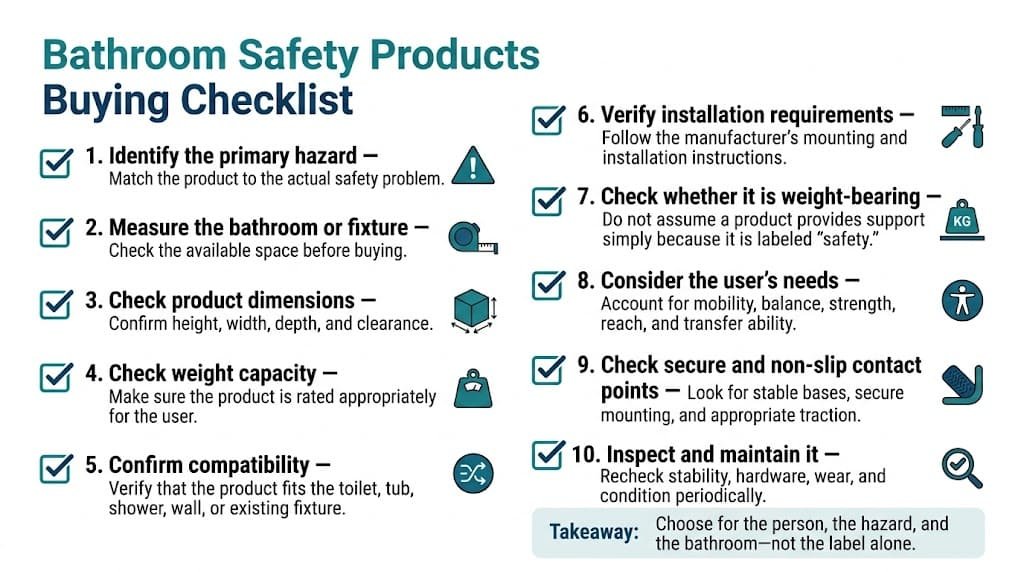
- Identify the primary bathroom hazard
- Measure the bathroom or fixture
- Check the product dimensions
- Check weight capacity where applicable
- Confirm compatibility with the tub, shower, toilet, or wall
- Verify installation requirements
- Determine whether the product is actually designed for weight-bearing support
- Consider who will use it and how they move
- Check that non-slip components are secure
- Follow the manufacturer’s instructions
- Inspect installed equipment periodically
A product that fits the space but does not fit the user’s abilities is not necessarily the right choice. Safety equipment should work as part of the bathroom’s overall setup.
9. When Bathroom Safety Products May Not Be Enough
Bathroom safety products can reduce specific hazards, but they cannot solve every safety problem.
Additional help may be appropriate when someone has:
- Major mobility limitations
- Repeated falls
- Difficulty transferring independently
- A bathroom layout that prevents safe movement
- Structural or installation challenges
- Significant accessibility requirements
If you are unsure which equipment a person needs, especially after a fall, surgery, or major change in mobility, consider asking a healthcare professional or occupational or physical therapist to assess the situation. MedlinePlus specifically identifies occupational and physical therapists as professionals who can help determine appropriate home safety changes.
The goal is not simply to add more equipment. It is to create a bathroom that the person can use as safely and independently as their circumstances allow.
10. FAQs
What are the most important bathroom safety products?
The most important products depend on the hazard. Common priorities include grab bars for support, non-slip products for traction, shower seating for people who cannot safely stand, toilet supports for transfers, lighting for nighttime visibility, and appropriate temperature-control measures for scald prevention.
What bathroom safety products help prevent falls?
Common bathroom fall prevention products include properly installed grab bars, appropriate shower chairs or benches, transfer equipment, non-slip surfaces, raised toilet seats or toilet support equipment, and better lighting. The appropriate combination depends on why the person is at risk of falling. CDC guidance specifically recommends grab bars and improved lighting as part of home fall prevention.
What bathroom safety products are useful for seniors?
Useful bathroom safety products for seniors may include grab bars, shower chairs or benches, transfer benches, raised toilet seats, toilet safety frames, non-slip products, and bathroom night lights. Selection should be based on the person’s specific balance, strength, mobility, and transfer needs rather than age alone.
What bathroom safety products are useful for children?
For children, useful protections can include toilet or cabinet latches, anti-scald measures, non-slip surfaces, and secure storage for medicines and hazardous household chemicals. These products supplement—not replace—close supervision around water.
Are suction grab bars safe?
Whether a suction grab bar is appropriate depends on its design and the purpose for which it is rated. Some models are intended only to provide light balance support, not to bear a person’s full weight. Always check the manufacturer’s stated limitations and never rely on a suction-mounted bar for body-weight support unless it is specifically designed and approved for that use.
How can I select the best bathroom safety product for my needs?
Start with the hazard, identify the task that is difficult, choose the product designed for that problem, and then check fit, compatibility, installation requirements, stability, and user needs. This hazard-to-product approach is more reliable than choosing products from a generic list.
11. Conclusion
The best bathroom safety products are not necessarily the ones that fill the bathroom with the most equipment. They are the products that address the specific risks a person actually faces.
Start with the hazard: improve traction where floors are slippery, add appropriate support where balance or transfers are difficult, use shower seating when standing is unsafe or tiring, consider toilet-support equipment when sit-to-stand movements are difficult, improve nighttime visibility, and address excessive hot-water temperatures.
For older adults and people with mobility limitations, prioritize the equipment that supports their most difficult bathroom tasks. For children, combine physical safety measures with close supervision and secure storage.
Most importantly, check product fit, installation, stability, and intended use before relying on any safety aid. When mobility or accessibility needs are significant or unclear, professional assessment can help determine which changes are appropriate.
The goal is simple: choose bathroom safety equipment based on the person, the hazard, and the task—not simply the product label.
2 Comments