
1. Introduction
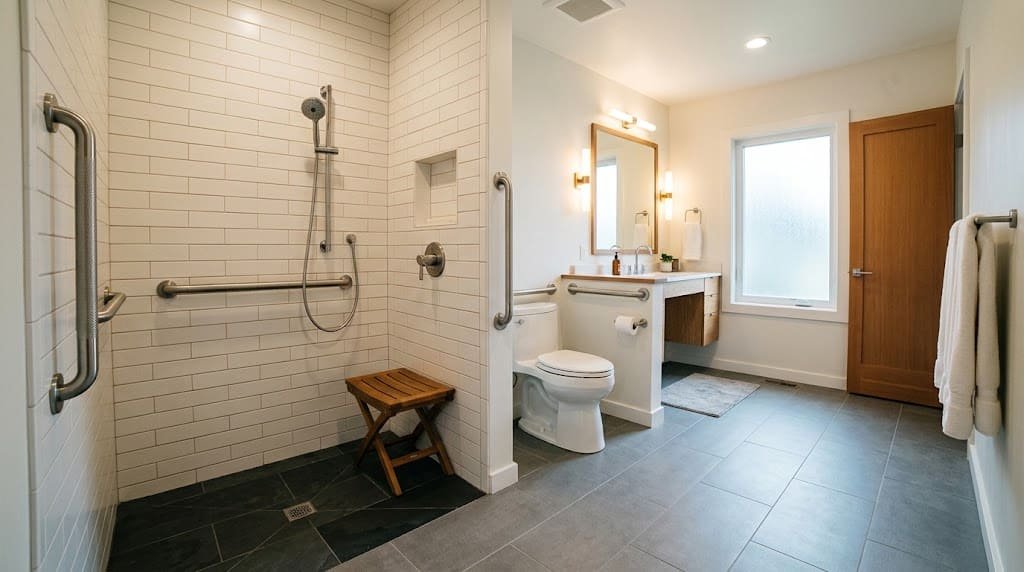
Bathroom safety modifications are targeted changes to the surfaces, fixtures, layout, support points, lighting, or access features of a bathroom that make everyday activities safer and easier. They can address problems such as slippery floors, difficult shower entry, unstable toilet transfers, poor nighttime visibility, or limited maneuvering space.
The right modification depends on what makes the bathroom difficult or unsafe to use. Someone who finds it difficult to get in and out of a bathtub may require a different modification than someone who needs extra support when rising from the toilet. Likewise, a bathroom used by someone with a walker or wheelchair may need more attention to pathways and maneuvering space.
Many bathroom safety changes can be made without remodeling the entire space. Some changes are relatively simple, while others involve installing structural supports or changing the bathroom layout. The most effective approach is to identify the highest-risk activities first, match each problem with an appropriate modification, and then decide whether smaller changes are sufficient or a larger bathroom safety renovation is warranted.
Before choosing specific modifications, it helps to understand the broader risks involved, from slips and falls to scalding and electrical hazards, covered in our complete guide to bathroom safety.
Table of Contents
2. What Are Bathroom Safety Modifications?
Bathroom safety modifications are changes made to a bathroom to reduce hazards or make common activities easier to perform safely. They can range from improving traction and lighting to installing grab bars, changing shower access, modifying toilet height, or creating more usable space for mobility equipment.
The goal is not to make every bathroom look or function the same. Instead, a modification should address a specific need while fitting the person’s abilities, the bathroom’s existing layout, and the way the space is actually used.
How Modifications Differ From Safety Products and a Full Remodel
Although these terms are closely related, each refers to a different type of change made to improve bathroom safety.
- Bathroom safety product: An item added to help with a particular task, such as a shower chair, handheld showerhead, or nonslip mat.
- Bathroom safety modification: A change to the bathroom itself, such as installing a properly anchored grab bar or changing the shower entry.
- Bathroom safety upgrade: A more general improvement that can make a bathroom safer, easier to use, more accessible, or more comfortable. Upgrading the lighting, for example, can improve visibility and reduce potential hazards.
- Bathroom remodel: A larger construction project that may change walls, plumbing, flooring, fixtures, or the overall layout.
The distinction matters because a safety problem does not automatically call for a remodel. If the problem is poor nighttime visibility, improved lighting may be enough. If someone cannot safely step over a high tub wall, a more substantial shower or access modification may be appropriate.
3. How to Identify Which Bathroom Modifications You Need
Start by observing how the bathroom is being used, rather than immediately shopping for safety equipment. The right modification is the one that solves the specific problem causing difficulty.
For example, if someone feels unstable getting into the shower, consider whether the problem comes from the threshold, lack of support, wet flooring, limited space, or difficulty maintaining balance while turning. Every bathroom safety concern may require its own practical solution.
Check the Bathroom by Movement, Not Just by Fixture
Walk through the bathroom as the person normally would and consider each movement:
- Entering and exiting: Is the doorway and path easy to navigate?
- Sitting and standing: Can the person lower onto and rise from the toilet safely?
- Transferring: Is there enough stable support to move safely from standing to sitting, or from a mobility aid into a bathroom seat?
- Turning: Is there enough usable space to turn without twisting around obstacles?
- Reaching: Are controls, toiletries, towels, and other necessities within a comfortable reach?
- Walking on wet surfaces: Are floors or shower surfaces slippery when wet?
- Nighttime trips: Is the route from the bedroom to the bathroom adequately visible?
This movement-based approach is more useful than assuming that every bathroom needs the same collection of safety products.
Look for the Highest-Risk Areas First
Pay particular attention to the places where support, balance, visibility, or transfers are most demanding.
| Area | What to look for | Modification to consider |
|---|---|---|
| Shower/tub | Difficult entry, unstable transfers, slippery surfaces | Grab bars, seating, improved access, traction measures |
| Toilet | Difficulty sitting or standing | Appropriate support or toilet-height modification |
| Floor | Water, loose rugs, clutter, poor traction | Hazard removal and suitable slip-resistant surfaces |
| Doorway/path | Narrow or obstructed route | Clear the path or consider accessibility changes |
| Lighting | Shadows, glare, dark route | Better general and nighttime lighting |
| Sink/vanity | Hard-to-reach controls or supplies | Reposition items or improve access |
The priority should be the specific hazard or movement problem, not the number of modifications you can add.
4. The Most Useful Bathroom Safety Modifications
The most useful bathroom safety improvements are those that address common problems with support, transfers, wet surfaces, visibility, and access. The appropriate combination varies by household.
Improve Support With Properly Installed Grab Bars
Properly installed grab bars offer dependable support when stepping into or out of the shower, sitting down or standing up from the toilet, and maintaining balance while moving around the bathing area. They are particularly useful where a person needs reliable support rather than simply something to hold while moving.
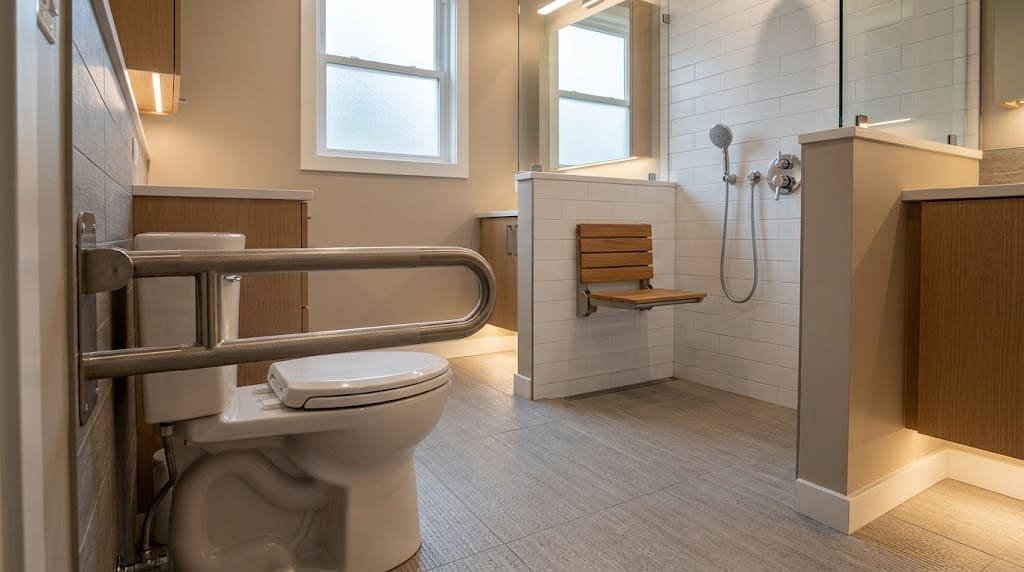
Placement should be based on the movement that needs support. A grab bar intended to help with a shower transfer may serve a different purpose from one positioned near a toilet.
Installation is equally important. A grab bar should be securely attached to an appropriate structural support system and installed according to the requirements of the specific location and application. Never rely on a towel bar, decorative rail, or similar fixture for support unless it has been specifically designed and securely installed to bear a person’s weight.
If you are modifying a bathroom to meet specific accessibility requirements, follow the standards that apply to the type of facility rather than treating general safety advice as an ADA requirement. The U.S. Access Board outlines technical accessibility requirements for covered facilities, including provisions for accessible toilet rooms, showers, and other bathing facilities.
Make Shower and Tub Access Safer and More Comfortable
Shower and tub access is often one of the most important areas to evaluate because bathing can involve stepping over a threshold, standing on a wet surface, turning, and transferring.
Possible bathroom modifications include:
- reducing a difficult shower threshold;
- replacing an inaccessible tub or shower configuration;
- using an appropriate shower seat or bench;
- adding stable support at the points where a person enters or exits;
- using a handheld showerhead to make bathing easier while seated or standing; and
- improving the surrounding floor and drainage conditions to reduce water spreading into walking areas.
A low-threshold or curbless shower can make entry easier for some users, but it is not automatically the right solution for every bathroom. Drainage, available space, mobility needs, construction conditions, and the person’s ability to transfer should all be considered.
For a broader discussion focused specifically on shower and bathtub safety, see our guide to shower and bathtub safety.
Improve Toilet Transfers
The toilet should be evaluated as a transfer point, not simply as a fixture.
Someone who has difficulty lowering onto or rising from a low toilet may benefit from an appropriate raised toilet seat or another suitable height modification. Stable support near the toilet can also make transfers easier when properly installed.
Consider:
- whether sitting and standing can be performed comfortably;
- whether support is available where it is actually needed;
- whether the approach to the toilet is unobstructed;
- whether the person’s mobility equipment can be positioned appropriately; and
- whether the toilet or surrounding fixtures are being used as unintended support.
A higher toilet is not necessarily better for every person. The appropriate height depends on the user’s needs and ability to transfer safely.
Improve Wet-Surface Safety
Water changes the conditions of bathroom floors and bathing surfaces, so wet-area traction deserves specific attention.
Bathroom safety improvements can include:
- addressing slippery shower or tub surfaces;
- choosing appropriate slip-resistant flooring or surface treatments;
- removing loose rugs or securing bathroom floor coverings appropriately;
- promptly addressing water that spreads outside the shower or tub; and
- repairing damaged flooring or unsafe transitions.
The CDC’s home-safety checklist recommends checking bathroom floors for slippery conditions and using nonslip measures where appropriate. The National Institute on Aging also recommends reducing fall hazards in the bathroom, including using nonslip surfaces.
Don’t assume a bathroom becomes safer simply by placing an unsecured bath mat on the floor. A floor covering that shifts underfoot can introduce another hazard. The objective is a stable, suitable walking surface.
Improve Lighting and Nighttime Visibility
Good bathroom lighting should make the room, walking route, fixtures, and potential obstacles easy to see.
Useful improvements can include:
- adequate general lighting;
- task lighting where activities require more visibility;
- appropriate nightlights;
- a well-lit route between the bedroom and bathroom;
- reducing excessive glare and deep shadows; and
- placing switches where they can be reached easily.
For fall prevention at home, the National Institute on Aging emphasizes the importance of good lighting and nightlights. The CDC also recommends making sure the route to the bathroom is well lit, particularly where poor visibility could make nighttime movement more difficult.
Lighting is particularly important when someone regularly uses the bathroom at night. The assessment should therefore include the entire route, not just the light inside the bathroom.
Improve Bathroom Layout, Access and Reach
A bathroom can contain excellent safety equipment and still be difficult to use if the layout forces a person to squeeze through tight spaces, turn awkwardly, or reach too far.
Look at:
- the route into and through the bathroom;
- doorway access;
- available maneuvering space;
- the space needed for a walker or wheelchair;
- the location of frequently used items;
- faucet and shower controls;
- storage height; and
- areas that require repeated bending, twisting, or stretching.
For someone using a mobility device, usable space matters as much as the individual fixture. Moving frequently used supplies to an easier-to-reach location may be a simple improvement, while insufficient maneuvering space may require a more substantial bathroom accessibility modification.
5. Bathroom Safety Modifications for Seniors and People With Mobility Challenges
Older adults and people with mobility limitations may have different bathroom needs because activities such as stepping over a tub, maintaining balance, transferring, or walking at night can become more difficult.
Bathroom modifications for older adults should therefore be based on the person’s actual abilities rather than age alone.
Modifications That May Help Older Adults
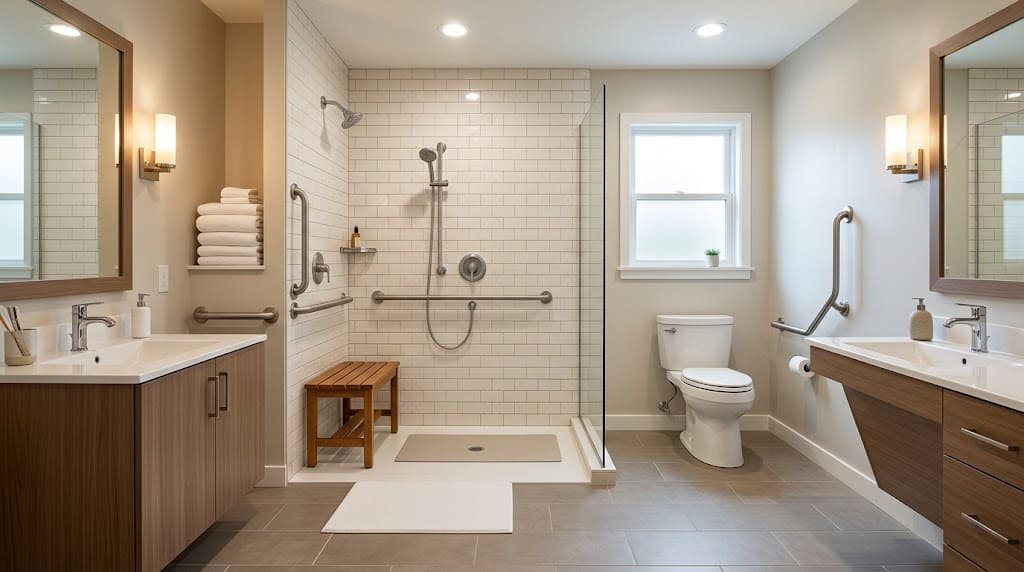
Potential priorities include:
- stable support for transfers;
- easier shower or tub entry;
- appropriate shower seating when standing for bathing is difficult;
- improved toilet access;
- better lighting and nighttime visibility;
- reduced slipping hazards; and
- keeping essential items within a manageable reach.
Reducing fall risks is especially important for older adults. According to the CDC, more than one in four people aged 65 and older report experiencing a fall each year. That statistic describes older-adult falls generally; it should not be interpreted as a bathroom-specific fall rate.
A bathroom modification can support safer movement, but it cannot eliminate every fall risk. The person’s balance, strength, vision, medications, mobility equipment, and other factors may also affect safety.
When Mobility Equipment Changes the Bathroom Requirements
A bathroom used with a walker or wheelchair may need different modifications from one used without mobility equipment.
Consider whether the person can:
- enter the bathroom without obstruction;
- turn or reposition the mobility device;
- approach the toilet adequately;
- reach the shower or bathing area;
- transfer between the device and a seat safely; and
- move through the room without fixtures or storage creating unnecessary barriers.
For more significant mobility limitations, simply adding products may not solve the underlying problem. The bathroom may require changes to its layout, doorway, shower access, or maneuvering space.
For a broader discussion focused specifically on older adults, see our guide to bathroom safety for seniors.
6. How to Prioritize Your Bathroom Safety Modifications
If several problems are present, prioritize modifications according to risk and difficulty of movement, rather than trying to change everything at once.
1. Remove immediate hazards
Start with conditions that can create avoidable problems, such as loose rugs, cluttered pathways, standing water, or damaged flooring.
2. Add reliable support
Next, address places where the person needs stable support during transfers or changes in position. Properly installed grab bars may be appropriate in these locations.
3. Reduce difficult transfers
Pay close attention to how easily you can get into and out of the shower or tub, as well as sit down and stand up from the toilet. If stepping over a tub wall or rising from a low toilet is particularly difficult, address that movement directly.
4. Improve visibility
Make the bathroom and the route to it easier to see, especially during nighttime use.
5. Improve accessibility
If the person has difficulty maneuvering a walker or wheelchair, evaluate the usable space, doorway, fixture placement, and reach requirements.
6. Consider structural remodeling
When basic safety adjustments are not enough to solve the main accessibility or safety problem, a more extensive bathroom renovation may be necessary. This could include modifying the shower area, replacing or altering flooring, reinforcing or changing walls, widening a doorway, or reconfiguring the overall layout. Because these changes can affect the bathroom’s structure and usability, they should be carefully planned before work begins.
Bathroom Safety Modification Priority Checklist
Use this simple sequence when assessing your bathroom:
- ☐ Remove immediate slipping and tripping hazards
- ☐ Clear the route into and through the bathroom
- ☐ Identify transfers that are difficult or unstable
- ☐ Determine where reliable support is needed
- ☐ Evaluate shower/tub entry
- ☐ Evaluate toilet access and height
- ☐ Improve nighttime visibility
- ☐ Check maneuvering space for mobility equipment
- ☐ Move essential items within practical reach
- ☐ Decide whether structural changes are actually necessary
7. Do You Need Bathroom Safety Upgrades or a Full Remodel?
Not every bathroom safety problem requires a full remodel. The appropriate starting point depends on whether the problem can be solved by removing a hazard, adding support, changing a fixture, or altering the physical layout.
| Situation | More appropriate starting point |
|---|---|
| Slip hazard | Surface or hazard modification |
| Need for stable support | Properly installed grab-bar/support modification |
| Difficulty standing | Appropriate seating, support, or toilet modification |
| Difficult tub entry | Transfer solution or shower-access modification |
| Poor lighting | Lighting upgrade |
| Walker cannot maneuver | Layout/accessibility modification |
| Major wheelchair-access barrier | Structural accessibility remodeling may be appropriate |
When Smaller Modifications May Be Enough
Smaller modifications may be sufficient when the bathroom’s basic layout works but a specific hazard or activity creates difficulty.
Examples include:
- improving lighting;
- removing clutter;
- addressing loose floor coverings;
- adding appropriate shower seating;
- installing properly supported grab bars;
- improving the showerhead or controls; or
- making frequently used supplies easier to reach.
The key question is whether the modification solves the actual problem without creating another obstruction or safety issue.
When Structural Changes Make More Sense
Structural changes become more relevant when the existing bathroom cannot accommodate the person’s required movements.
Examples include a shower threshold that remains difficult to negotiate, inadequate maneuvering space for mobility equipment, or a doorway/layout that prevents practical access.
A structural bathroom safety renovation should be planned around the person’s current and reasonably foreseeable needs rather than simply adding the latest accessibility feature. If construction is involved, the work should be evaluated for structural, plumbing, electrical, drainage, and applicable accessibility requirements.
8. How to Plan Safe Bathroom Modifications
Good planning starts with the person, the bathroom, and the activities they need to perform. Avoid choosing products first and trying to make them fit afterward.
Assess the Person and the Bathroom Together
Consider:
- current mobility and balance;
- vision and ability to see obstacles;
- mobility equipment such as a walker or wheelchair;
- ability to sit, stand, and transfer;
- caregiver assistance, if applicable;
- nighttime bathroom use; and
- the bathroom’s existing layout and available space.
A modification that works well for one person may be unnecessary or unsuitable for another.
Choose the Modification Before Choosing the Product
Start with the problem, then determine the appropriate modification, and only afterward select equipment or products.
For example, Instead of immediately asking, “Which shower chair is right for me?” Begin with, “Does this person need to sit while bathing, and where can the seat be positioned and used safely?”
That distinction helps prevent a common planning mistake: buying equipment that does not address the actual movement problem or that makes the bathroom harder to navigate.
Recognize When Your Bathroom Needs Expert Assessment
Consider professional input when:
- a fall or near-fall has occurred;
- someone cannot transfer safely;
- a walker or wheelchair cannot maneuver adequately;
- you are uncertain where support should be installed;
- major structural changes are being considered; or
- the person’s mobility or balance has changed significantly.
An occupational therapist or physical therapist may be able to assess how the person performs everyday activities and recommend appropriate home-safety changes. A qualified contractor or accessibility professional can help translate those recommendations into physical modifications, particularly when structural work is required.
The National Institute on Aging recommends considering professional assessment when fall concerns exist and notes that occupational or physical therapy professionals can help identify home-safety changes.
9. Bathroom Safety Modification Checklist
Use this checklist as a practical final inspection. It is designed to help identify areas that may need attention; it does not replace an individualized professional assessment when one is needed.
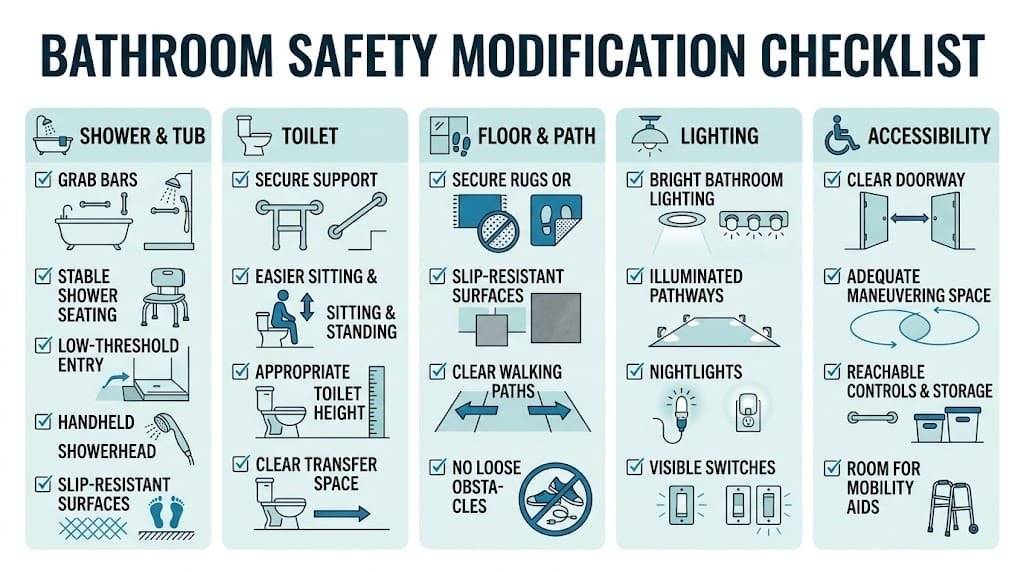
Shower/tub
- ☐ Entry is easy to negotiate
- ☐ Stable support is available where needed
- ☐ Wet surfaces provide appropriate traction
- ☐ Seating is stable and appropriate if needed
- ☐ Shower controls are reachable
- ☐ Water is not creating an unnecessary wet area outside the bathing space
Toilet
- ☐ Sitting and standing are manageable
- ☐ Stable support is available where needed
- ☐ The approach to the toilet is unobstructed
- ☐ Mobility equipment can be positioned appropriately
Floor/path
- ☐ No loose rugs or unstable floor coverings
- ☐ No unnecessary clutter
- ☐ Wet areas are addressed
- ☐ Flooring and transitions are in good condition
- ☐ The path into the bathroom is clear
Lighting
- ☐ Bathroom lighting is adequate
- ☐ The nighttime route is visible
- ☐ Dim areas and heavy shadows are minimized throughout the bathroom
- ☐ Switches or controls are reasonably accessible
Accessibility
- ☐ Doorway and path are usable
- ☐ Mobility equipment can maneuver where necessary
- ☐ Essential items are within practical reach
- ☐ Fixtures do not unnecessarily obstruct movement
10. When Should You Get a Professional Bathroom Safety Assessment?
A professional bathroom safety assessment is especially worthwhile when a person’s needs cannot be evaluated reliably through a simple visual inspection.
Consider getting professional help after a fall or near-fall, when transfers are unsafe, when mobility equipment cannot maneuver properly, when you are unsure about support placement, or when significant remodeling is being considered.
An occupational therapist or physical therapist can evaluate how a person moves through everyday activities and identify functional barriers. A qualified contractor can then address the construction aspects of appropriate modifications.
Professional input is also useful when the bathroom needs to accommodate substantial mobility changes. Rather than installing several unrelated products, an assessment can help determine whether the underlying problem is support, transfer technique, access, reach, maneuvering space, or the physical configuration of the room.
11. FAQs
What are the most important bathroom safety modifications?
The most important modifications are the ones that address the bathroom’s specific hazards and the user’s most difficult movements. Common priorities include stable support, safer shower or tub access, manageable toilet transfers, appropriate wet-surface traction, adequate lighting, and clear pathways. The right combination depends on the person and the bathroom.
Can You Improve Bathroom Safety Without a Full Remodel?
Yes. You can make many meaningful bathroom safety changes without undertaking a full-scale renovation. Removing hazards, improving lighting, repositioning essential items, adding appropriate seating, and installing properly supported grab bars can address specific problems. However, major access or maneuvering barriers may require structural changes.
What bathroom modifications help prevent falls?
Bathroom fall prevention modifications commonly focus on reducing slipping and tripping hazards, improving lighting, providing reliable support during transfers, making shower and tub entry easier, and improving toilet access. These measures can reduce environmental risks, but they cannot eliminate every cause of falls.
What modifications help older adults?
Bathroom modifications for older adults may include easier shower access, stable support, appropriate shower seating, improved toilet transfers, better lighting, safer walking surfaces, and clearer pathways. The modifications should be selected according to the person’s mobility, balance, vision, and daily bathroom activities rather than age alone.
When does a bathroom safety modification require professional help?
Professional help is appropriate when someone has fallen or nearly fallen, cannot transfer safely, uses mobility equipment that cannot maneuver effectively, needs structural changes, or when you are unsure how a modification should be designed or installed. Occupational or physical therapy professionals can help assess functional needs, while qualified contractors can address construction requirements.
12. Conclusion
The most effective bathroom safety changes are not always the costliest or most involved options. They are the changes that solve the specific problems a person encounters while entering, moving through, bathing, using the toilet, and leaving the bathroom.
Start by identifying the highest-risk movements and hazards. Remove immediate problems, add reliable support where needed, improve difficult transfers, address visibility, and then consider accessibility or structural remodeling if smaller changes cannot solve the problem.
For older adults and people with mobility challenges, evaluate the person and the bathroom together. A well-planned modification should make the space easier to use without creating new obstacles.
The goal is a bathroom that supports safer movement, practical access, and greater independence not simply a bathroom filled with safety products.
1 Comment