
1. Introduction
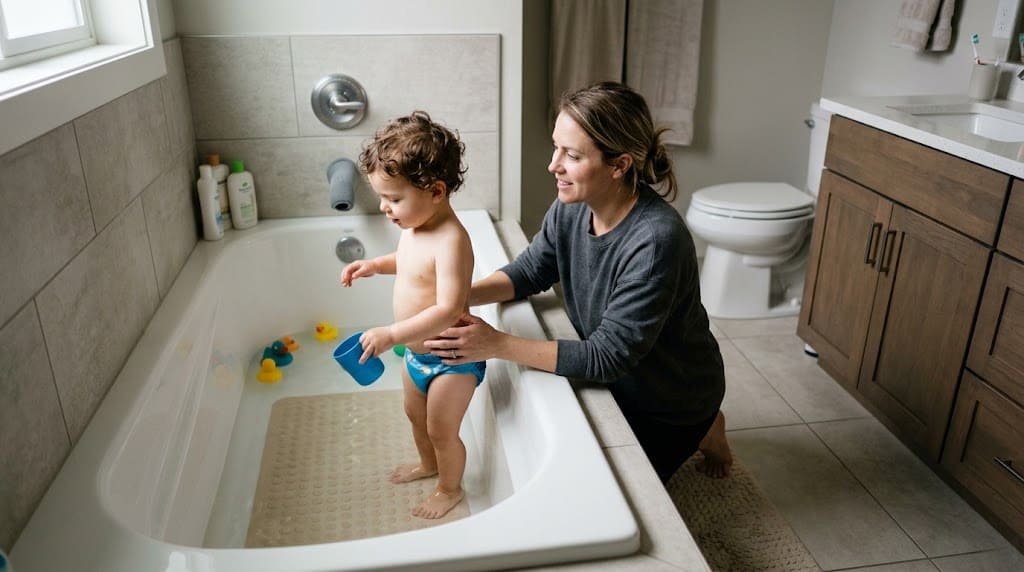
Bathrooms contain several hazards that can be easy for adults to overlook but dangerous for young children. Water, slippery surfaces, hot faucets, medicines, cleaning products, sharp grooming tools, and electrical appliances can all create risks in a relatively small space.
Bathroom safety for children starts with active adult supervision around water, controlled access to the bathroom, and removing or securing hazards that a child can reach. The goal is not to make the bathroom completely risk-free but to identify predictable hazards and add practical layers of protection.
This guide explains the most important bathroom hazards for infants, toddlers, preschoolers, and young children, including drowning, slips and falls, hot-water scalds, poisoning, cuts, and electrical injuries. It also provides a childproofing approach, age-specific considerations, a bath-time routine, and a bathroom safety checklist parents can use at home.
Table of Contents
2. What Are the Biggest Bathroom Safety Risks for Children?
The biggest bathroom risks for children generally fall into five groups: drowning, falls, burns or scalds, poisoning and cuts, and electrical hazards. Understanding where each hazard occurs makes it easier to decide what needs to be changed.
Drowning and Unsupervised Access to Water
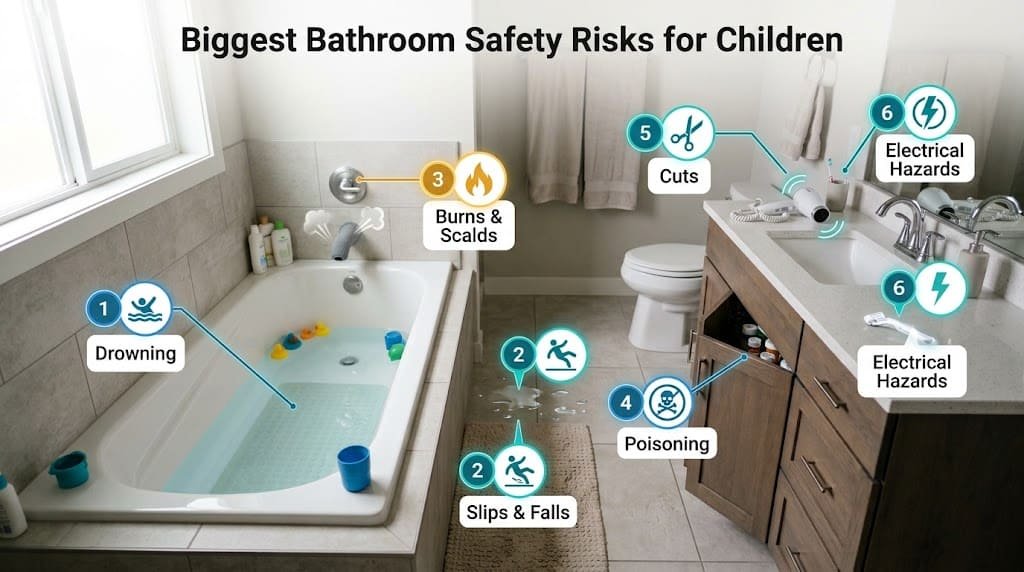
Drowning can happen quickly and quietly, including in bathtubs and other relatively small amounts of water. The CDC recommends close and constant adult supervision whenever children are in or near water, including bathtubs.
Potential bathroom water hazards include:
- Bathtubs containing water
- Toilets that a curious toddler can access
- Buckets or containers holding water
- Sinks or other accessible water
- A bathroom that a young child can enter without an adult
The safest approach is to prepare everything you need before bath time and stay with the child. Afterward, empty the tub rather than leaving water available.
Slips, Falls and Hard Surfaces
Water makes bathroom surfaces slippery, and children may be particularly vulnerable because they are still developing balance and coordination. Falls can happen while getting into or out of the tub, standing on a wet floor, or running across the bathroom.
Use appropriate nonslip surfaces, clean up spills promptly, keep the floor as dry as practical, and teach children not to run in the bathroom. MedlinePlus specifically recommends nonskid tub surfaces and drying both the child’s feet and the bathroom floor after bathing.
Burns and Hot-Water Scalds
Hot tap water can cause serious scalds. The risk comes from hot water at the faucet, bathwater that is too hot, and a child gaining access to faucet controls.
The American Academy of Pediatrics recommends that the hottest water temperature at the faucet be no more than 120°F (48.9°C) to help prevent tap-water scalds. Parents should still test bathwater before placing a child in it.
Poisoning, Cuts and Electrical Hazards
Bathrooms often contain products that should not be accessible to young children, including medicines, cleaning products, cosmetics, razors, scissors, and personal-care products.
Electrical appliances create another hazard, particularly around water. Hair dryers, curling irons, and electric razors should be unplugged when not in use and stored where children cannot access them. MedlinePlus recommends keeping electronic items unplugged while a child is in the bathroom.
| Bathroom hazard | Possible problem | Practical prevention |
|---|---|---|
| Bathtub water | Drowning | Stay with the child and empty the tub afterward |
| Wet floor or tub | Slips and falls | Use appropriate nonslip surfaces and dry spills |
| Hot tap water | Scalds | Keep hottest faucet temperature at or below 120°F |
| Toilet water | Drowning/falls | Keep the lid closed and consider a toilet lock |
| Medicines and cleaners | Poisoning | Store in locked, inaccessible storage |
| Razors and scissors | Cuts | Keep secured and out of reach |
| Hair dryers and curling irons | Burns/electrical injury | Unplug and store securely |
3. How to Childproof a Bathroom Before Your Child Uses It
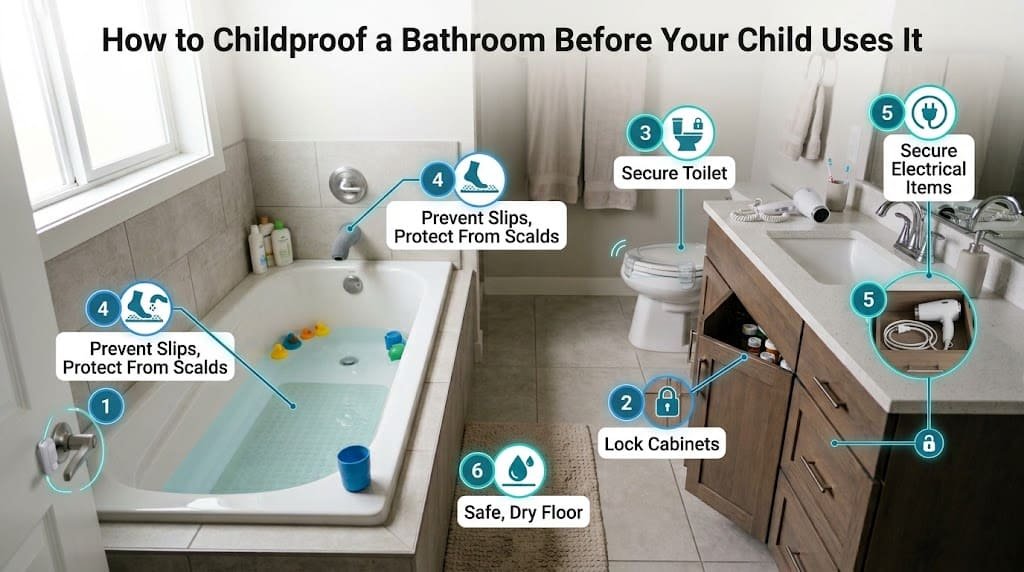
A childproof bathroom is one where predictable hazards have been removed, locked away, or made difficult for a young child to access. Start at your child’s eye level rather than looking around the room from an adult’s height.
Control Access to the Bathroom
If a young child can wander into the bathroom without supervision, controlling access can reduce exposure to several hazards at once.
Keep the bathroom door closed when it is not being used and consider an appropriate child-safety latch if needed. Any door lock or latch used for child safety should still allow an adult to access the room quickly in an emergency.
The AAP recommends making the bathroom inaccessible to young children unless they are accompanied by an adult.
Lock or Move Dangerous Products
Move medicines, cleaners, cosmetics, mouthwash, and other potentially harmful products out of a child’s reach. For young children, a locked cabinet provides an additional barrier.
Do not rely only on a high shelf if the child can eventually climb to it. Also avoid leaving products temporarily on the countertop while you are distracted or away.
Secure Toilets, Cabinets and Drawers
Use appropriate safety latches or locks on cabinets and drawers containing medicines, cleaners, sharp objects, or other hazardous items. The CPSC recommends safety latches and locks for bathroom cabinets and drawers to help prevent children from accessing medicines, household cleaners, and sharp objects.
For toddlers, consider a toilet lid lock if toilet access is a concern. Keep the lid closed whenever practical.
Make the Tub, Shower and Floor Safer
Use an appropriate nonslip surface inside the tub or shower and keep the surrounding floor dry. Remove clutter that could become a tripping obstacle.
A faucet cover may also help reduce the chance of a child hitting their head against a hard spout, but it should not be treated as protection from hot water or as a substitute for supervision.
Secure Electrical and Hot Appliances
Hair dryers, curling irons, electric razors, and similar devices should be unplugged after use and stored where children cannot reach them.
Keep hot styling tools away from the edge of a counter and away from sinks, tubs, and wet surfaces. Bathroom electrical work should be handled by a qualified professional when needed rather than improvised by a parent.
4. Bathtub and Bath-Time Safety for Children
Bathtub safety for children depends heavily on active supervision and preparation. Have the towel, soap, clothing, and other necessary supplies within reach before the bath begins so you do not have to leave the child to retrieve something.
Never Rely on Supervision From Another Child
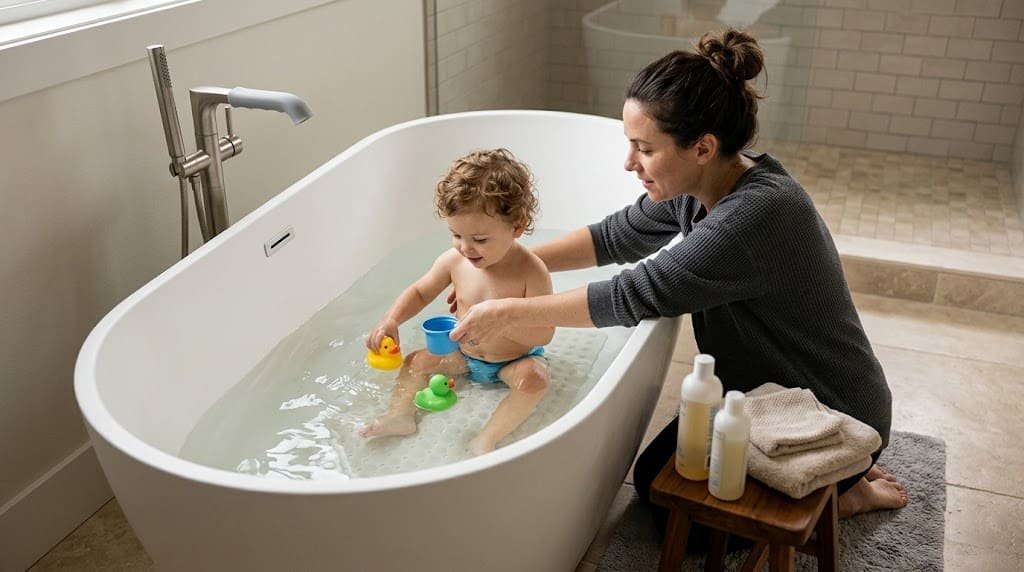
An older sibling should not be responsible for the safety of a younger child during bath time. A responsible adult should supervise.
The CDC recommends close and constant adult supervision when children are in or near water, including bathtubs. It also advises supervisors to avoid distractions such as phone use because drowning can happen quickly and quietly.
If you need to leave the bathroom, take the child with you rather than assuming they will be safe for “just a minute.”
Keep Bathing Supplies Within Reach
Before putting your child in the tub, gather everything you expect to need:
- Towel
- Soap and shampoo
- Clean clothes or pajamas
- Diapers, if applicable
- Bath toys
- Any other necessary supplies
This simple preparation reduces the chance that you will need to turn away or leave the bathroom during the bath.
Make the Tub Less Slippery
An appropriate nonslip tub surface can help reduce slipping. Keep your child’s feet and the floor outside the tub dry when possible.
Teach children that the bathroom is not a place for running or rough play. For younger children, bath toys can help keep them seated rather than moving around unnecessarily.
Check Water Temperature Before Bathing
Test bathwater before your child enters. The water should feel pleasantly warm, never uncomfortably hot.
For tap-water scald prevention, the AAP recommends keeping the hottest water temperature at the faucet at no more than 120°F (48.9°C). A water-heater setting is not a substitute for checking the actual bathwater because the temperature at the fixture can vary.
Do Bath Seats and Rings Prevent Drowning?
No. Bath seats and rings should not be treated as drowning-prevention devices or substitutes for adult supervision.
HealthyChildren.org specifically warns that bathing aids do not prevent drowning if a child is left unattended. A child can slip, tip, or otherwise get into a dangerous position even when using a bathing aid.
The important safety measure is continuous adult supervision, with the caregiver close enough to respond immediately.
5. Prevent Bathroom Drowning Beyond the Bathtub
Bathroom drowning prevention should not stop when the bath is over. Young children may investigate water wherever they find it.
Prevent Toilet Drowning
A curious toddler can fall headfirst into an open toilet and may have difficulty getting back out. Keep the toilet lid closed and consider an appropriate toilet lid lock if your child can access the toilet.
HealthyChildren.org specifically recommends keeping toilet lids down and using safety latches or locks where appropriate for curious toddlers.
Empty Buckets and Other Containers
Never leave a bucket or other container filled with water where a young child can reach it. Empty containers immediately after use.
The CDC identifies bathtubs and buckets among places where children can drown when they have unsupervised access to water.
Keep Bathroom Doors Closed When Not in Use
For toddlers who explore independently, a closed bathroom door can add another layer of protection. This is especially useful when there is water, cleaning equipment, or other hazards inside.
The goal is not to rely on the door alone, but to combine controlled access with supervision and proper storage.
6. How to Prevent Slips and Falls in the Bathroom
Slips and falls can happen during bathing, when children climb into or out of the tub, or when they run across a wet floor.
Reduce Wet and Slippery Surfaces
Keep the tub or shower floor as secure as practical with an appropriate nonslip surface. Wipe up water on the bathroom floor and dry your child’s feet after bathing.
Do not leave loose rugs, toys, or other objects where they can become unexpected obstacles.
Teach Safe Bathroom Behavior
Children should learn simple rules appropriate for their age:
- Walk rather than run.
- Sit safely during bathing.
- Do not climb on the toilet, sink, or countertops.
- Avoid grabbing unstable objects for support.
- Tell an adult when the floor is wet.
Rules are most effective when combined with a safer physical environment. A child who is still learning balance should not be expected to compensate for a slippery floor or inaccessible safety hazard.
Make the Tub and Shower Easier to Enter and Exit
Getting into and out of a tub is a common opportunity for slipping. Use an appropriate nonslip surface and provide hands-on assistance when your child’s age or development requires it.
Do not use towel racks, loose shelves, or other objects as makeshift supports. A bathroom safety modification should be stable and intended for the purpose for which it is being used.
7. Prevent Burns and Scalds From Bathroom Water
Hot-water safety is an important part of child bathroom safety because a young child may not recognize how dangerous a hot faucet or bath can be.
Set the Water Heater to an Appropriate Maximum
The AAP recommends that the hottest temperature at the faucet be no more than 120°F (48.9°C) to help prevent tap-water scalds. MedlinePlus gives the same 120°F recommendation for household hot-water settings.
Do not interpret this as meaning every bath should be exactly 120°F. The recommendation concerns limiting the maximum hot-water temperature available at the faucet. Bathwater should be checked before the child enters and should feel warm, not hot.
Test Bathwater Before Your Child Enters
Check the water with your wrist or elbow before bathing a young child. Also be cautious about running water while a child is already in the tub because the temperature can change.
HealthyChildren.org recommends testing the water and notes that water temperature can fluctuate as it moves through household plumbing.
Reduce Access to Hot Faucets
For younger children, consider whether they can reach or operate the faucet. A faucet or spout guard may reduce the chance of impact against a hard spout, but it does not make hot water safe by itself.
As children become more independent, teach them how to use the faucet safely rather than assuming they understand the difference between hot and cold controls.
8. Keep Medicines, Cleaners and Bathroom Products Out of Reach
A bathroom can contain many products that are safe when used correctly but dangerous when swallowed, spilled, or misused by a child.
Store Medicines in Locked Storage
Keep prescription and over-the-counter medicines in locked storage that children cannot access.
Child-resistant packaging is helpful, but it is not the same as childproof storage. HealthyChildren.org recommends keeping medicines and cosmetics in a locked cabinet and emphasizes that safety caps are child-resistant rather than completely childproof.
Keep medicines in their original containers and return them to secure storage immediately after use.
Lock Away Cleaning Products
Bathroom cleaners, disinfectants, bleach products, and other household chemicals should be stored where children cannot access them.
Keep products in their original containers and do not transfer chemicals into cups, food containers, or unlabeled bottles. A locked cabinet is preferable to simply placing hazardous products on a higher shelf.
Secure Cosmetics and Personal-Care Products
Do not assume that ordinary personal-care products are harmless because they are commonly used by adults.
Secure products such as:
- Mouthwash
- Nail products
- Hair products
- Fragrances
- Shaving products
- Other personal-care items that may be harmful if swallowed or misused
The safest storage location is one that a child cannot reach or open.
9. Bathroom Electrical Safety for Children
Water and electricity create a particularly important combination of hazards. The simplest strategy is to keep electrical appliances away from water and prevent children from accessing them.
Unplug Hair Dryers and Other Appliances
Unplug hair dryers, curling irons, electric razors, and similar appliances after use.
Do not leave a hot styling tool unattended on a counter where a child can reach it. Let heat-producing appliances cool in a safe location before storing them.
Keep Electrical Devices Away From Water
Never leave an electrical appliance beside a bathtub or sink where it could fall into water.
Store appliances in a dry location that children cannot access. Unplugging an appliance reduces one risk, but safe storage and keeping electrical equipment away from water remain important.
Understand GFCI Protection
A ground-fault circuit interrupter (GFCI) is designed to interrupt electrical power when it detects a ground-fault condition, helping reduce the risk of severe electrical shock.
GFCI protection is an important bathroom electrical safeguard, but it is not permission to use electrical appliances around water carelessly. Parents should never rely on GFCI protection instead of keeping appliances dry and unplugged when not in use.
If you need to install, replace, or troubleshoot bathroom electrical equipment and are not qualified to do the work safely, use a qualified electrician.
10. Bathroom Safety by Age: Babies, Toddlers and Older Children
Children’s bathroom risks change as they become more mobile and independent. There is no single age at which every child is ready to use the bathroom or bathe without adult supervision.
Babies and Infants
For babies, the priorities are direct supervision, safe bathing, water-temperature control, and preventing access to water outside the bath.
Always stay with your baby during bath time, and never leave them unattended, even for a moment. Prepare supplies first and remain close enough to respond immediately. HealthyChildren.org also recommends checking bathwater temperature and keeping the hottest faucet temperature at no more than 120°F.
Toddlers
Toddlers become mobile and curious quickly, so childproofing must account for what they can reach, open, climb, and pull.
Pay particular attention to:
- Toilet access
- Cabinet and drawer access
- Faucet controls
- Medicines and cleaning products
- Sharp grooming tools
- Bathroom doors
- Slippery surfaces
The CDC advises that toddlers should not be left around water without someone watching them.
Preschoolers and Young Children
As children get older, parents can gradually teach them how to use bathroom fixtures safely and follow basic rules such as walking rather than running and keeping electrical appliances away from water.
Greater independence should be based on the individual child’s development, judgment, ability to follow instructions, and the specific bathroom environment. Do not use a universal age as the sole test for whether a child is ready to bathe without an adult.
11. A Before, During and After Bath Safety Routine
A repeatable routine can make bathroom safety easier because parents do not have to remember every precaution from scratch each time.
Before Bath
Before placing your child in the tub:
- Gather towels, soap, clothing, and other supplies.
- Check the bathwater temperature.
- Check the tub and surrounding floor for slippery areas.
- Remove electrical appliances from the immediate area.
- Make sure you can remain with the child for the entire bath.
During Bath
During the bath:
- Stay with the child.
- Keep your attention on the child rather than your phone or other distractions.
- Keep necessary supplies within reach.
- Monitor the child’s position and movement.
- Watch faucet controls and water temperature.
- Never leave the child alone to answer a phone call, retrieve an item, or perform another task.
After Bath
When bath time is finished:
- Remove the child safely.
- Dry the child and wet areas of the floor.
- Empty the tub.
- Return medicines, cleaners, cosmetics, and grooming tools to secure storage.
- Unplug and store electrical appliances.
- Close or secure the bathroom if young children can enter without supervision.
This routine turns child bathroom safety from a collection of individual tips into a repeatable habit.
After addressing child-specific hazards, use our bathroom safety checklist to inspect the rest of the bathroom and identify additional risks involving floors, lighting, water temperature, electrical safety, and storage.
12. Bathroom Safety Checklist for Children
Use this checklist to inspect the bathroom from a child’s perspective. If an item does not apply to your household, focus on the hazards that do.
Water Safety
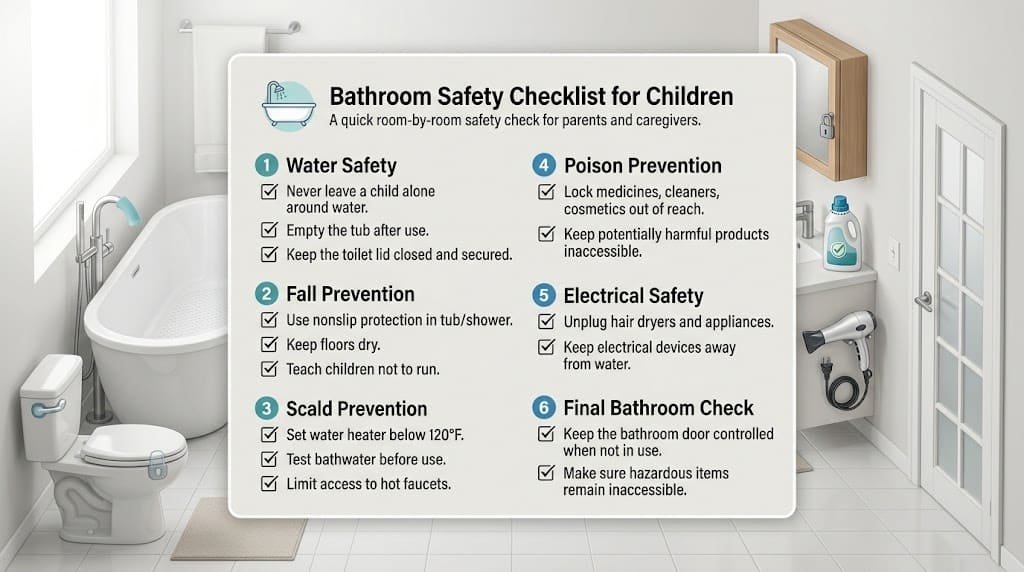
- ☐ An adult provides active supervision during bathing.
- ☐ The bathtub is emptied after use.
- ☐ The toilet is kept closed and secured when appropriate.
- ☐ Buckets and other water containers are emptied.
- ☐ Young children cannot enter the bathroom around water without supervision.
Fall Prevention
- ☐ The tub or shower has an appropriate nonslip surface.
- ☐ Water spills are cleaned up promptly.
- ☐ The bathroom floor is kept as dry as practical.
- ☐ Children are taught not to run in the bathroom.
Scald Prevention
- ☐ The hottest faucet temperature is limited appropriately.
- ☐ Bathwater is tested before the child enters.
- ☐ Young children cannot easily operate hot-water controls.
- ☐ Hot faucets and surfaces are addressed as the child becomes more mobile.
Poisoning Prevention
- ☐ Prescription and over-the-counter medicines are locked away.
- ☐ Cleaning products are locked away.
- ☐ Cosmetics and personal-care products are secured.
- ☐ Razors, scissors, and other sharp objects are inaccessible.
Electrical Safety
- ☐ Hair dryers and other appliances are unplugged after use.
- ☐ Electrical appliances are stored away from water and children.
- ☐ Bathroom outlets have appropriate GFCI protection.
- ☐ Electrical repairs or installation are handled safely by a qualified professional when needed.
Final Childproofing Check
- ☐ Bathroom access is controlled when necessary.
- ☐ Cabinets and drawers containing hazards are secured.
- ☐ The toilet is secured if a toddler can access it.
- ☐ The bathroom has been inspected from the child’s eye level.
- ☐ A caregiver can reach the child quickly during bath time.
13. Five-Minute Bathroom Safety Inspection for Parents
You can perform a quick bathroom childproofing check by moving through the room in a consistent order:
Door → Tub/Shower → Toilet → Sink → Cabinets → Electrical → Floor → Final access check
At each stop, ask three questions:
Can my child reach it? Can it hurt them? Can I remove, lock, cover, or control the hazard?
Start at the door. Consider whether a young child can enter without supervision. At the tub and shower, look for water, slippery surfaces, hot controls, and objects that could cause injury. At the toilet, consider access to the bowl and lid.
Next, inspect the sink and vanity for medicines, cosmetics, razors, and electrical appliances. Open every accessible cabinet and drawer to see what your child could actually reach. Finally, check the floor for water, clutter, loose objects, and other fall hazards.
This five-minute inspection is useful because it evaluates the actual environment, not just whether you remember a list of safety rules.
14. FAQs
What are the most common bathroom hazards for children?
The major hazards include drowning, slips and falls, hot-water scalds, poisoning from medicines or household chemicals, cuts from sharp grooming tools, and electrical injuries. Young children can also get into trouble by accessing toilets, cabinets, faucets, or bathroom appliances without supervision.
How do I childproof my bathroom?
Start by controlling unsupervised access, then secure medicines and chemicals, lock hazardous cabinets and drawers, address toilet access, reduce slippery surfaces, secure sharp objects, and store electrical appliances safely. Most importantly, provide close adult supervision around water. The CPSC recommends safety latches and locks for bathroom cabinets and drawers where they are needed to prevent children’s access to hazardous items.
How can I prevent my toddler from drowning in the toilet?
Keep the toilet lid closed and consider an appropriate toilet lid lock if your toddler can access the toilet. Also control unsupervised bathroom access. HealthyChildren.org specifically recommends toilet lid locks as a way to prevent curious toddlers from accessing the toilet bowl.
What temperature should bathroom water be for children?
The American Academy of Pediatrics recommends that the hottest temperature at the faucet be no more than 120°F (48.9°C) to help prevent tap-water scalds. Parents should also test bathwater before the child enters and make sure it feels warm rather than hot.
Are bath seats safe for babies?
Bath seats and rings should not be considered drowning-prevention devices. They cannot take the place of attentive supervision by an adult. A caregiver should remain with a baby or young child throughout the bath.
When can a child bathe without an adult?
There is no single age that makes independent bathing safe for every child. Readiness depends on development, judgment, ability to follow safety instructions, and the bathroom environment. Parents should follow age-appropriate pediatric guidance and continue supervision when a child is not ready to manage the risks independently.
What should I lock away in a bathroom?
Lock away medicines, cleaning products, chemicals, sharp grooming tools, and any personal-care product that could be harmful if swallowed or misused. Also secure electrical appliances and consider locking toilet access for toddlers when necessary.
15. Conclusion
Bathroom safety for children is built from layers of protection, not one safety product or one rule. Active adult supervision is the most important protection around water, while controlled bathroom access, safer water temperatures, nonslip surfaces, secure storage, toilet precautions, and electrical safety address other predictable hazards.
For parents, the most useful approach is to inspect the bathroom from the child’s perspective. Look at what your child can reach, open, climb, touch, or enter. Then remove the hazard, lock it away, control access, or add an appropriate safety measure.
A regular bathroom safety check also matters as children grow. A bathroom that is reasonably secure for a baby may need additional childproofing once a toddler can walk, climb, open cabinets, and operate faucets.
Use the checklist in this guide as a practical starting point, but keep the central rule simple: when a young child is in or near bathroom water, stay close, stay attentive, and do not rely on a device to replace supervision.
For a broader look at bathroom hazards and prevention strategies, see our complete guide to bathroom safety.
3 Comments