
1. Introduction
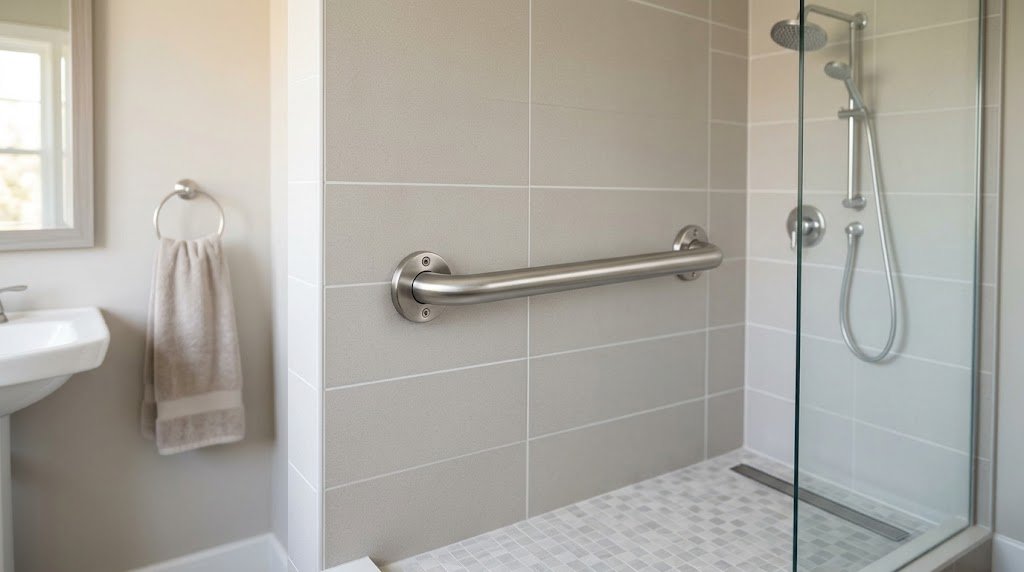
Bathroom grab bars are support bars designed to help people maintain balance, change positions, and move more safely around showers, bathtubs, and toilets. When selected and installed correctly, they can provide a dependable handhold during everyday bathroom activities. A grab bar’s real safety value relies on proper installation, suitable placement, and reliable support not just its design or stated weight capacity. Its position, mounting system, wall construction, and the user’s support needs all matter.
Choose bathroom grab bars that you can reach naturally, hold without discomfort, and rely on because they are firmly attached to appropriate structural support. This guide explains the different types of grab bars, where to place them, how height and length affect usability, and what to consider before installation. It also covers suction cup models, accessibility needs, and practical checks that can help you plan a safer bathroom.
Table of Contents
2. What Are Bathroom Grab Bars and What Are They Used For?
Bathroom grab bars are fixed or specially designed support bars that provide a handhold while someone moves around a bathroom. They are commonly installed near showers, bathtubs, and toilets to assist with tasks such as stepping into a bathing area, changing position, sitting down, or standing up.
Unlike decorative bathroom accessories, a grab bar intended for body-weight support must be suitable for that purpose and installed using an appropriate mounting system.
How bathroom grab bars provide a stable handhold
A properly installed grab bar gives the user a place to hold while performing a movement that requires balance or controlled positioning. For example, someone stepping over a bathtub edge may use a correctly positioned bar for support, while someone rising from the toilet may need a bar within comfortable reach.
The bar must be positioned where the person can grasp it before or during the movement. A strong bar installed too far away may provide little practical assistance.
Secure mounting is equally important. The complete installation—including the bar, fasteners, wall structure, and any reinforcement—must be appropriate for the intended use. A product’s advertised load rating does not, by itself, establish the capacity of the installed assembly.
Grab bars can be part of a wider bathroom-safety plan, but they do not eliminate every risk. Slippery surfaces, poor lighting, restricted movement, and other hazards may still need attention.
Who may benefit from bathroom grab bars?
Bathroom grab bars can offer extra stability to individuals who find it difficult to maintain balance, lower themselves onto a seat, rise to standing, or move safely between surfaces. This can include:
- Older adults who want to maintain independence during daily activities.
- People with limited mobility, reduced strength, or difficulty maintaining balance.
- Individuals recovering from surgery or an injury who have temporary movement restrictions.
- People who find it difficult to step into a bathtub or stand up from a toilet.
- Caregivers helping someone plan a bathroom that better accommodates their needs.
The appropriate setup varies from person to person. The right grab bar setup depends on the person’s needs: someone who needs only a little help maintaining balance while standing may need a different arrangement than someone who must move from a wheelchair onto a shower seat.
When mobility is severely limited, a healthcare professional or occupational or physical therapist can evaluate the individual’s requirements and suggest appropriate bathroom safety adaptations.
Grab bars vs. towel bars and other bathroom supports
A grab bar and a towel bar may look similar, but they serve different purposes. A towel bar is designed to hold towels, not to support a person’s body weight. It may pull away from the wall or bend if someone relies on it while losing balance.
The same caution applies to toilet-paper holders, shower-door handles, and other fixtures that are not designed and installed for body-weight support.
According to MedlinePlus bathroom-safety guidance, towel racks should not be used as grab bars because they cannot support a person’s weight.
Other bathroom aids serve different functions:
- Grab bars: Provide a handhold for support during movement.
- Shower chairs and benches: Provide a seated bathing option.
- Raised toilet seats: Increase toilet-seat height for people who have difficulty sitting down or standing up.
- Handheld showerheads: Allow users to control the direction of the water more comfortably, whether bathing while seated or standing.
Although these products work well together, each serves a different purpose and cannot replace the other.
3. Types of Bathroom Grab Bars
Bathroom grab bars come in several shapes, configurations, and mounting styles. The best option depends on the task the user needs help with, the available wall space, and the installation requirements.
One important distinction is that a bar’s shape is different from its mounting method. For example, a straight grab bar can be wall-mounted, while an L-shaped bar is also commonly wall-mounted. These categories overlap rather than represent separate product groups.
To compare straight, vertical, angled, L-shaped, and fold-down designs in more detail, explore our guide to the different types of bathroom grab bars.
| Type | Typical use | Main consideration |
|---|---|---|
| Straight grab bar | General support near a shower, tub, or toilet | Provides a continuous gripping area along one direction |
| Angled or L-shaped bar | Support during standing, repositioning, or transfers | Configuration must match the user’s reach and movement |
| Fold-down grab bar | Support beside a toilet or in an appropriate accessible layout | Requires suitable structural mounting and clearance |
| Wall-mounted grab bar | Fixed support for an intended bathroom task | The wall and fastening system must support the intended load |
| Suction cup grab bar | Limited balance assistance when the specific product permits it | Surface compatibility and product limitations are critical |
Straight grab bars
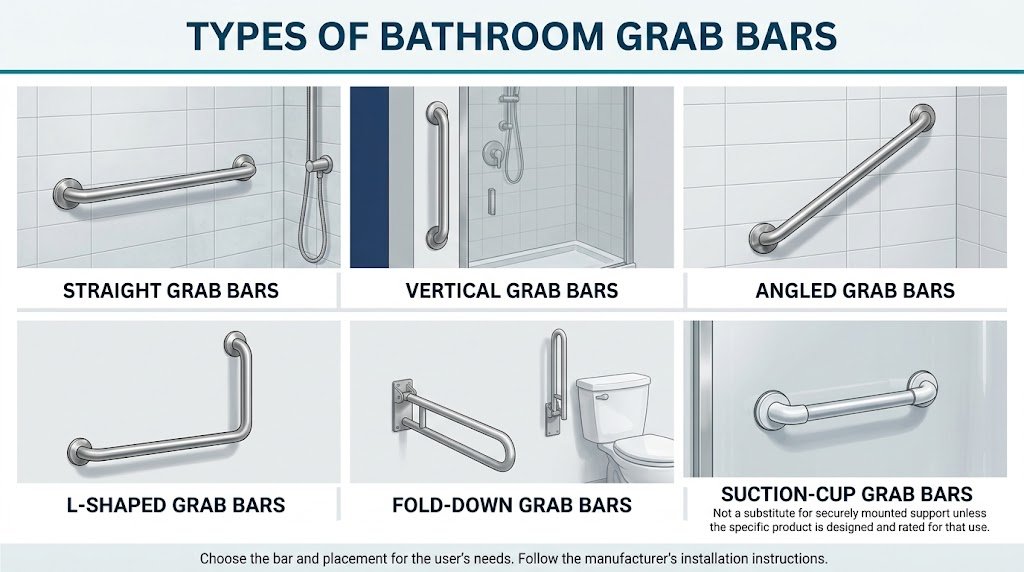
Straight grab bars are simple bars with a continuous gripping surface. Depending on their length and installation position, they may provide support along a shower wall, beside a bathtub, or near a toilet.
A horizontal bar can provide a handhold for someone who needs to steady themselves while standing. A vertical bar may be useful for grasping during a particular movement, depending on the user’s reach and the product’s permitted use.
Choose the length and position based on where the hand needs to land during the movement. The longest bar is not automatically the best option if it obstructs controls, doors, or other necessary clearances.
Angled, L-shaped, and multi-grip grab bars
Angled grab bars provide a gripping surface that follows a diagonal direction. Some people may find this arrangement useful for a particular transfer or movement, but suitability depends on individual strength, reach, and technique.
L-shaped grab bars combine horizontal and vertical sections. They can offer more than one gripping direction in a compact area, which may be helpful when a person needs support while changing position.
Multi-grip designs provide different handhold positions. Check that you can comfortably reach each gripping section and that the bar’s design suits the specific movement or support you need.
Bar shape alone does not determine safety. The product must be appropriate for the intended use and installed according to its instructions.
Fold-down and flip-up grab bars
Fold-down or flip-up grab bars can be moved out of the way when they are not needed. They may be considered beside a toilet or in layouts where a fixed horizontal bar would obstruct access.
These bars are particularly dependent on correct mounting because their support function relies on the strength of the complete assembly and its attachment points. The wall must be suitable for the selected product, and the bar must lock or remain in its intended position as specified by the manufacturer.
Check the available space before installation. The raised and lowered positions should not interfere with transfers, doors, or other bathroom fixtures.
Wall-mounted grab bars
Wall-mounted grab bars are attached to a wall using a mounting system designed for the product and the wall construction. They are commonly used where dependable, fixed support is needed.
The term describes the attachment method rather than the bar’s shape. Straight, angled, and L-shaped bars can all be wall-mounted.
Before buying one, confirm how it must be anchored. Some installations require fastening into studs or suitable reinforcement. Others may use a mounting system specifically designed and approved for a particular wall assembly. Ordinary drywall anchors or adhesive should not be assumed suitable for a body-weight-support grab bar.
Suction cup grab bars and their limitations
Suction cup grab bars attach to compatible surfaces using suction rather than conventional structural fasteners. Some are marketed as temporary balance aids, but their permitted use depends on the specific product.
A suction cup bar should not automatically be treated as a replacement for a securely mounted grab bar. Its hold depends on the surface, seal, installation conditions, and the manufacturer’s instructions. A cup may lose its seal if the surface is unsuitable, uneven, textured, dirty, or otherwise incompatible.
Before using one, read the product warnings and confirm whether it is intended only for balance assistance or is rated for another specific purpose. Do not use a product to support body weight when its instructions prohibit that use.
Vertical, horizontal, and angled configurations
Grab bars can be positioned vertically, horizontally, or at an angle, depending on the user’s needs and the applicable installation requirements.
- Vertical: May provide a handhold when entering or exiting a bathing area, if positioned within comfortable reach.
- Horizontal: May provide a continuous grip while standing, repositioning, or sitting down.
- Angled: May suit a particular movement or transfer when the user can grip it comfortably and safely.
Grab bar placement and design should be tailored to each person’s mobility, reach, and support requirements. Placement should reflect the movement being supported, the user’s ability to reach and grip the bar, and any applicable product or accessibility requirements.
For guidance on common bathroom hazards beyond grab bars, see the Complete Guide to Bathroom Safety.
4. Where to Place Grab Bars in Your Bathroom
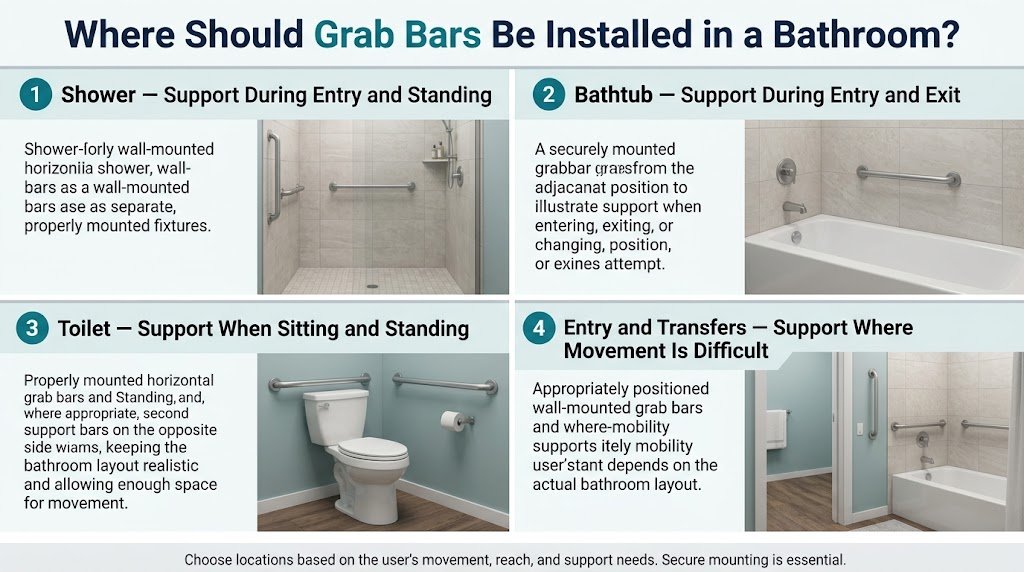
Grab bars should be positioned where a person needs support during a specific bathroom activity. The shower, bathtub, and toilet create different movement requirements, so each location should be assessed separately.
A useful starting point is to observe the movement that causes difficulty. Consider where the person reaches for support, when they need it, and whether the bar can be grasped without stretching or twisting awkwardly.
| Bathroom area | Support task | Placement considerations |
|---|---|---|
| Shower | Standing, repositioning, or entering and exiting | Reach, shower layout, controls, seat location, and available wall support |
| Bathtub | Stepping over the tub edge, sitting, or rising | Tub rim, entry direction, transfer needs, and wall construction |
| Toilet | Sitting down, standing up, or transferring | Reach from the seated position, transfer direction, and available clearance |
These are planning considerations, not universal installation measurements. Exact positions should be determined by the user’s needs, product instructions, wall structure, and any applicable accessibility specifications.
Grab bars in the shower
Shower grab bars are commonly considered for people who need support while entering, exiting, standing, or repositioning. The best location depends on the shower configuration and the movement the user needs to perform.
For example, someone who uses a shower seat may need a bar within reach when moving between standing and sitting. Someone who enters a walk-in shower may need support near the entrance instead.
Before selecting a position, check:
- Whether the bar can be reached without leaning too far.
- Whether it interferes with the shower controls or handheld showerhead.
- Whether a shower seat, door, or enclosure affects access.
- Whether the wall can accommodate the required mounting system.
- Whether the gripping surface remains accessible during the intended movement.
A grab bar should not obstruct the user’s access to controls or create a new obstacle. If the shower layout is complex, a qualified installer or occupational therapist can help assess the arrangement.
Grab bars are one part of a safer bathing routine, but safe entry, careful movement, and a suitable bathing setup also matter. Read our guide to bathing safety for practical advice on preparing the bathing area, bathing safely, and reducing risks for people with limited mobility.
For more bathing-specific guidance, see Shower and Bathtub Safety.
Grab bars around a bathtub
Bathtub grab bars may assist with entering the tub, stepping over its edge, changing position, or getting out. Because a bathtub has a raised rim, the user may need support before stepping in and while moving inside the bathing area.
Consider the direction in which the person enters the tub and where they can comfortably grasp a bar before shifting their weight. A bar located only inside the tub may not provide the support needed during the initial step over the rim.
The arrangement may differ for someone who bathes while seated or uses a transfer bench. Check that the bar does not interfere with the faucet, shower controls, tub enclosure, or the user’s transfer path.
For technical examples, the U.S. Access Board’s bathing-room guidance explains grab-bar arrangements for specific accessible bathtub and shower configurations. These requirements apply within their defined scope; they should not be copied as a universal layout for every private bathroom.
Grab bars beside the toilet
Toilet grab bars can provide a handhold when a person sits down, stands up, or transfers between the toilet and another surface.
The correct arrangement depends on which side the person approaches from, which hand they can use comfortably, and whether they need support on one or both sides. A person transferring from a wheelchair may have different requirements from someone who simply needs help rising from a seated position.
Check that the bar is within reach without forcing the user to twist or lean excessively. It should also leave enough space for clothing management, caregiver assistance when needed, and any mobility equipment.
A raised toilet seat or toilet safety frame can make sitting down and standing up easier, but neither replaces the steady support provided by a properly installed wall-mounted grab bar. Select them according to the person’s needs and the product’s intended use.
For additional guidance on toilet-related risks and support, see Toilet Safety Tips.
Choosing locations based on movement and transfer needs
The most useful placement plan starts with the task rather than the product.
Ask the following questions:
- What movement requires support? Identify whether the difficulty occurs when entering, standing, sitting, turning, or transferring.
- Where does the person naturally reach? Consider comfortable reach and the hand or hands they can use.
- When is support needed? A person may need a handhold before stepping into a tub, not only after entering.
- What could obstruct the movement? Check doors, controls, shower seats, fixtures, and mobility equipment.
- Is the chosen spot suitable for a secure and stable grab bar installation? Confirm the wall construction and installation method before finalizing the plan.
This task-based approach is more useful than choosing a bar based solely on appearance or installing one wherever wall space is available.
For specific guidance on positioning grab bars in showers, bathtubs, and around toilets, see our detailed guide to bathroom grab bar placement.
5. Bathroom Grab Bar Height, Length and Positioning
The appropriate height, length, and orientation of a bathroom grab bar depend on its location, intended use, the user’s reach, and any applicable technical requirements.
A measurement that applies to one accessible toilet or shower configuration may not apply to a bathtub, a different product, or a personalized residential setup. Use published standards for the situations they cover, and assess individual needs when planning a private bathroom.
How high should bathroom grab bars be?
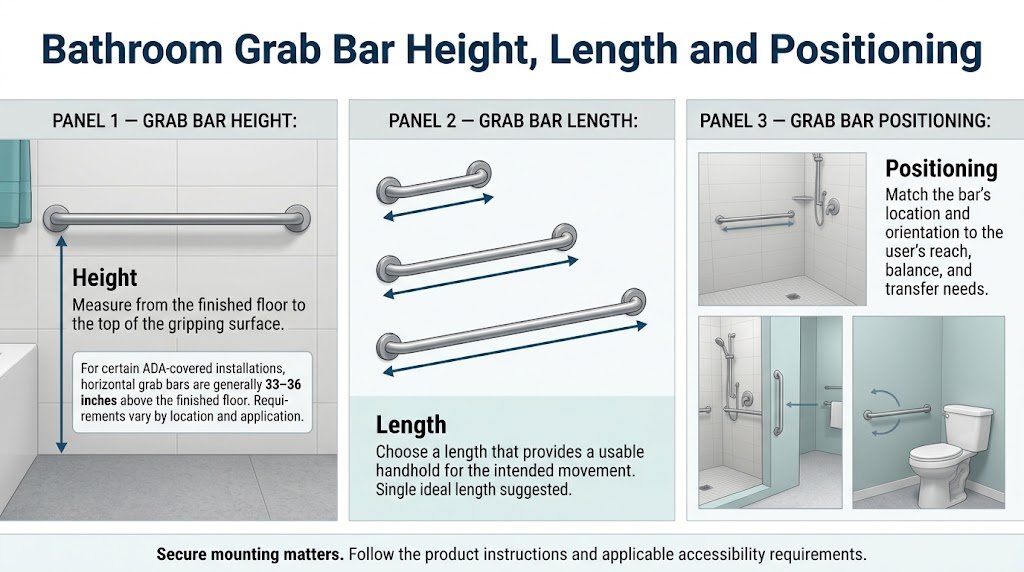
The ideal grab bar height depends on where it will be installed and how it will be used, so one measurement will not suit every bathroom situation.
Under ADA Standard Section 609.4, grab bars in applicable installations are typically mounted horizontally, with the upper surface of the gripping area set 33–36 inches above the finished floor. The standards contain specific provisions and exceptions for certain configurations, including bathtub installations and facilities intended for children.
That range is a technical accessibility specification for the situations covered by the standard—not an automatic recommendation for every residential grab bar.
When planning a home installation, consider the user’s height, reach, posture, transfer technique, and the activity the bar is intended to support. The finished position should allow a comfortable, dependable grip without requiring an awkward reach.
For technical requirements, consult the official ADA Standards, Chapter 6, particularly Sections 607–609 for bathing facilities and grab bars.
Getting the measurements right is an important part of safe grab bar installation. Read our detailed guide to bathroom grab bar height for measurement reference points and height considerations for showers, bathtubs, and toilets.
What Is the Ideal Length for a Bathroom Grab Bar?
The ideal grab bar size is determined by how much space is needed for a secure handhold and the area available for mounting. A bar must be long enough for the intended handhold while fitting the wall and leaving necessary clearances.
Consider these factors:
- Support task: A person who needs to hold the bar throughout a movement may need a longer gripping area than someone who needs a brief handhold.
- User reach: The bar should extend into a position the person can reach comfortably.
- Wall space: The available wall area may limit the length or configuration.
- Obstructions: Controls, fixtures, corners, and door movement may affect the usable space.
- Applicable specifications: Some accessible facilities have minimum lengths and prescribed locations for specific grab bars.
Do not choose a length based only on what looks balanced on the wall. Determine the support task first, then check the manufacturer’s dimensions and any applicable technical requirements.
Horizontal vs. vertical vs. angled positioning
Orientation affects how a person can grasp a bar and apply support. Horizontal bars offer a continuous grip along a level path; vertical bars may offer a handhold during entry or repositioning; angled bars may suit a specific movement when the person can comfortably grip them.
The appropriate orientation depends on the task, user, and installation context. Avoid assuming that one orientation is universally safer than another.
MedlinePlus advises that bathroom safety bars be secured vertically or horizontally rather than diagonally. For a particular installation, follow the relevant accessibility provisions and the manufacturer’s instructions instead of treating general descriptions as a substitute for technical guidance.
Where the user has difficulty gripping or reaching, an occupational or physical therapist can help evaluate whether the proposed orientation matches the person’s movement.
Grip diameter, wall clearance, and reach
A grab bar should be comfortable to hold and provide sufficient clearance for the hand. The gripping surface should also be free from sharp edges or abrasive features that could injure the user.
The ADA Standards specify cross-section and clearance requirements for grab bars in covered installations. For example, Section 609.2 addresses acceptable cross-sections, while Section 609.3 addresses spacing between the bar and the wall or nearby objects.
When choosing a product, consider:
- Whether the diameter or shape allows the user to maintain a comfortable grip.
- Make sure there is enough clearance between the grab bar and the wall to fit your hand comfortably.
- Whether nearby fixtures interfere with gripping or movement.
- Whether the finish remains usable when wet, in accordance with the product’s specifications.
- Whether the bar’s position allows the intended movement without excessive stretching or twisting.
A product can have the right length but still be unsuitable if its grip is uncomfortable or surrounding fixtures prevent the user from holding it properly.
6. How to Choose the Right Bathroom Grab Bars
Choosing bathroom grab bars involves matching the user’s support needs to the product’s shape, length, grip, and mounting requirements. The best option is not necessarily the largest or most expensive bar; it is the one that suits the intended task and can be installed appropriately.
Choose based on the support task and user’s mobility
Start by identifying the movement the bar should assist with. Someone who needs a handhold while standing in a shower may need a different arrangement from someone who has difficulty rising from the toilet.
Consider whether the person can stand independently, grip with one or both hands, reach comfortably, and transfer between surfaces. Also consider whether a caregiver or mobility aid must fit into the space.
For significant mobility limitations, professional assessment can help determine the most appropriate configuration. The grab bar should be positioned to accommodate the user’s natural movements without forcing them into awkward or potentially hazardous positions.
Select the right bar shape, length, and grip
Once the support task is clear, compare bar shapes and gripping surfaces.
A straight bar may suit a simple support point, while an L-shaped bar may provide two gripping directions. A fold-down model may be appropriate where a movable support is useful and the wall can accommodate its mounting requirements.
Check the length, grip dimensions, finish, and available space. The user should be able to grasp the bar comfortably, and the installation should not obstruct essential bathroom functions.
If the person has limited hand strength or difficulty grasping conventional shapes, seek guidance before choosing a design. A product’s visual design alone does not determine whether it meets your specific needs.
Compare materials, finishes, and wet-area suitability
Bathroom grab bars come in a range of materials and surface finishes to suit different bathroom styles and needs. When comparing them, consider durability, corrosion resistance, grip comfort, cleaning requirements, and compatibility with the intended location.
A finish that looks attractive may not be the easiest for a particular user to grip. Likewise, a product suitable for a dry area may not be appropriate for a wet shower environment unless its documentation confirms that use.
Review the manufacturer’s specifications for the intended installation location, permitted cleaning products, and maintenance requirements. Do not assume that every metal, coating, or textured finish performs identically.
Check wall construction and mounting compatibility
Confirm how the bar will attach before purchasing it. Wall construction can include tiled surfaces over framing, fiberglass surrounds, drywall, masonry, or other assemblies. Each may require a different installation approach.
The important question is not simply whether the bar can be attached to the visible surface. It is whether the mounting system can transfer the expected forces safely to an appropriate supporting structure.
Check the manufacturer’s installation instructions, required fasteners, mounting locations, and any reinforcement requirements. If the wall construction is unknown or the installation involves concealed plumbing or electrical wiring, have it assessed before drilling.
Consider bathroom space, reach, and obstructions
The bar must fit the bathroom without blocking doors, controls, shower seats, or transfers. Its position should also allow the user to reach it when support is needed.
Measure the available area and consider the user’s movements before finalizing the selection. In smaller bathrooms, choose a grab bar arrangement that offers dependable support without restricting access for mobility equipment or leaving too little room for a caregiver to help.
A practical five-step selection checklist
- Identify the movement that requires support.
- Determine the best location for the handhold.
- Choose a suitable shape, length, and grip.
- Confirm wall construction and mounting compatibility.
- Verify that the finished position is accessible and unobstructed.
Checking the wall, mounting area, and product specifications beforehand reduces the risk of buying a grab bar that cannot be safely installed in the intended location.
Grab bars are just one option for improving bathroom safety. Explore our guide to essential bathroom safety products to learn about other helpful aids, including shower chairs, transfer benches, raised toilet seats, non-slip products, and bathroom night lights.
7. How Are Bathroom Grab Bars Installed Securely?
Bathroom grab bars must be installed according to the product’s instructions and the requirements of the wall assembly. A secure installation depends on the supporting structure, appropriate fasteners, correct placement, and proper workmanship—not simply on how firmly the bar feels when first touched.
Because an installation failure can result in injury, seek qualified help if the wall construction, mounting requirements, or concealed services are uncertain.
Why wall support and correct anchoring matter
When a person grips a grab bar, the forces applied to it are transferred through the mounting points into the wall. If the fasteners or supporting structure are inadequate, the bar may loosen or pull away.
For this reason, grab bars intended for body-weight support should use a mounting system suitable for the product and wall assembly. A product’s load rating does not guarantee that any installation will safely support that load.
Before work begins, identify the wall construction, locate the required mounting points, and check the manufacturer’s specified fasteners and installation method. The installer should also confirm that the chosen location is clear of concealed plumbing and electrical services.
Installing grab bars on tile, fiberglass, drywall, and other wall types
The visible surface does not always reveal what supports it. Tile may cover a framed wall, while a fiberglass surround may be part of a larger assembly. Drywall may conceal studs or reinforcement, and masonry requires a different fastening approach.
The installation method must account for both the surface and the structure behind it.
- Tile: Drilling must avoid cracking the tile, and the mounting system must anchor appropriately into the supporting structure or an approved reinforcement system.
- Fiberglass surrounds: Confirm the product and wall assembly are compatible with the required support and fastening method. A thin surround should not automatically be treated as structural support.
- Drywall: Ordinary drywall alone should not be assumed sufficient for a body-weight-support grab bar. The installation may require studs, reinforcement, or a mounting system specifically approved for the assembly.
- Masonry or other wall types: Use fasteners and procedures suited to the actual material and the product’s instructions.
These are general planning principles, not instructions for every possible wall. If a secure attachment cannot be confirmed, use a qualified installer rather than improvising with unsuitable anchors or adhesive.
Do bathroom grab bars need to be installed into studs?
Not every approved installation uses the same fastening arrangement, but a grab bar intended to support body weight must be anchored to a structure or mounting system designed for that purpose. Standard drywall anchors should not be assumed adequate.
Depending on the wall assembly and product, secure mounting may involve wall studs, properly installed reinforcement, or a specialized mounting system approved for the specific application.
Before installation, verify the manufacturer’s requirements and the construction behind the finished wall. If the intended mounting points do not align with suitable support, the installer may need to add reinforcement or select a compatible alternative.
The key requirement is a secure, appropriate structural attachment—not simply fastening the bar to whatever surface is easiest to drill.
When reinforcement, specialized mounting systems, or professional installation may be needed
Reinforcement may be necessary when the existing wall cannot provide the required attachment points at the desired location. This can arise during a bathroom renovation, when installing a bar on a particular wall assembly, or when the user’s support needs require a position that lacks suitable backing.
Specialized mounting systems may be appropriate in certain installations, but their suitability must be confirmed for the particular product, wall construction, and intended use.
Consider professional installation when:
- The wall construction or location of reinforcement is unknown.
- Tile, fiberglass, or another finished surface makes mounting more complex.
- Plumbing or electrical wiring may be concealed behind the intended location.
- The installation must meet a particular accessibility specification.
- The user depends heavily on the bar for transfers or body-weight support.
An occupational or physical therapist may help assess the placement, while a qualified installer can assess the wall and mounting requirements. These roles are complementary: correct positioning and correct structural installation are both important.
Installation mistakes to avoid
Common mistakes include:
- Mounting a body-weight-support bar to an unsuitable surface.
- Using fasteners that do not match the wall assembly or manufacturer’s instructions.
- Drilling without checking for concealed plumbing or electrical wiring.
- Positioning the bar where the user cannot reach it comfortably.
- Blocking shower controls, transfers, doors, or other necessary clearances.
- Assuming a bar is secure because it feels firm during a quick initial check.
- Substituting a towel rack or decorative handle for a purpose-designed grab bar.
Before installation, use the manufacturer’s instructions and a reliable installation guide, such as The Home Depot’s grab-bar installation guide, as planning references. The exact mounting procedure must still match the selected product and wall.
8. Are Suction Cup Grab Bars Safe?
Suction cup grab bars can be useful for certain limited purposes when the product is designed for that use and attached to a compatible surface. However, they should not automatically be treated as equivalent to securely anchored grab bars intended for body-weight support.
Their suitability depends on the specific product’s instructions, surface compatibility, installation conditions, and stated limitations.
How suction cup grab bars attach to a surface
Suction cup models use one or more cups to create a seal against a surface. When the seal is maintained under the conditions specified by the manufacturer, it holds the device in place.
Unlike a conventionally anchored grab bar, a suction cup model does not necessarily transfer forces into a wall’s structural framing. Its hold depends on the suction mechanism and the surface to which it is attached.
That difference is important when deciding whether the product is appropriate for a particular bathroom task.
Why surface condition and product limitations matter
Suction cup products may require a smooth, flat, nonporous surface. Textured tile, grout lines, uneven finishes, dirty surfaces, or incompatible materials can prevent a reliable seal.
Even on a compatible surface, the product must be installed and checked according to its instructions. Conditions that affect the seal may compromise the hold.
Read the manufacturer’s directions for permitted surfaces, installation, inspection, and intended use. Do not assume that a product is suitable for every shower wall simply because its cups attach during an initial test.
When not to rely on a suction cup bar for body-weight support
Do not rely on a suction cup bar for body-weight support when the manufacturer identifies it only as a balance aid or prohibits that use. If the user depends on a bar to support a transfer, steady a substantial shift in weight, or prevent a fall, a suitable, securely mounted grab bar may be necessary.
A suction cup product that loses its seal can detach unexpectedly. If a person relies heavily on the grab bar for stability, an unexpected failure could put their safety at significant risk.
Always follow the specific product’s warnings. If the intended use is unclear, contact the manufacturer or choose a product whose approved purpose and installation requirements are appropriate for the user’s needs.
What to consider when a securely mounted bar is needed
When dependable structural support is required, evaluate a grab bar designed for that purpose and a mounting system compatible with the wall.
Confirm the following before choosing the product:
- The bar is intended for the required type of support.
- The mounting system is appropriate for the wall construction.
- The position matches the user’s reach and movement.
- The installation instructions can be followed correctly.
- The completed installation can be checked and maintained.
Suction cup products should be judged by their specific intended use, not by their appearance or the general label “grab bar.”
9. Choosing Bathroom Grab Bars for Older Adults and Individuals With Mobility Challenges
Properly selected bathroom grab bars can give older adults and individuals with mobility challenges extra stability when carrying out everyday bathroom activities. However, age alone does not determine which bar is appropriate. Individual strength, balance, reach, grip, and transfer ability are more useful considerations when planning placement.
Grab bars for older adults who need help with balance
An older adult who feels unsteady while entering a shower or standing near a bathtub may benefit from a suitably positioned grab bar. The right arrangement depends on when support is needed and whether the person can grasp the bar comfortably.
A bar should be placed where the user can reach it without excessive leaning or twisting. It should also be securely installed for its intended use.
Grab bars are one part of bathroom fall-risk reduction. They do not replace other measures that may be necessary, such as keeping floors dry, improving lighting, removing obstacles, or using appropriate bathing equipment.
Grab bars for sitting, standing, and transfers
Different movements can require different support arrangements.
Someone who has difficulty rising from a toilet may need a handhold that can be reached while seated and used during the transition to standing. A person transferring from a wheelchair may need a different configuration that accommodates the direction of movement and available clearance.
For bathing, a shower chair or transfer bench may reduce the need to remain standing, while a grab bar may provide a handhold during repositioning or transfer. Each aid has a different function, and the combination should reflect the person’s abilities and bathroom layout.
Do not assume that one bar configuration will work equally well for every movement.
Adapting bar placement to reach, grip, and mobility
A useful assessment considers the user’s actual movement rather than relying on age-based assumptions.
Consider:
- Which hand or hands the person can use comfortably.
- Whether the person can grip a conventional bar.
- Whether support is needed while standing, sitting, turning, or transferring.
- Whether a wheelchair, walker, shower seat, or caregiver affects available space.
- Whether the proposed location allows a comfortable reach without awkward movement.
A bar that is technically installed but difficult for the user to reach may provide little benefit. When the person’s needs are complex or changing, an individualized assessment can help identify an appropriate arrangement.
When to seek an occupational or physical therapy assessment
Consider asking a healthcare provider for an occupational or physical therapy referral when the right bathroom modifications are uncertain, the person has difficulty with transfers, or existing supports do not seem to meet their needs.
An occupational therapist may assess daily activities and the bathroom environment. A physical therapist may help evaluate movement, balance, strength, and transfer techniques. Their recommendations can help determine where support is needed and whether additional equipment may be appropriate.
For broader home-safety planning, MedlinePlus guidance on bathroom safety recommends seeking a healthcare provider’s referral to occupational or physical therapy when someone is unsure which modifications are needed.
10. How to Check and Maintain Bathroom Grab Bars
After installation, bathroom grab bars should be checked according to the manufacturer’s instructions and whenever there is reason to suspect a problem. Regular attention to visible condition and mounting stability can help identify issues before the bar is relied on again.
Check for movement, loose hardware, and visible damage
Look for visible signs that the bar or its mounting points may have changed. These include loose fasteners, movement at the mounting flanges, damaged components, or a bar that appears to have shifted.
If the bar moves, loosens, or shows signs of mounting failure, stop relying on it until the problem has been assessed and corrected. Do not try to compensate by gripping harder or placing additional weight on it.
Any repair should follow the manufacturer’s requirements and account for the condition of the wall and fasteners. Simply tightening a screw may not resolve a damaged or inadequate mounting point.
Inspect the grip surface, finish, and surrounding wall
Check the gripping surface for damage, corrosion, sharp edges, or changes that could make it harder to hold. Also inspect the surrounding wall for cracking, water damage, loose tile, or other signs that could affect the installation.
Clean the bar according to the manufacturer’s instructions. Avoid cleaning methods or products that could damage the finish or interfere with the intended grip surface.
If the wall or mounting components show deterioration, have the installation assessed before continuing to rely on it.
Follow the manufacturer’s maintenance and inspection instructions
There is no single inspection schedule that applies to every grab bar, mounting system, and wall assembly. Follow the manufacturer’s recommendations and pay attention to the product’s condition and the bathroom environment.
A simple maintenance record can help track visible damage, repairs, or changes in the wall. Any movement or suspected failure should prompt an immediate assessment rather than waiting for the next routine check.
11. Bathroom Grab Bar Safety Checklist
Use this checklist to organize decisions before purchasing a bar, preparing for installation, and checking the completed setup. It complements the detailed guidance above rather than replacing product instructions or professional assessment.
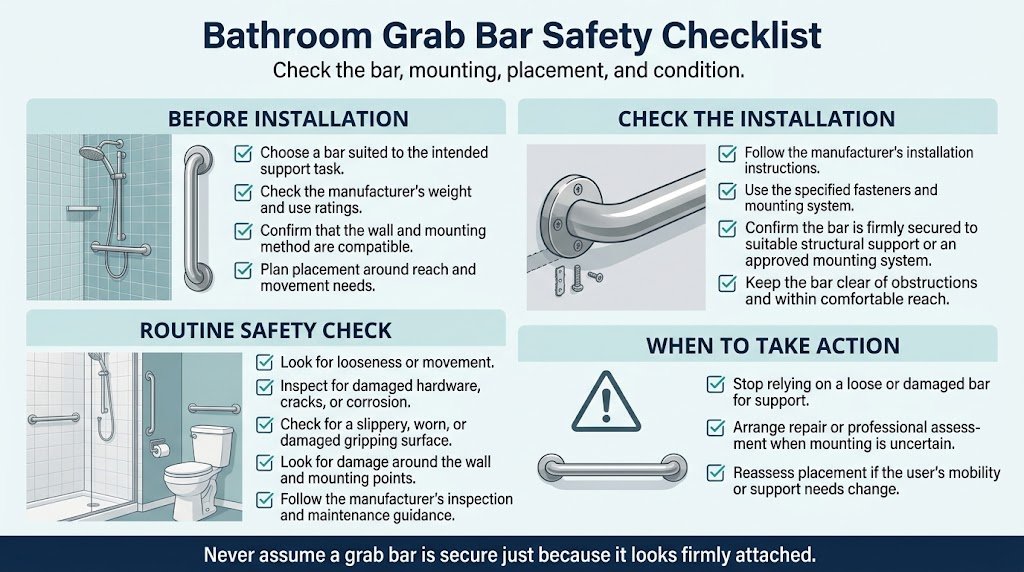
Before choosing a grab bar
- Identify the movement that requires support.
- Decide whether the bar is intended for a shower, bathtub, toilet, or transfer area.
- Consider the user’s reach, grip, strength, and mobility.
- Choose a suitable bar shape, length, and gripping surface.
- Confirm that the product is intended for the required type of support.
- Check the wall construction and the product’s mounting requirements.
- Consider controls, doors, seats, mobility aids, and other obstructions.
Before and after installation
- Confirm the proposed position is suitable for the intended movement.
- Check for concealed plumbing and electrical services before drilling.
- Verify that the specified fasteners and mounting system are appropriate.
- Follow the manufacturer’s installation instructions.
- Confirm that the finished installation does not obstruct necessary clearance.
- Inspect for movement, loose hardware, damaged surfaces, or other visible problems.
- Follow the manufacturer’s maintenance and inspection instructions.
When to arrange a professional assessment
Seek qualified assistance when the wall construction is uncertain, the mounting requirements cannot be confirmed, or the installation involves complex surfaces or concealed services.
An occupational or physical therapist may also be helpful when the user’s mobility, reach, or transfer needs make placement difficult to determine. If an installed bar moves or appears damaged, stop relying on it until the issue has been assessed and corrected.
For a wider room-by-room review, use the Bathroom Safety Checklist alongside this grab-bar-specific list.
12. FAQs
Can bathroom grab bars be installed on tile?
Yes, bathroom grab bars can be installed on tiled walls when the installation method is appropriate for the tile and the supporting wall structure. The installer must use a suitable method for drilling the tile without damaging it and secure the bar according to the product’s instructions. Tile alone should not automatically be treated as sufficient structural support.
Are grab bars useful if someone can still walk independently?
They may be useful for someone who walks independently but needs extra support during specific bathroom activities, such as stepping into a bathtub or standing up from the toilet. The decision should be based on the person’s balance, strength, reach, and actual movement needs rather than walking ability alone.
Can a grab bar be installed without drilling?
Some products attach using suction cups or other nontraditional mounting methods, but their permitted uses and limitations vary. A suction cup product should not be assumed suitable for body-weight support. If a securely anchored bar is required, choose a product and mounting system designed for the wall assembly and intended use.
How do I know if an installed grab bar is secure?
Start by checking the installation against the manufacturer’s instructions and looking for movement, loose hardware, damaged mounting points, or deterioration in the surrounding wall. A quick hand test alone cannot establish the capacity of the complete assembly. If the bar moves or its structural attachment is uncertain, stop relying on it and arrange an appropriate assessment.
Are bathroom grab bars required in every home?
There is no universal rule requiring grab bars in every private home. Requirements depend on the applicable laws, building standards, property type, and circumstances. The ADA Standards establish requirements for covered facilities and include specific provisions for residential dwelling units; they should not be interpreted as a blanket requirement for every home. Even where installation is not legally required, grab bars may be useful when a person’s mobility or support needs warrant them.
13. Conclusion
Bathroom grab bars can provide a useful handhold during showering, bathing, toileting, and transfers, but choosing the right product requires more than comparing shapes or finishes. The bar must suit the user’s movement, fit the available space, and be mounted securely using a system appropriate for the wall and intended support.
Start by identifying where support is needed. Then choose a suitable configuration, confirm the height and length requirements, and check the installation method before purchasing or drilling. Treat suction cup products according to their specific instructions, and seek professional help when placement, mobility needs, or wall construction is uncertain.
A well-planned grab-bar installation can form an important part of a safer, more accessible bathroom. The goal is to provide support where the person needs it, without introducing new obstacles or relying on a mounting system that is not suitable for the task.
5 Comments