
1. Introduction
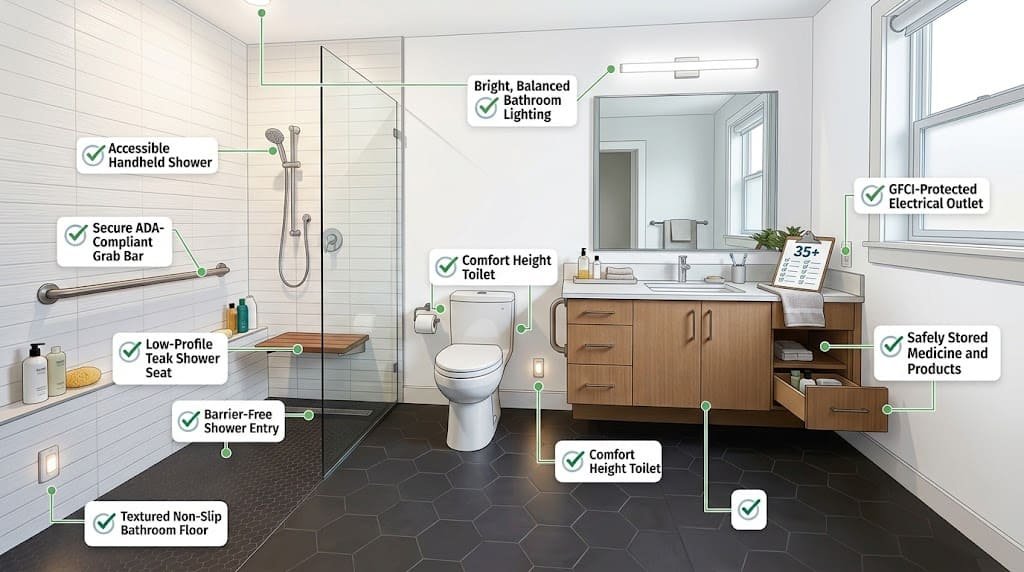
A bathroom safety checklist helps you inspect the room for hazards before they cause a slip, fall, burn, electrical injury, or other preventable accident. A truly safe bathroom goes beyond installing grab bars or laying down a nonslip mat; it should be designed so everyone can enter, move around, use the fixtures, and leave with confidence and minimal risk.
Use this checklist as a simple walkthrough:
Check → Identify → Prioritize → Fix → Recheck.
The process works for a typical household bathroom and can also be adapted for children, older adults, and people with limited mobility. Start by checking the bathroom’s floors, bathing area, toilet, lighting, water temperature, electrical setup, storage, and access to emergency exits or assistance.
A bathroom safety checklist helps you inspect the room systematically, identify hazards, and determine which changes should be made first. If you want a broader overview of bathroom hazards, prevention strategies, and safety modifications, start with our complete guide to bathroom safety before working through this checklist.
Table of Contents
2. Quick Bathroom Safety Checklist
Use this quick bathroom safety checklist for home before moving into the more detailed inspection. Check each item that applies to your bathroom, then address problems according to their level of risk.
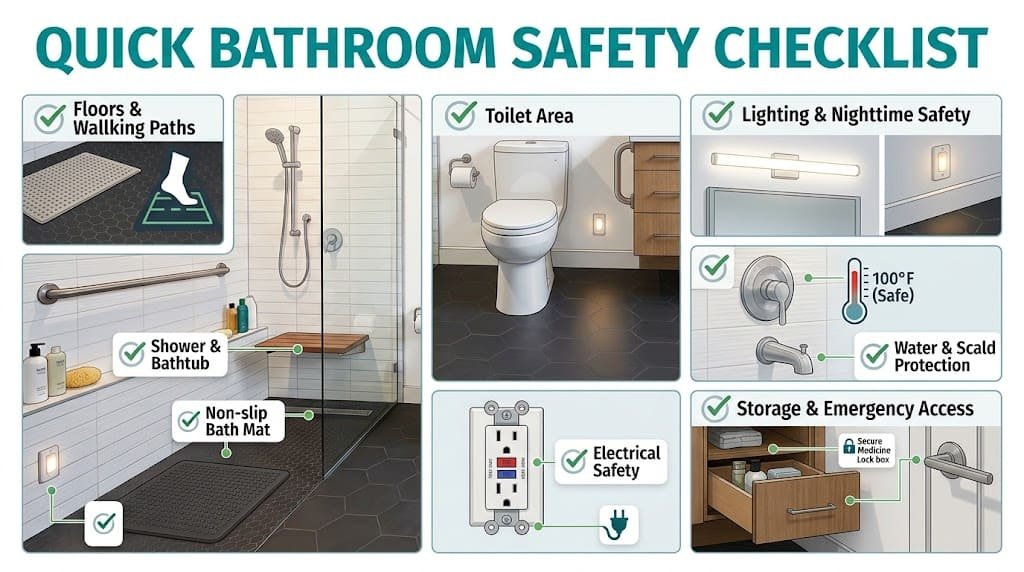
Floors and walking paths
- ☐ Floors are dry and reasonably clear.
- ☐ There are no loose, curling, or unsecured rugs.
- ☐ Clutter is not blocking walking paths.
- ☐ Cords are not crossing areas where someone walks.
- ☐ Flooring is in good condition without significant damage or uneven areas.
- ☐ The entrance and threshold can be crossed safely.
Moisture, loose items, and clutter on the bathroom floor can easily turn a routine walk into a slip or trip. If someone is more vulnerable to falls, keeping floors dry and pathways unobstructed is a simple but important step toward creating a safer bathroom.
Shower and bathtub
- ☐ The tub or shower floor provides secure footing.
- ☐ Getting into and out of the tub or shower can be done safely.
- ☐ Appropriate support is available where needed.
- ☐ A shower chair or bench is used when appropriate for the person’s needs.
- ☐ Everyday toiletries such as soap and shampoo are positioned within easy reach, so you do not need to overreach, bend, or twist awkwardly.
For someone with poor balance, limited strength, or difficulty moving safely, getting into and out of a shower or bathtub can become challenging. MedlinePlus recommends measures such as nonslip surfaces, keeping the area outside the tub or shower dry, and using a bath chair or bench when appropriate.
Toilet area
- ☐ Sitting down and standing up feel stable.
- ☐ Support is available if the user needs it.
- ☐ The toilet height allows the user to sit down and stand up comfortably and safely.
- ☐ The area surrounding the toilet is free of obstructions and provides ample room to move safely.
- ☐ Nothing requires the user to twist, reach, or step around an obstacle during a toilet transfer.
For a person who struggles to lower onto or rise from a standard toilet, a raised toilet seat can reduce the distance involved in the transfer and make getting on and off easier. The best option will depend on the individual’s mobility needs, available support, and the layout of the bathroom.
Lighting and nighttime safety
- ☐ The bathroom is adequately illuminated.
- ☐ The shower, bathtub, and toilet area are all clearly visible and unobstructed.
- ☐ The nighttime route from the bedroom to the bathroom has enough lighting for safe, clear movement.
- ☐ Light switches are easy to reach.
Poor lighting can make bathroom hazards much more difficult to notice and avoid. The CDC recommends adequate lighting and accessible switches as part of home fall prevention, particularly for older adults.
Water and scald protection
- ☐ Hot-water temperature has been reviewed.
- ☐ Faucets operate properly.
- ☐ Water temperature is easy to adjust to a safe, comfortable level.
- ☐ Anti-scald protection is considered where appropriate.
For safer bathroom water temperatures, MedlinePlus advises keeping the household water heater at 120°F (49°C) or below. This lower setting can help reduce the risk of hot-water scalds, particularly for children, who are more vulnerable to burns from overheated water.
Electrical safety
- ☐ GFCI protection is present where required.
- ☐ GFCI devices are tested according to the manufacturer’s instructions.
- ☐ Electrical devices are placed well away from sinks, tubs, showers, and other sources of water.
- ☐ Remove any appliance or cord that shows signs of damage before using it again.
- ☐ Electrical devices are positioned securely away from sinks, bathtubs, and showers to prevent them from falling into water.
Bathrooms combine electricity with moisture, so electrical problems deserve prompt attention. The CPSC recommends GFCI protection in potentially damp locations such as bathrooms and advises consumers to have an electrician inspect outlets or switches that become unusually warm or hot.
Storage and emergency access
- ☐ Everyday bathroom essentials are stored within easy reach.
- ☐ Medicines and potentially harmful chemicals are stored appropriately.
- ☐ The bathroom entrance remains clear.
- ☐ Doors and pathways do not create unnecessary obstacles.
- ☐ Make sure anyone who falls or cannot get up can quickly alert someone for assistance.
Bathroom storage should place frequently used items where they can be reached comfortably without climbing, excessive bending, or awkward stretching. If children use the bathroom, keep medications, cleaning supplies, and other hazardous products securely out of their reach rather than relying on standard bathroom cabinets.
3. How to Perform a Bathroom Safety Inspection
A bathroom safety inspection should focus on real-life movement, not just the presence of safety equipment. Follow the normal path through the room from entry to exit and pay attention to anything that makes a person reach too far, step awkwardly, turn excessively, maintain balance, or move between surfaces with difficulty.
Start at the bathroom entrance
Begin before entering the room. Check the:
- Doorway
- Threshold
- Floor
- Walking path
- Lighting
- Nighttime route
Ask a simple question: Could someone enter this bathroom safely without stepping around an unexpected obstacle or losing their balance?
Then continue toward the fixtures. Look for anything that becomes a problem when the floor is wet, the room is dark, or the person is carrying something.
Follow the user’s normal movements
A useful bathroom safety assessment follows the person’s actual movements:
Entering → turning → sitting → standing → bathing → reaching → exiting
For example, a shower can have a slip-resistant surface yet still be unsafe if getting in requires stepping over a tall tub wall. Similarly, a toilet may be perfectly functional but challenging to use when there isn’t enough room to maneuver a walker comfortably.
This movement-based approach helps identify hazards that a simple visual inspection can miss.
Record problems and assign a priority
Once you identify a problem, decide how urgently it needs attention.
| Finding | Priority |
|---|---|
| Immediate electrical, drowning, scald, or serious injury hazard | Fix now |
| Increased fall or transfer difficulty | Fix soon |
| Convenience or accessibility improvement without an immediate hazard | Improve as needed |
This prevents the inspection from becoming just a list of observations. The goal is to turn each finding into an appropriate next step.
4. Bathroom Hazard Checklist: How to Spot Safety Risks
A useful bathroom hazard checklist should cover more than falls. MedlinePlus identifies falls, fainting, and burns among the main bathroom-safety threats, while other hazards can involve electricity, children, visibility, and unsafe transfers.
Slip and trip hazards
Look for:
- Wet floors
- Loose rugs or mats
- Clutter
- Electrical cords
- Uneven flooring
- Difficult thresholds
- Items left where someone needs to walk
Do not assume that a bathroom is safe simply because it has a nonslip mat. The entire route from the doorway to the shower, tub, toilet, and sink should remain clear and reasonably secure.
For older adults and people with a higher fall risk, CDC guidance emphasizes removing trip hazards, improving lighting, and using appropriate grab bars in bathrooms.
Fall and transfer hazards
Consider how difficult it is to:
- Step over the tub wall
- Get into or out of the shower
- Move safely when lowering onto or rising from the toilet
- Turn around in a confined area
- Reach for a towel or control
- Maintain balance while entering or exiting
A support device should not be treated as a universal solution. Grab bars, for example, need to be appropriate for the user’s needs and securely installed. A towel rack should not be treated as a grab bar because it is not designed to provide weight-bearing support.
Burn and scald hazards
Check for:
- Excessively hot water
- Unexpected temperature changes
- Hot-water controls that are difficult to operate
- Faucets that can be reached by young children
- Lack of appropriate anti-scald protection
For residential bathroom safety, MedlinePlus recommends a water-heater setting of no more than 120°F (49°C). This does not mean every faucet will necessarily deliver water at exactly that temperature, so the actual water temperature and the home’s plumbing controls should also be considered.
For young children, extra caution is important because they have less tolerance for hot water and may be unable to move away quickly from a hot stream.
Electrical hazards
Check for:
- Electrical appliances being used close to water
- Damaged cords or plugs
- Missing or malfunctioning GFCI protection
- Appliances positioned where they could fall into a sink or tub
- Electrical equipment being handled with wet hands
Do not try to solve an electrical defect with a temporary workaround. If an outlet, switch, wiring condition, or GFCI appears defective, have the issue evaluated by a qualified electrician.
The CPSC specifically warns against using portable electric heaters in bathrooms because of the electrocution hazard associated with electricity and water.
Visibility and nighttime hazards
Check whether:
- The bathroom is adequately lit.
- The toilet and shower area remain clearly visible and easy to navigate.
- The floor is visible without significant shadows.
- The route from the bedroom to the bathroom is illuminated at night.
- Light switches are accessible before the person enters a dark area.
Nighttime safety is especially important for someone who may wake suddenly and have difficulty with balance, vision, or orientation. Good lighting does not eliminate a physical hazard, but it can make hazards easier to identify and navigate around.
For a deeper look at the risks you may find during an inspection, see our guide to common bathroom safety hazards and how to recognize them.
5. Bathroom Safety Checklist for Children
A bathroom safety checklist for children needs to go beyond fall prevention. Young children can face drowning, scalding, poisoning, and electrical risks because they may not recognize hazards or react quickly enough to them.
Prevent drowning and unsupervised water access
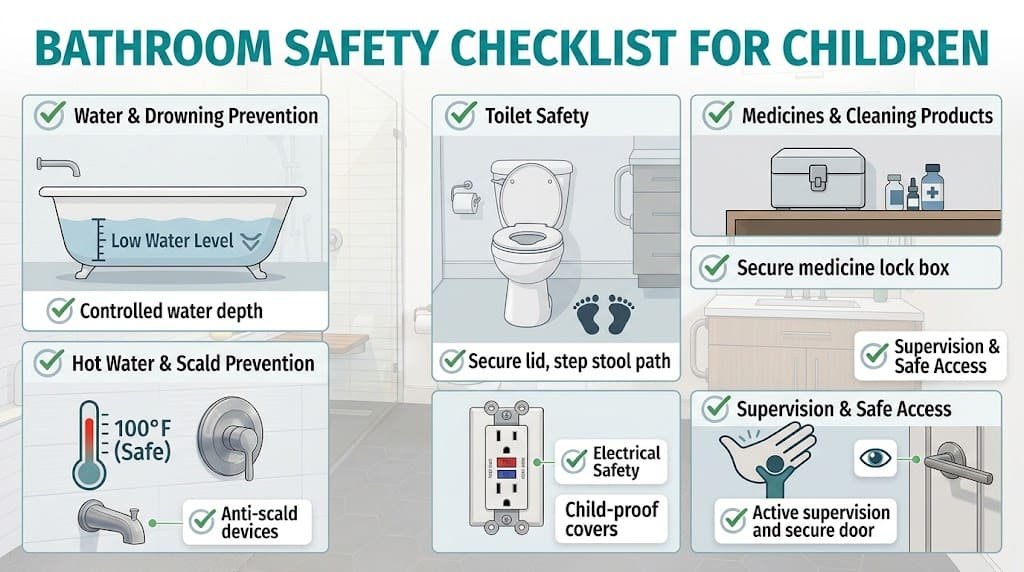
Check that:
- A young child is never left alone in a bath.
- The bathtub is emptied after use.
- Bathroom access can be restricted when appropriate.
- Toilet access is considered when childproofing the room.
- Bathing supplies are within the supervising adult’s reach before bathing begins.
The American Academy of Pediatrics states that young children should never be left alone in the bath, even briefly, and that bath seats and rings do not prevent drowning when a child is left unattended.
For toddlers, the bathroom itself can also be an access concern. HealthyChildren.org recommends measures such as an adult-height door latch when appropriate and toilet-seat locks as an additional childproofing measure.
Prevent burns, poisoning, and electrical injuries
Check that:
- Hot-water settings are appropriate.
- Medicines are kept out of a child’s reach and secured as appropriate.
- Cleaning products and other harmful substances are locked away or otherwise inaccessible.
- Hair dryers, curling irons, and similar electrical items are unplugged and safely stored when not in use.
- Appropriate childproof latches are used where needed.
MedlinePlus specifically recommends keeping medicines in locked storage and keeping potentially dangerous bathroom items, including electrical devices and cleaning products, out of children’s reach.
For a more detailed child-focused approach, see our bathroom safety guide for children, which covers drowning prevention, scalds, electrical hazards, medications, and other risks parents should address.
6. Bathroom Safety Checklist for Seniors and People With Limited Mobility
A bathroom safety checklist for seniors should focus heavily on transfers, balance, visibility, and the ability to use fixtures without unnecessary physical strain. The same principles can also help adults who use a walker, wheelchair, cane, or other mobility aid.
Check transfers first
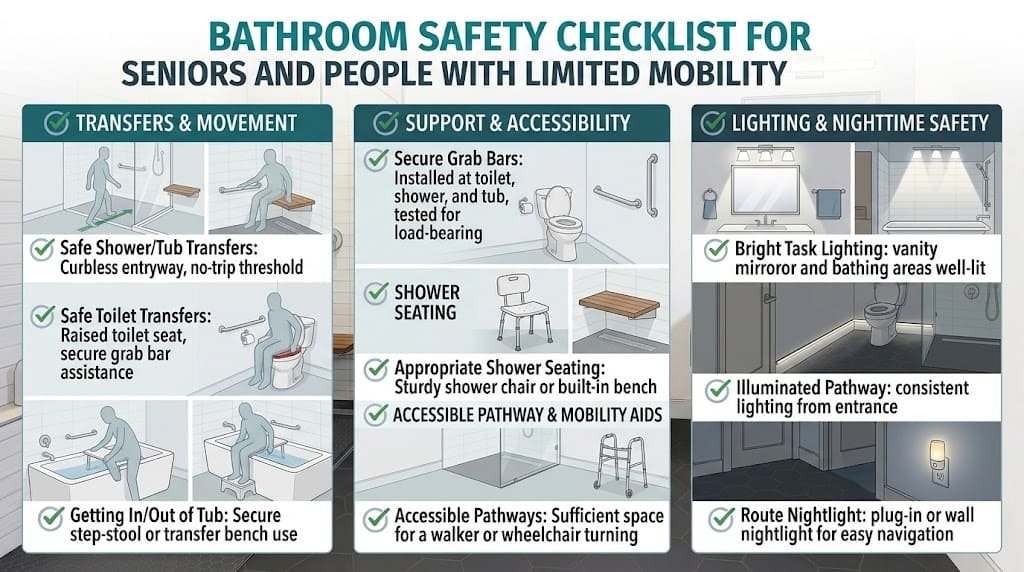
Evaluate:
- Entering and leaving the shower or bathtub safely
- Sitting down and standing up from the toilet
- Standing balance
- Turning within the bathroom
- Maneuvering a walker or wheelchair
- Being able to reach bathroom controls and fixtures without losing your balance
A bathroom may look accessible while still creating a difficult transfer. If someone must pull on an unstable fixture, twist sharply, or step over an obstacle while balancing, that movement deserves attention.
If a person’s mobility or balance has changed, it may be useful to have a healthcare professional assess which modifications are appropriate. MedlinePlus specifically recommends discussing bathroom modifications with a healthcare provider and considering an occupational or physical therapist when needed.
Check support and accessibility
Review whether the bathroom has appropriate:
- Grab bars
- Shower seating
- Transfer equipment
- Toilet height
- Storage placement
Grab bars should be securely installed for their intended use rather than substituted with towel racks or other fixtures. CDC fall-prevention guidance recommends grab bars in and around the tub or shower and next to the toilet for older adults at risk of falling.
Not every bathroom needs every accessibility product. The right modification depends on the person’s abilities, the room’s layout, and the tasks that are difficult or unsafe.
Check lighting and nighttime movement
Review:
- Bathroom lighting
- The route between bedroom and bathroom
- Nightlights or other appropriate nighttime lighting
- Accessibility of light switches
Someone who can safely navigate a bathroom during the day may have more difficulty at night when visibility is reduced. CDC guidance recommends good lighting and easily accessible switches as part of fall prevention.
If you are making a bathroom safer for an older adult, our bathroom safety guide for seniors provides more detailed guidance on fall prevention, transfers, grab bars, accessibility, and other important modifications.
7. What Should You Fix First? A Bathroom Safety Priority Guide
Not every bathroom improvement has the same urgency. If you identify several problems, address hazards that could cause serious harm first rather than starting with convenience upgrades.
| Priority | Examples |
|---|---|
| Fix now | Active electrical danger, serious slip hazard, unsafe child water access, unstable support |
| Fix soon | Difficult tub entry, unsafe toilet transfer, poor nighttime lighting, significant scald risk |
| Improve as needed | Storage arrangement, convenience features, accessibility upgrades based on individual needs |
This simple priority approach helps turn a bathroom safety assessment into clear, practical next steps. It is meant only as a planning tool not as a medical assessment or formal measure of risk.
When a DIY fix may not be enough
Some bathroom changes require more than rearranging products or adding a mat.
Consider professional help when:
- An electrical outlet, switch, wiring condition, or GFCI appears unsafe.
- A grab bar or other support needs structural installation.
- A person has difficulty transferring, walking, or using the bathroom independently.
- A mobility change makes the current bathroom layout difficult to use.
- You are unsure which modifications are appropriate for a specific person’s abilities.
A qualified electrician should handle electrical problems. For mobility and functional concerns, an occupational or physical therapist may be able to assess how the person moves through the bathroom and recommend appropriate modifications.
8. Bathroom Safety Assessment: Recheck After Making Changes
A bathroom safety assessment should not end when you install a product or remove a hazard. Recheck the room to make sure the change actually makes the intended movement safer and does not create a new obstacle.
Test the bathroom after modifications
After making a change, check whether it improves:
- Entry
- Transfers
- Reach
- Visibility
- Footing
- Emergency access
For example, moving frequently used toiletries to a lower shelf may reduce reaching, but the new location should not obstruct the walking path. Similarly, adding equipment should not make it harder to turn or transfer.
The best modification is one that addresses the original problem without creating another practical barrier.
Inspect safety equipment periodically
Look for:
- Loose components
- Cracks or visible damage
- Worn surfaces
- Deteriorating nonslip materials
- Equipment that no longer functions properly
Do not assume a safety product remains safe simply because it was safe when installed. A loose support or damaged nonslip surface can introduce a new hazard.
If a device is designed to bear weight, follow its manufacturer’s installation, inspection, and maintenance instructions.
Reassess when household needs change
Repeat your bathroom safety inspection after:
- A fall or near-fall
- A significant mobility change
- An illness or injury affecting movement
- A change in who uses the bathroom
- Installation of new equipment
A bathroom that works well for one person may become difficult to use after a change in strength, balance, vision, or mobility. Reassessment helps keep the safety measures matched to the people actually using the room.
9. FAQs
What should be on a bathroom safety checklist?
A bathroom safety checklist should cover the floor and walking path, shower or tub, toilet, lighting, water temperature, electrical safety, storage, emergency access, and household-specific risks. For children, add drowning, scalding, medication, chemical, and electrical precautions. For older adults or people with limited mobility, pay particular attention to transfers, support, accessibility, and nighttime movement.
How do you assess bathroom safety at home?
Start at the entrance and follow the person’s normal movements through the room: entering, turning, sitting, standing, bathing, reaching, and exiting. Record hazards, then classify them as something to fix now, fix soon, or improve as needed. Recheck the bathroom after making changes.
What are the biggest bathroom safety hazards?
The major hazards to look for include slips and falls, unsafe transfers, hot water and scalding, electrical hazards, poor visibility, and child access to water or harmful substances. The most important risks vary according to the bathroom’s design and the needs of the people using it.
How Frequently Should You Check Your Bathroom for Safety Risks?
There is no single inspection interval that applies to every household. Recheck the bathroom routinely and whenever something changes, such as a fall, mobility change, new equipment, or a change in who uses the bathroom. Safety equipment should also be checked for damage, looseness, wear, or malfunction.
10. Final Bathroom Safety Checklist
Use this shorter version when you want to perform a quick home bathroom safety checklist:
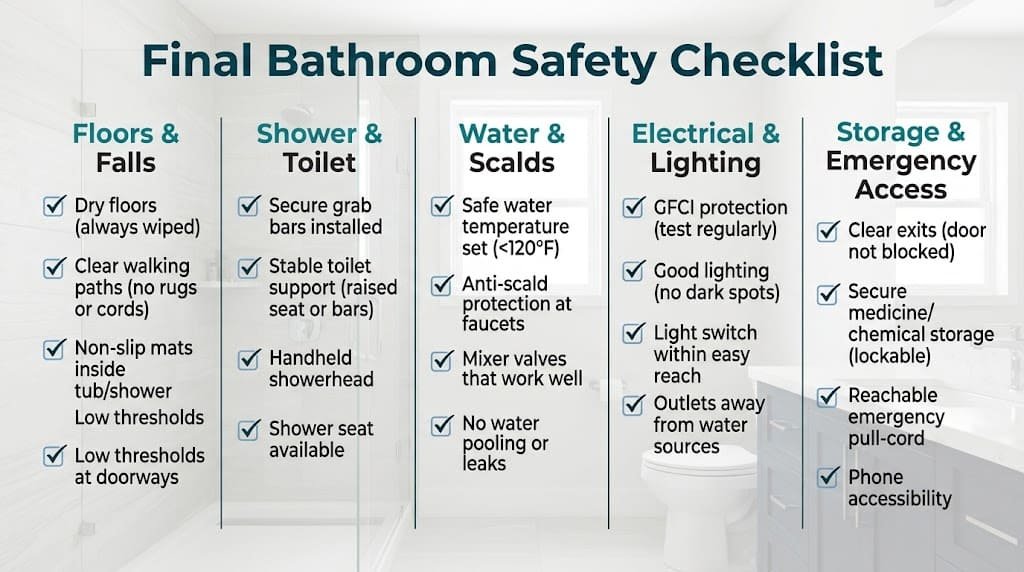
- ☐ Floors are dry, clear, and in good condition.
- ☐ Rugs and mats are secure and appropriate for the space.
- ☐ Walking paths and thresholds are easy to navigate.
- ☐ Shower and tub surfaces provide secure footing.
- ☐ Tub or shower entry and exit can be completed safely.
- ☐ Appropriate support is available where needed.
- ☐ Toilet transfers can be completed safely.
- ☐ The area around the toilet is unobstructed.
- ☐ Bathroom and nighttime lighting provide adequate visibility.
- ☐ Hot-water temperature has been reviewed.
- ☐ Faucets and controls work properly.
- ☐ GFCI protection is present where required and functioning as intended.
- ☐ Electrical appliances and cords are kept away from water.
- ☐ Medicines and harmful chemicals are stored appropriately.
- ☐ Frequently used items can be reached without unsafe stretching.
- ☐ The bathroom entrance and exit remain clear.
- ☐ Child-specific water, burn, poisoning, and electrical risks are addressed when applicable.
- ☐ Senior or mobility-related transfer needs are addressed when applicable.
- ☐ A person can summon help if an emergency occurs.
The goal is not to make every bathroom identical. A safer bathroom is one that matches its users’ abilities, reduces avoidable hazards, and allows essential activities to be completed without unnecessary risk.
If you find a serious electrical problem, an unstable weight-bearing support, or a mobility issue you cannot confidently address, use an appropriately qualified professional rather than relying on a temporary workaround. For older adults or people with mobility difficulties, a healthcare provider or occupational or physical therapist can help determine which bathroom modifications are appropriate.
A good bathroom safety checklist is therefore more than a list of products. Use it to check the room, identify the highest-priority hazards, make appropriate changes, and recheck the bathroom as needs change.
5 Comments