
1. Introduction
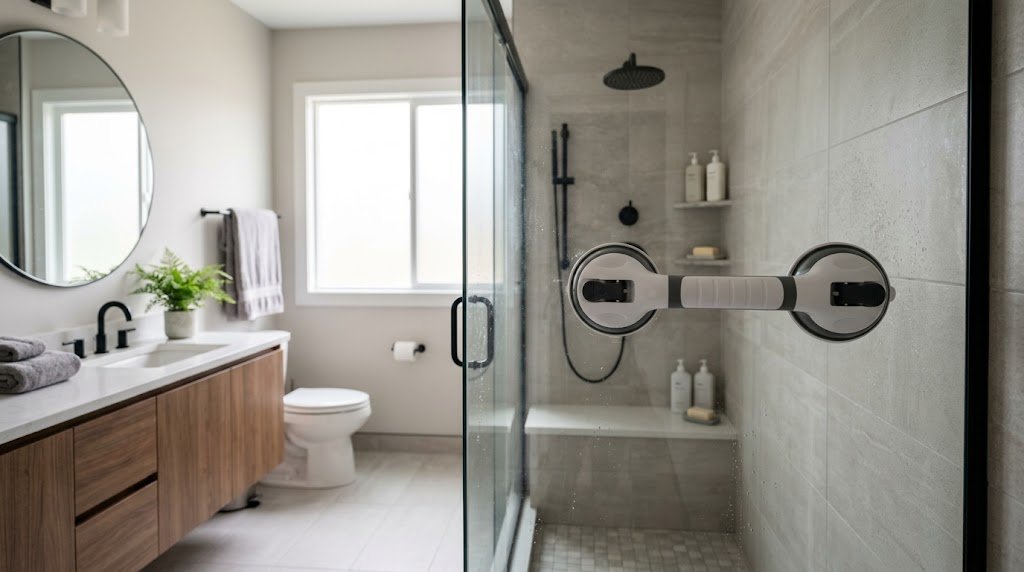
Are suction cup grab bars safe? They can provide temporary assistance with balance when used exactly as the manufacturer intends, but they should not automatically be treated as weight-bearing bathroom grab bars. A suction-mounted bar can loosen or detach if its seal is compromised, and a sudden loss of support in a wet shower can lead to a serious fall.
Before relying on one, check its intended use, surface requirements, and installation instructions. This guide explains how suction cup grab bars work, seven important safety risks, whether they are appropriate for seniors and tiled showers, and which alternatives offer more dependable support.
Table of Contents
2. Are Suction Cup Grab Bars Safe?
Suction cup grab bars are not a dependable substitute for properly installed, load-bearing grab bars when a person needs to support body weight, transfer into or out of a bathtub, or catch themselves during a fall. Their suitability depends on the specific product, its approved use, the mounting surface, and the person’s support needs.
Some models are designed as balance aids rather than devices for pulling, lifting, or bearing a person’s weight. The manufacturer’s instructions may outline additional restrictions for certain models. A suction cup attachment alone does not establish that a bar is suitable for weight-bearing support.
To assess a product, consider three questions:
- What is it designed to do? Determine whether the manufacturer permits only light balance assistance or explicitly allows the type of support you need.
- Where can it be installed? The surface must meet the product’s requirements for smoothness, flatness, cleanliness, and material.
- What happens if the attachment fails? If losing your grip could cause you to fall, choose a more secure support system designed for that risk.
Do suction cup grab bars really work? They can attach to compatible surfaces and may provide limited assistance in suitable conditions. However, attachment does not guarantee that the bar will remain secure under every movement or load. A person who needs reliable weight-bearing support should consider a properly installed structural grab bar and other appropriate bathroom safety equipment.
3. How Do Suction Cup Grab Bars Work?
Suction cup grab bars attach to a surface by creating a pressure difference between the area beneath the cup and the surrounding air. Their effectiveness depends on the cup’s seal, the surface, and the condition of the device.
How suction cups create a seal
A suction cup is pressed against a compatible surface, and its design removes or displaces air from the area beneath it. This creates lower pressure under the cup than outside it, helping atmospheric pressure hold the cup against the surface.
Many bathroom models use locking levers or similar mechanisms to help create and maintain the seal. When installed correctly, a cup can remain attached without screws or permanent wall modifications.
However, suction is not the same as structural anchoring. A cup relies on maintaining a seal against the surface, while a permanently mounted grab bar transfers forces through its fasteners into suitable structural backing or other approved mounting components.
Why surface condition affects suction
A suction cup needs continuous contact with the mounting surface. Gaps, pores, texture, curves, and uneven areas can allow air to enter beneath the cup and weaken the seal.
For example, a smooth, flat, nonporous tile may be suitable for a particular model, while a textured tile or a cup placed across a grout line may not be. The material alone is not enough: the exact surface finish and shape also matter.
Soap film, mineral deposits, dirt, and damaged or aging suction cups can further interfere with attachment. Always prepare the surface as directed by the manufacturer rather than assuming that a bar will adhere securely simply because the wall looks clean.
What locking levers and safety indicators actually tell you
Locking levers help activate the attachment mechanism on products designed with them. Some models also include indicators that signal when the attachment needs attention.
These features can help users check the device’s status according to the manufacturer’s instructions. However, a locked lever or a reassuring indicator does not prove that the bar can safely support body weight or catch a falling person. It does not turn a suction attachment into a structurally anchored grab bar.
Follow the product’s specific installation and checking procedure. If an indicator shows a problem, a cup will not lock as instructed, or the bar shifts during the prescribed check, do not rely on it.
4. 7 Risks of Using Suction Cup Grab Bars
The main concern with suction cup grab bars is that their attachment can change after installation. A bar that appears secure at one moment may not remain secure when exposed to repeated pressure, moisture, temperature changes, or a compromised seal.
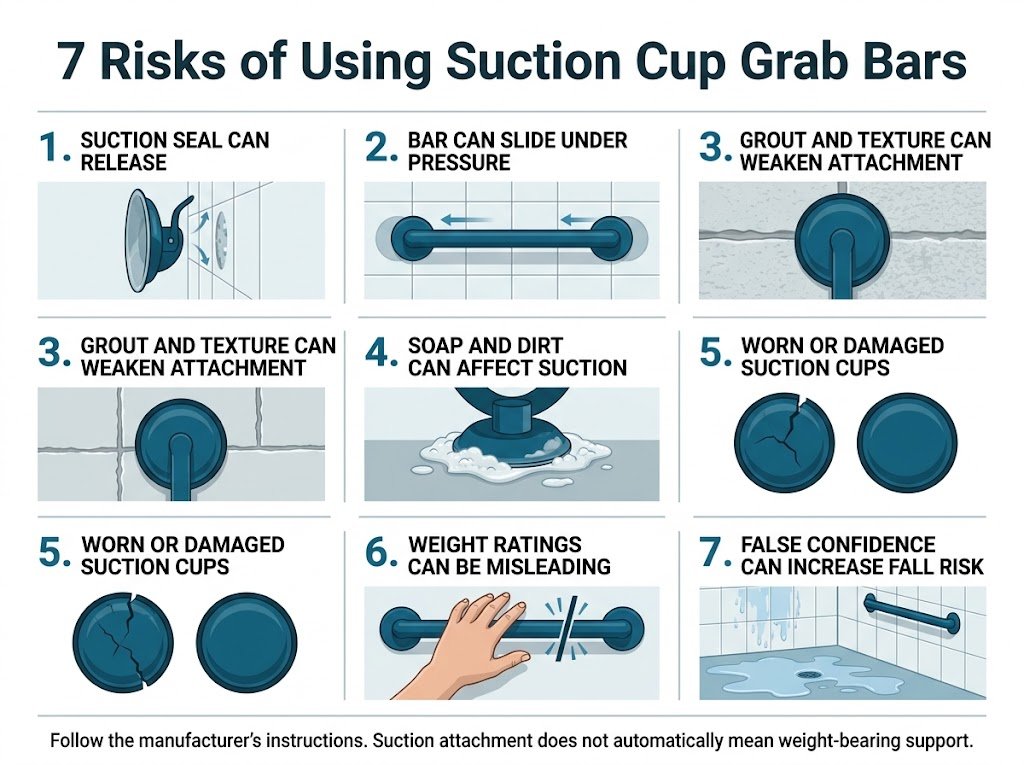
A 2025 laboratory study evaluated 36 suction cup handholds from two brands across six bathtub-wall materials. None of the tested handhold-and-surface combinations remained effective for the full 28-day test period, and failures commonly involved sliding. The findings raise concerns about using these devices for bathing support, but they should not be interpreted as a test of every product on the market. Read the study in the Journal of Rehabilitation and Assistive Technologies Engineering.
1) The suction seal can release unexpectedly
A suction cup depends on a seal between the cup and the mounting surface. If air enters beneath the cup or the seal weakens, the attachment may release.
The user may not notice a developing problem before reaching for the bar. If the person is standing on a wet shower floor or stepping over a bathtub edge, losing support at that moment can have serious consequences.
This is particularly concerning when someone uses the bar to pull themselves upright or steady themselves during a transfer. Do not assume that an attachment that held yesterday will remain reliable today.
2) The bar can slide under pressure
A suction cup bar does not have to detach completely to become unsafe. It can shift sideways or downward while remaining partly attached.
That movement may cause a person’s hand to lose its expected support position. Someone who reaches for the bar to steady themselves may have to react quickly when it moves, which can make it harder to maintain balance.
The 2025 laboratory study found that sliding was the most frequent failure mode among the tested handholds. This is one reason a quick visual check alone cannot establish that a suction-mounted bar will stay in place during real-world use.
3) Grout lines and textured surfaces can compromise attachment
Suction cups generally need a sufficiently smooth, flat, nonporous surface to form a seal. Grout joints, bevels, deep texture, and uneven tile can create gaps beneath the cup.
For example, a bar may appear to fit across a tiled shower wall, but one cup may overlap a grout line. That small gap can interfere with the seal even when the rest of the cup sits against smooth tile.
Follow the specific product’s surface requirements, including any minimum clearance from grout joints or tile edges. If the manufacturer does not approve the surface, choose another support option rather than trying to compensate by pressing harder.
4) Soap residue, dirt, or moisture can affect surface preparation
Soap film, body oils, dust, mineral deposits, and cleaning-product residue can interfere with contact between the suction cup and the wall. The condition of the cup itself also matters.
Use only the cleaning and preparation method specified by the manufacturer. Some products require both the mounting surface and suction cups to be cleaned and dried before installation. Do not assume that a wet surface is acceptable just because the device is intended for bathroom use.
Even careful preparation cannot guarantee that a suction cup bar will remain secure under weight-bearing pressure. Cleanliness is one condition for attachment, not proof of structural safety.
5) Wear or damage can undermine the suction cups
Suction cups can deteriorate or become damaged through age, repeated installation, improper storage, or exposure to conditions outside the manufacturer’s recommendations. Cracks, deformation, hardened rubber, damaged locking components, or a cup that no longer lies flat can interfere with attachment.
Inspect the complete device according to its instructions. If a cup is torn, misshapen, or no longer locks correctly, stop using the bar and replace it if the manufacturer recommends replacement. Do not try to repair a damaged suction cup with household adhesives or other improvised fixes.
6) Users may mistake a weight-capacity claim for permission to bear body weight
A product’s stated capacity can be misleading if the intended use is not understood. A number on the packaging may describe a specific test or limit; it does not automatically mean the bar is approved for pulling, lifting, transferring, or catching a fall.
For example, a manufacturer may explicitly describe a suction-mounted handle as a balance aid and warn users not to apply body weight. That restriction still applies even if the product also advertises a numerical support capacity. Check the manufacturer’s specific instructions and safety warnings to confirm how the product is designed to be used, rather than judging its suitability by its name or advertised claims.
If you need a bar to bear body weight, use a support system designed for that purpose and installed according to its requirements.
7) False confidence can increase the consequences of a failure
A grab bar is useful only if it provides the type of support the user needs. A suction-mounted device that looks sturdy can encourage someone to rely on it during a risky movement, even when its attachment is not suitable for that load.
The danger is not limited to the device falling off. A person may lose balance while stepping into a tub, standing up, or reaching for a towel because the expected support shifts or disappears.
The practical rule is simple: do not use a suction cup bar as your safety net if a failure could cause you to fall. Choose equipment based on the movement you need help with, not just on whether the device attaches to the wall.
5. Are Suction Cup Grab Bars Safe for Seniors?
Suction cup grab bars are not automatically safe for seniors. The deciding factor is the kind of assistance a person needs. Someone who only wants a light handhold for orientation has different needs from someone who relies on a bar to stand, transfer, or recover balance.
Older adults may also have reduced grip strength, slower balance reactions, or difficulty bending and reaching. Those factors can make a sudden loss of support especially consequential. The same considerations apply to people of any age who have limited mobility or balance difficulties.
When a person needs only light balance assistance
Some people use a bathroom handle as a reference point while moving, rather than to support a significant portion of their weight. Even in this situation, the product must be used only for the purpose stated by its manufacturer, and the mounting surface must meet its requirements.
A suction cup handle should not be assumed to be appropriate simply because the person is relatively steady or because the device feels secure when touched. If the user might instinctively pull on it when losing balance, a more secure support may be necessary.
When standing, transferring, or recovering balance requires weight-bearing support
If a person needs to pull themselves up from a seated position, support their weight while stepping into a bathtub, or catch themselves during a loss of balance, a suction cup grab bar is not an appropriate default choice.
A properly installed, load-bearing grab bar may provide more dependable support when it is positioned for the person’s movement and anchored to suitable structural backing. Other equipment, such as a shower chair or transfer bench, may reduce the need to balance while standing.
The right setup depends on the person’s abilities, the bathroom layout, and the movement involved. If the necessary level of support is unclear, consult a qualified occupational therapist or another appropriate healthcare professional.
Why caregivers should assess the person’s actual support needs
Caregivers should observe how the person actually uses the bathroom rather than judging equipment needs by age alone. Consider whether they can:
- Step over the tub edge without pulling on a nearby object.
- Sit down and stand up without needing to lift or support themselves with their arms.
- Maintain balance on a wet surface.
- Reach and grip a support without twisting or leaning dangerously.
- Use the proposed equipment consistently and safely.
If any of these movements require substantial support, select equipment designed for that task. A qualified professional can evaluate the person’s needs and recommend the right combination of bathroom safety features, such as grab bars, a shower chair, or a bathtub transfer bench.
6. Are Suction Cup Grab Bars Safe in the Shower or on Tile?
A suction cup grab bar may attach to some shower tiles, but a compatible tile surface does not guarantee that the bar is safe for weight-bearing support. Surface compatibility and load-bearing capability are separate questions.
The manufacturer’s instructions for the exact model should determine whether the surface is suitable. A bar that fits one tiled shower may be unsuitable for another, even if both bathrooms appear similar.
Smooth glazed ceramic tile and other nonporous surfaces
Smooth, flat, glazed ceramic or porcelain tile may meet the surface requirements for some suction-mounted products. Certain models may also permit use on specified smooth acrylic, fiberglass, or glass surfaces.
However, not all products are compatible with all of these materials. Surface curvature, texture, tile size, and the position of grout lines can affect whether a cup forms a proper seal. Check the manufacturer’s approved surface list before installation.
Even if the bar attaches correctly to an approved surface, do not infer that it can support body weight. That decision depends on the product’s stated intended use and limitations.
Textured tile, grout lines, uneven surfaces, and damaged walls
Textured tile, porous material, uneven finishes, deep grout joints, beveled edges, and damaged surfaces can prevent a suction cup from making continuous contact.
Use the following table as a preliminary guide, not as approval for a particular product.
| Bathroom surface | What to consider |
|---|---|
| Smooth, glazed ceramic tile | May be compatible if the specific product permits it and the cup fits entirely on the smooth surface. |
| Smooth porcelain tile | May be compatible, subject to the product’s instructions and the tile’s finish. |
| Textured or rough tile | Often unsuitable because texture can interrupt the seal. |
| Tile with grout beneath a suction cup | Avoid unless the manufacturer explicitly allows the exact placement and surface configuration. |
| Curved or uneven fiberglass | Compatibility varies by model and by the shape of the surface. |
| Smooth acrylic shower surround | May be permitted for some models; check the manufacturer’s instructions. |
| Porous stone, unsealed surfaces, or damaged walls | Do not assume the cup will seal reliably. Verify compatibility before use. |
If the bar cannot be placed so that every suction cup meets the manufacturer’s surface requirements, do not install it there. Do not attempt to make an incompatible surface suitable by filling gaps with sealant or using an unapproved adhesive.
Why a suitable surface does not guarantee weight-bearing safety
A smooth surface helps a suction cup form a seal, but it does not prove that the attachment will withstand the forces applied during bathing. Pressure from a hand can vary in direction and intensity, and a person who stumbles may pull suddenly rather than apply a controlled, steady force.
In addition, the seal and the mounting surface can change with use and environmental conditions. Even a product that appears properly attached should not be used beyond its approved purpose.
For a person who needs dependable support while entering or leaving a shower or tub, a properly installed structural grab bar is generally the safer choice.
For detailed review on shower safety, see our guide on shower and bathtub safety.
7. Do Suction Cup Grab Bars Hold Body Weight?
Do not assume that a suction cup grab bar can hold body weight. Many consumer suction-mounted bathroom handles are intended for balance assistance only and explicitly prohibit using them for body-weight leverage. Other products may have different specifications, so the instructions for the exact model matter.
If you need support to help lift your body, steady a transfer, or catch yourself during a fall, choose equipment specifically designed and installed for that purpose.
What a stated weight capacity does—and does not—mean
A weight-capacity claim must be interpreted in the context of the manufacturer’s test conditions and intended use. It may not describe every force a user could apply during a real bathroom movement.
For example, a person may pull sharply on a bar when their foot slips. That movement can place force on the device in a different direction from a controlled test. A stated capacity should never override a warning that prohibits body-weight support.
Before purchasing or installing a device, look for clear answers to these questions:
- Is it intended only for balance assistance, or is weight-bearing use explicitly permitted?
- What surface types and conditions are required?
- Are there restrictions on pulling, lifting, or use during transfers?
- What installation and inspection procedures must be followed?
If the instructions do not clearly establish that the device is suitable for your support needs, do not rely on it for weight-bearing assistance.
Why sudden pulling or catching a fall is different from a controlled test
A controlled test applies a defined load under specified conditions. Everyday movement is less predictable: a user may pull at an angle, shift their weight suddenly, or grip the bar while trying to stop a fall.
The attachment may also be affected by surface condition, repeated use, and changes in the suction cup. As a result, a capacity figure alone cannot establish that a suction-mounted handle will safely support a person in every situation.
This distinction matters most during transfers. If you need to rely on a bar to move from a seated position to standing or to enter and exit a bathtub, choose a support system rated and installed for that function.
How permanently mounted grab bars differ in structural support
A properly installed, load-bearing grab bar transfers force through its fasteners and mounting system into suitable structural backing or another approved support structure. Its reliability depends on correct product selection, placement, fasteners, and installation—not merely on being screwed into a wall.
The U.S. Department of Justice’s 2010 ADA Standards for Accessible Design include a structural-strength criterion in Section 609.8: qualifying grab bars in covered accessibility applications must meet the specified allowable-stress requirement when a 250-pound force is applied at any point on the bar, fastener, mounting device, or supporting structure.
That requirement is not a universal guarantee for every grab bar in every home, nor is it a rating for suction cup products. It illustrates why structural support and correct installation matter. For a home installation, follow the product’s requirements and applicable building guidance, and use a qualified installer when needed.
8. Suction Cup Grab Bars vs. Wall-Mounted Grab Bars
Suction cup grab bars are portable and usually do not require drilling, but their attachment depends on a suitable surface and a maintained suction seal. Properly installed wall-mounted grab bars use structural anchoring and are generally the more appropriate option when a person needs dependable weight-bearing support.
Installation, portability, and surface requirements
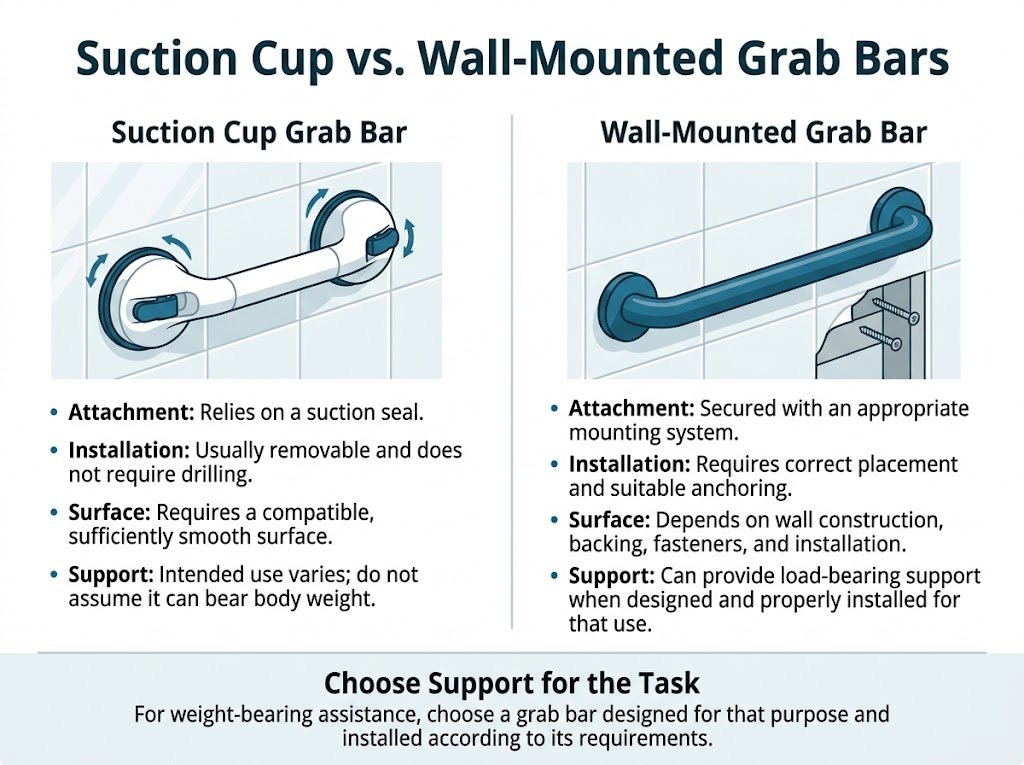
Suction-mounted handles are often quick to install and remove, which may appeal to renters or people who travel. Their main limitation is that they work only on compatible surfaces and cannot be treated as permanent structural supports.
Wall-mounted bars usually require more planning. The location must suit the user’s movement, and the mounting system must be appropriate for the wall construction. Installation may require drilling and secure attachment to suitable backing or a manufacturer-approved mounting system.
Convenience should not be the only deciding factor. Consider what the user will do with the bar, how much support they need, and what the consequences would be if it moved.
Structural anchoring and appropriate support needs
Use this comparison to understand the main differences.
| Feature | Suction cup grab bar | Properly installed wall-mounted grab bar |
|---|---|---|
| Attachment | Relies on a suction seal against a compatible surface | Uses fasteners and a mounting system anchored to suitable structural support |
| Portability | Usually easy to remove and reposition | Generally intended to remain in a fixed location |
| Surface requirements | Usually requires a smooth, nonporous, sufficiently flat surface | Depends on the wall structure, backing, fasteners, and installation method |
| Weight-bearing support | Must not be assumed; many models are balance aids only | Can provide load-bearing support when designed and correctly installed for that use |
| Common limitation | Seal can weaken, slide, or release | Incorrect placement or installation can compromise support |
| Best next step | Follow the exact product’s intended-use restrictions | Select the right bar and have it installed according to its requirements |
A wall-mounted bar is not automatically safe just because it is permanent. Poor anchoring, unsuitable fasteners, or incorrect placement can make it unreliable. The important distinction is whether the entire installation is designed and completed to support the loads the user will apply.
For further guidance on grab bars types, see BathSmartly’s guide to bathroom grab bars types.
9. Safer Alternatives to Suction Cup Grab Bars
If you need reliable bathroom support, choose equipment that addresses the movement you find difficult. A grab bar may help with standing or transferring, while a shower chair can reduce the need to stand for the entire shower. These options solve different problems, so one is not automatically a replacement for another.
Properly installed, load-bearing bathroom grab bars
A properly installed grab bar is often the most appropriate alternative when you need to hold your weight while standing, changing position, or entering and exiting a shower or tub.
Choose a bar with a grip that is comfortable to hold and a length and position that suit the intended movement. The bar must be secured using a mounting method appropriate for the wall and the product. Towel bars, shower-door frames, and other bathroom fixtures should not be treated as grab bars unless they are specifically designed and installed for that purpose.
For further guidance on choosing a suitable bar, see BathSmartly’s complete guide to bathroom grab bars. For placement considerations, read the guide to bathroom grab bar placement.
Shower chairs and bath seats
A shower chair or bath seat provides a place to sit while bathing. It can reduce the time a person spends standing on a slippery surface and may help someone who experiences fatigue or has difficulty maintaining balance.
Select a model designed for the intended bathing area, and follow its instructions for setup, stability, and weight limits. Make sure the chair fits the space and does not obstruct safe entry or exit.
A shower chair does not replace a grab bar when a person needs support while moving into position or standing up. The safest arrangement may include both a suitable seat and a correctly installed grab bar.
Bathtub transfer benches
A bathtub transfer bench is designed to help a person move between the outside of the tub and the bathing area while seated. Depending on the model and the person’s abilities, it may reduce the need to step over the tub wall while standing.
The bench must fit the bathtub and be installed or positioned according to the manufacturer’s instructions. Check that its legs are stable and properly supported, and consider whether the user can transfer onto it safely.
A transfer bench is not suitable for every bathroom or every person. Someone who needs hands-on assistance or cannot transfer safely while seated may require a different setup and a professional assessment.
Toilet safety frames or raised toilet seats with appropriate arms
For people who struggle to sit down on or stand up from a toilet, a toilet safety frame or a raised toilet seat with appropriate arms may provide support. These devices address toileting movements rather than bathing transfers.
Choose a product compatible with the toilet and bathroom layout, and follow the manufacturer’s installation and weight-limit instructions. Check that the device is stable before use and does not interfere with the toilet’s operation.
For more information about toilet-related support, see BathSmartly’s toilet safety guide.
Choosing an alternative for a rental or temporary living arrangement
If you rent your home or need a temporary solution, you may be reluctant to drill into bathroom walls. However, avoiding permanent changes should not mean relying on a device that is unsuitable for your support needs.
Consider these options:
- Ask the landlord or property manager about approved grab bar installation, including whether suitable backing is already present.
- Consult a qualified installer about mounting options appropriate for the wall structure and the selected product.
- Use a shower chair, bath seat, or transfer bench if it safely addresses the specific movement you need help with.
- If considering a removable support, verify its intended use and limitations. Do not assume that a suction-mounted device can bear body weight simply because it is temporary.
If no suitable installation is immediately available, avoid using a suction cup handle for weight-bearing support while you arrange a safer option. A qualified occupational therapist may help identify equipment that fits your needs and the bathroom’s restrictions.
10. How to Check a Suction Cup Grab Bar Before Use
If you already own a suction cup grab bar, checking it according to the manufacturer’s instructions may help identify an obvious attachment problem. However, these checks do not certify the device as fall protection or make it suitable for body-weight support.
Read the intended-use restrictions and installation instructions
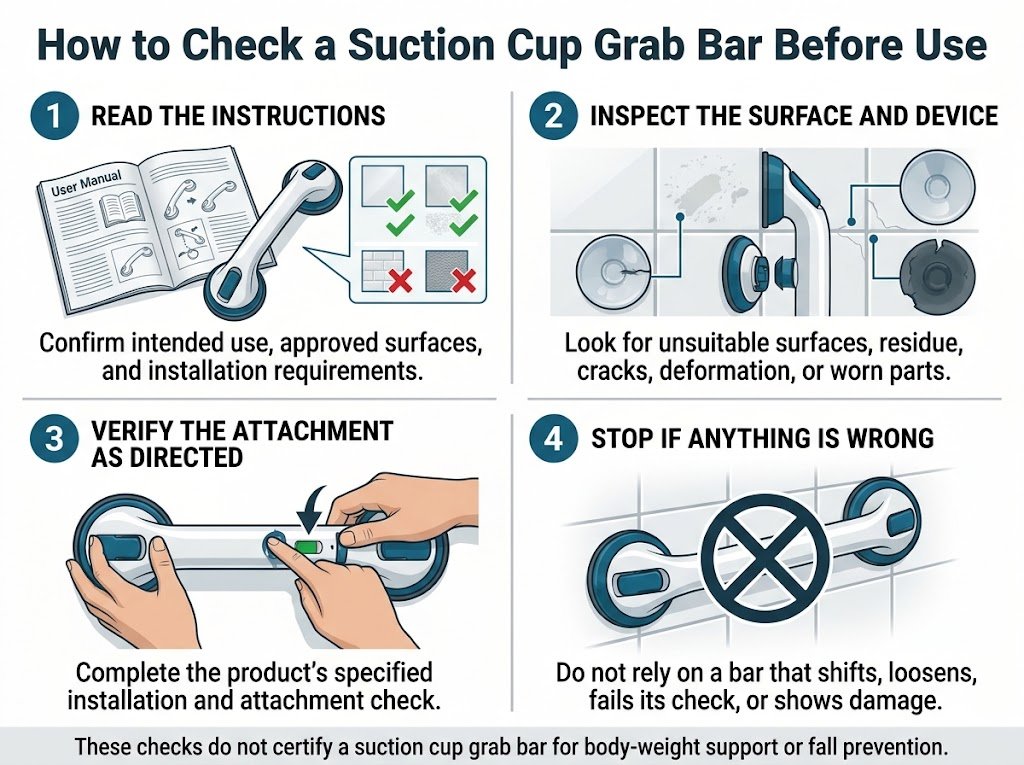
Start with the exact product manual, label, or manufacturer documentation. Confirm whether the bar is intended for light balance assistance only and whether the instructions prohibit pulling, lifting, or applying body weight.
Review the permitted surface materials, installation steps, cleaning requirements, and any directions for checking the attachment before use. If the documentation is unclear about a use you need, contact the manufacturer or choose a device with a clearly suitable intended use.
Inspect the surface, suction cups, and locking indicators
Before installing the device, inspect the mounting area for texture, grout joints, unevenness, damage, or residue. Check the suction cups and locking components for visible wear, cracks, deformation, or other damage.
If the model has a visual indicator, make sure you understand what its status means according to the instructions. A favorable indicator is only one part of the product’s checking procedure; it is not proof that the device can support body weight.
Do not install the bar if the surface or device does not meet the stated requirements.
Follow the manufacturer’s attachment-check procedure
Use the exact attachment and checking steps specified by the manufacturer. Some products require the user to press the cups firmly into place, engage locking levers, and perform a prescribed manual check before each use.
Do not improvise a stronger test by hanging from the bar or applying your full body weight. That could cause the device to detach and create the very hazard you are trying to avoid. Even if the bar passes the manufacturer’s check, stay within its stated intended use.
Stop using the device if it shifts, loosens, or shows damage
If the bar slides, a cup loses its seal, an indicator shows a problem, or any component appears damaged, stop relying on it. Remove and reinstall it only if the manufacturer permits that procedure and the surface and device remain suitable.
Repeatedly reattaching a bar does not make it an appropriate weight-bearing support. If you need a dependable handhold for transfers or balance recovery, choose an alternative designed for that purpose.
11. FAQs
Can suction cup bathroom grab bars suddenly detach?
Yes. A suction cup grab bar can detach or slide if its seal weakens, the surface is unsuitable, or the device is damaged or improperly installed. Even a bar that initially appears secure may not remain attached under changing conditions. Do not depend on a suction-mounted handle to catch you during a fall or support your body weight unless its specific intended use explicitly permits the required support.
Do suction cup grab bars work on fiberglass?
Some suction cup grab bars are approved for certain smooth fiberglass surfaces, but compatibility varies by product and surface shape. Curved, textured, or uneven fiberglass may prevent the cups from sealing properly. Check the manufacturer’s approved surface list and installation instructions before use. Even on a compatible surface, attachment alone does not establish that the bar is suitable for weight-bearing support.
Are suction cup grab bars suitable for temporary bathroom use?
They may be convenient for temporary placement when the product’s intended use and surface requirements are met. However, temporary use does not remove the risk of sliding or detachment. If you need support to stand, transfer, or recover balance, choose a suitable load-bearing grab bar or another appropriate assistive device instead of relying on suction attachment.
What should I use if I cannot drill into the bathroom wall?
Start by identifying the movement you need help with. A shower chair may reduce the need to stand while bathing, and a transfer bench may help with entering or exiting a bathtub. For weight-bearing support, ask a qualified installer about mounting options suitable for your wall and rental restrictions. Do not assume a no-drill suction handle can safely replace a structurally anchored grab bar.
12. Conclusion: Choose Bathroom Support That Matches Your Needs
So, are suction cup grab bars safe? They may provide limited assistance when used as directed, but they should not be treated as dependable, weight-bearing support simply because they attach firmly to a bathroom wall. Their performance depends on the product, surface, installation, and conditions of use, and detachment or sliding can create a serious fall hazard.
If you or someone you care for needs help standing, transferring, or maintaining balance in the shower or bathtub, consider a properly installed, load-bearing grab bar and other equipment suited to the task. Check the manufacturer’s instructions, choose support based on actual mobility needs, and seek professional guidance when necessary.
For more help choosing appropriate equipment, explore BathSmartly’s complete guide to bathroom safety.
1 Comment