
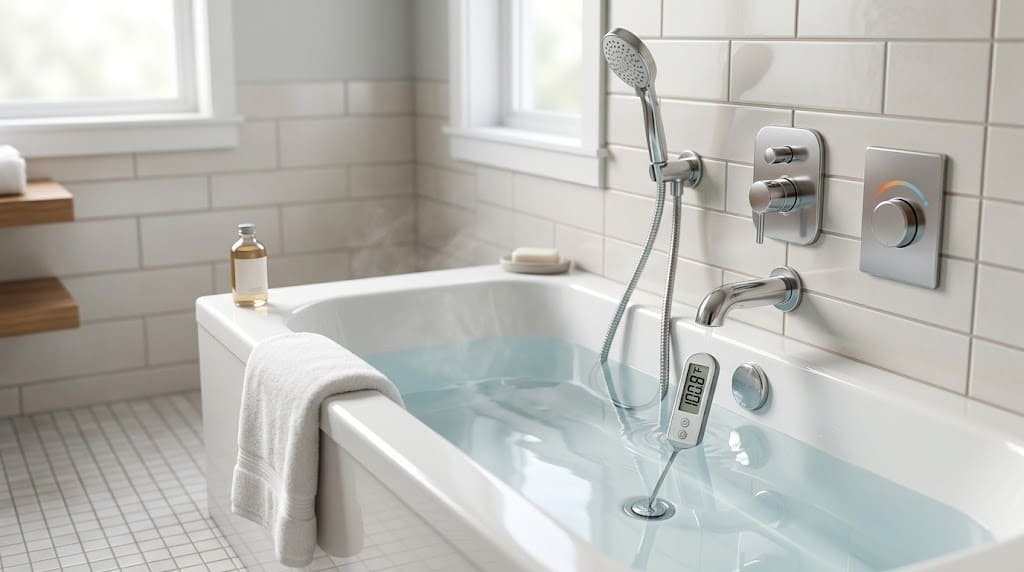
1. Introduction
Bathroom water temperature is a safety issue, not just a matter of comfort. Water that feels pleasantly warm can become a scald hazard when the temperature is too high, the exposure lasts too long, or the water suddenly becomes hotter.
The important point is that there is not one “safe bathroom water temperature” that applies to every situation. You need to distinguish between the temperature stored in the water heater, the temperature delivered by a faucet or shower, and the temperature of the mixed water you actually use for bathing.
For U.S. homes, the Consumer Product Safety Commission (CPSC) recommends lowering residential water heaters to 120°F to reduce tap-water scald risk. However, that does not mean 120°F is an appropriate bathing temperature. Actual bath and shower water should be considerably more comfortable, and the temperature delivered at the fixture should be controlled to prevent scalding.
This guide explains how hot shower and bath water should be, how temperature and exposure time affect scald risk, how to test your bathroom fixtures, and which safeguards can help protect everyone in the household.
Table of Contents
2. What Is a Safe Bathroom Water Temperature?
There is no single temperature that defines every safe use of bathroom water. A practical way to understand bathroom water safety is to separate the system into three temperature points.
The three temperatures you need to understand
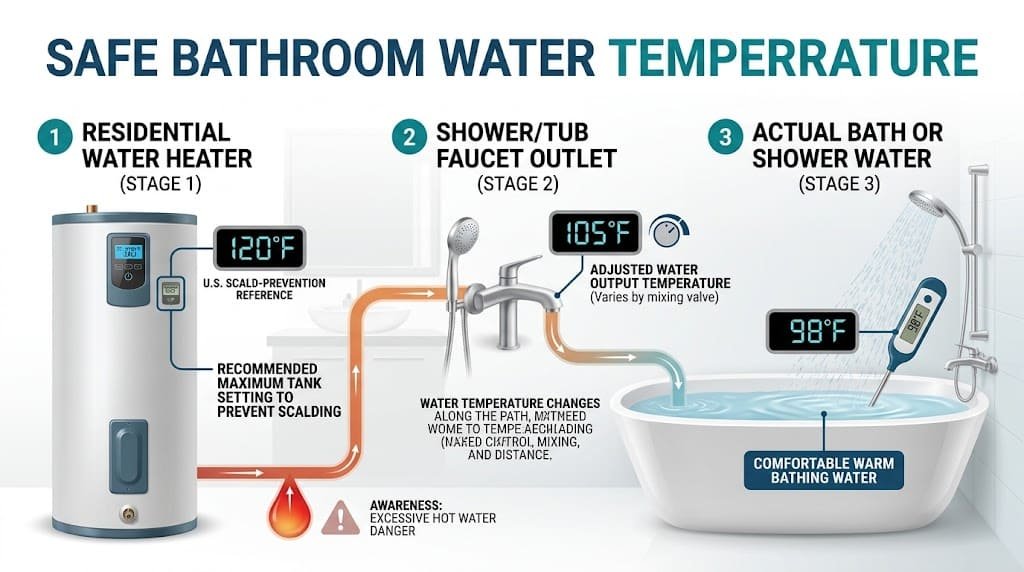
1. Water heater temperature:
This is the temperature at which hot water is stored or heated in the home’s water-heating system. CPSC recommends a 120°F water heater setting as a way to reduce tap-water scald injuries.
2. Fixture outlet temperature:
This is the temperature of water coming out of a showerhead, bathtub faucet, or sink faucet. It can differ from the water heater setting because of mixing valves, plumbing conditions, temperature fluctuations, and the operation of the water heater.
3. Actual bathing temperature:
This is the temperature of the mixed water that touches your skin when you shower or sit in a bath. It is the temperature that matters most for comfort during bathing.
These three temperatures should not automatically be treated as identical.
For example, setting a water heater to 120°F does not mean you should shower or bathe in 120°F water. In fact, 120°F water at the point of use is already hot enough to cause serious burns with sufficiently long exposure. CPSC’s scald guidance shows that burn severity increases rapidly as water temperature rises.
Why 120°F should not be confused with ideal bathwater
The 120°F figure is primarily a scald-prevention reference for hot-water systems and delivered tap water, not a recommendation to use 120°F water for bathing.
The American Academy of Pediatrics (AAP), for example, advises that the hottest temperature at a faucet should be no more than 120°F to help prevent children’s tap-water scalds.
For actual bathing, water should feel comfortably warm rather than hot. Some bath-industry guidance places a comfortable adult bath in the 90°F to 105°F range. That range should be understood as a comfort guideline, not as a universal medical or regulatory safety threshold.
The distinction is simple:
120°F = an important upper-limit reference for scald prevention at hot-water outlets; it is not the target temperature for a comfortable bath or shower.
3. How Hot Should Shower Water Be?
The safest shower temperature is one that feels comfortably warm without becoming hot enough to cause skin injury or excessive heat exposure. There is no single shower temperature that is ideal for every person, but the water should not approach the maximum temperature permitted for hot-water delivery.
Very hot shower water increases the potential for a scald, particularly when someone remains under the water for an extended period. The risk also increases when the water temperature changes unexpectedly.
For this reason, focus on comfortable mixed water and stable temperature, rather than simply turning the shower handle toward the hottest setting.
Why shower temperature can suddenly change
A shower’s temperature can change when the balance between hot and cold water changes elsewhere in the plumbing system.
For example, flushing a toilet or starting an appliance that uses a substantial amount of water can alter water pressure reaching the shower. That can change the ratio of hot and cold water coming through the shower valve. Plumbing Manufacturers International describes this sudden temperature change as thermal shock, which can contribute to both scalding and falls.
Two important technologies help control this problem:
- Pressure-balancing valves respond to changes in hot- and cold-water pressure to reduce sudden temperature swings.
- Thermostatic valves sense water temperature and adjust the hot/cold mix to maintain a more consistent outlet temperature.
These devices address a different problem from simply lowering a water heater setting. A water heater controls the hot-water supply, while a shower valve can help control the temperature experienced at the shower outlet.
If your shower becomes suddenly much hotter when another fixture is used, that is worth investigating rather than treating it as a normal inconvenience.
4. How Hot Should Bath Water Be?
Bathwater should be comfortably warm rather than very hot. For adults, commonly cited bath-temperature guidance places a comfortable range around 90°F to 105°F. Safe Step and KOHLER Walk-In Bath both currently describe this approximate range as a comfortable bath temperature.
That range is useful as a comfort reference, but it should not be interpreted as a guarantee that every person will tolerate every temperature in the same way. Individual sensitivity, exposure time, age, and health circumstances can affect how someone responds to heat.
Comfortable adult bathwater
A bath around the warm, rather than hot, end of the range can be comfortable for many adults. The goal is to avoid the common mistake of making bathwater as hot as possible simply because the heat initially feels relaxing.
A useful rule is:
If the water feels hot rather than comfortably warm, reduce the temperature.
A thermometer can provide a more objective check when temperature accuracy matters, especially when bathing children or someone who may not reliably sense heat.
Safe bathwater for babies and young children
Children require extra care because hot tap water can cause serious burns quickly.
The AAP recommends that the hottest water temperature at the faucet be no more than 120°F to help prevent tap-water scalds. It also recommends checking bathwater before placing a baby in it.
For a baby’s bath:
- Check the water before placing the child in the tub.
- Make sure it feels warm, not hot.
- Consider using a bath thermometer when you need a more objective temperature check.
- Never rely on the child’s ability to judge temperature.
- Do not place a child into water while very hot water is still running.
- Stay with your baby at all times while they are in the bathtub, and never leave them alone in the water.
HealthyChildren.org also notes that water temperature can fluctuate as it travels through household plumbing, meaning water that initially seemed appropriate can change while the bath is being prepared.
Why bathwater can have hot spots
Bathwater may not be perfectly uniform immediately after hot and cold water are mixed.
Problems can occur when:
- Hot water is entering the tub without sufficient mixing.
- Additional hot water is added after someone is already in the bath.
- Someone places a body part close to the hot-water stream.
- Water temperature is judged only by appearance rather than being checked.
For children especially, mix the water thoroughly and check it before bathing. If more hot water is needed, mix it carefully rather than directing a concentrated stream of very hot water toward someone already in the tub.
5. When Does Bathroom Water Become a Scald Hazard?
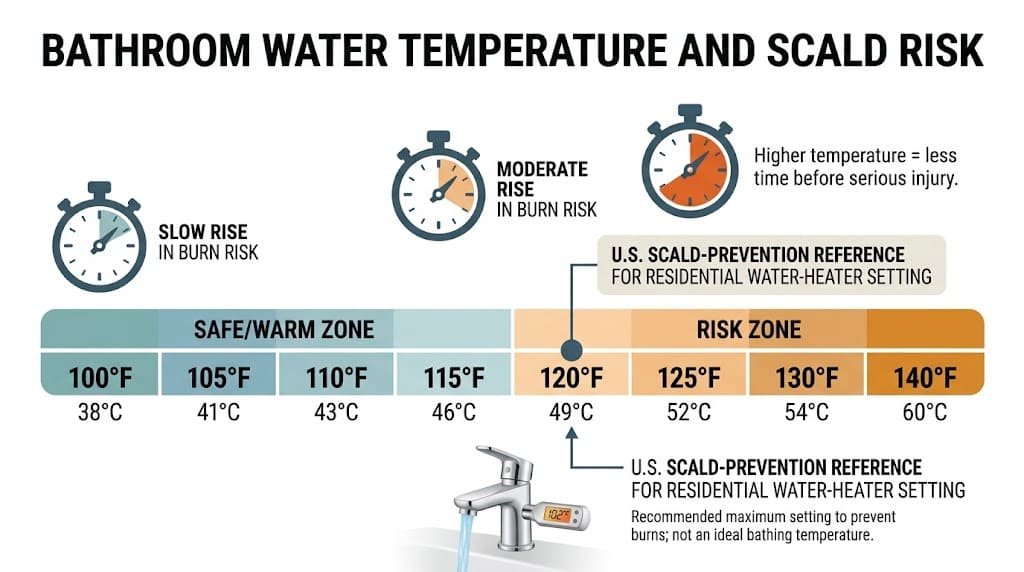
Scald risk depends on more than temperature alone. The hotter the water, the less time it can take to cause a serious burn.
This is why a temperature that seems tolerable for a brief moment should not automatically be considered safe for prolonged exposure.
Temperature and exposure time
CPSC’s tap-water scald guidance illustrates how quickly burn risk increases as water temperature rises:
| Water temperature | CPSC example of exposure risk |
|---|---|
| 150°F | Third-degree burns can occur after about 2 seconds |
| 140°F | Third-degree burns can occur after about 6 seconds |
| 130°F | Third-degree burns can occur after about 30 seconds |
| 120°F | Prolonged exposure can still cause serious burns |
These figures are examples from CPSC’s safety material and should not be interpreted as a precise prediction for every individual. Actual injury depends on factors including exposure conditions and the person involved.
The practical lesson is more important than memorizing the numbers:
Increasing water temperature sharply reduces the amount of time a person has to react before serious injury can occur.
Why children and older adults can face greater risk
Children and older adults are among the groups specifically identified in U.S. scald-prevention guidance as being vulnerable to tap-water scalds.
Risk can increase when a person:
- has more sensitive skin;
- cannot move away from hot water quickly;
- has difficulty recognizing a dangerous temperature;
- has reduced temperature sensation;
- has mobility limitations;
- needs another person to control the bathing water.
For these users, temperature control should not depend entirely on whether the water “feels okay.” Measured temperatures and properly functioning temperature-control devices provide an additional layer of protection.
6. How to Prevent Hot Water Scalds in the Bathroom
Effective bathroom scald prevention uses several layers of protection rather than relying on one setting.
Set and verify the water heater temperature
CPSC recommends lowering residential water heaters to 120°F to reduce tap-water scald risk.
However, the water heater setting should not be treated as the only protection against scalding.
The temperature at the fixture is what reaches the user. Plumbing system design, temperature controls, mixing devices, and water heater behavior can affect that delivered temperature.
The EPA also highlights an important tradeoff: higher hot-water temperatures may be used in some systems for control of Legionella, but hot water at faucets or showers above about 117°F can present a scalding risk. The EPA recommends considering local requirements and who may be at risk before increasing household water temperatures.
Because of this tradeoff, do not make a large water heater temperature change simply because of a general recommendation found online. Follow the heater manufacturer’s instructions and applicable local requirements, and use appropriate temperature-control devices where necessary.
Test the temperature at the fixture
For tap water scald prevention, check the actual water coming from the fixture rather than assuming the water heater dial tells the whole story.
Check:
- shower outlet;
- bathtub faucet;
- bathroom sink faucet;
- other hot-water outlets used for bathing or personal care.
A suitable thermometer gives you an objective reading. This is particularly useful if the water feels unusually hot, changes temperature unexpectedly, or the plumbing system has recently been modified.
Install appropriate anti-scald protection
Anti-scald protection is designed to reduce the chance that excessively hot water reaches the person using the fixture.
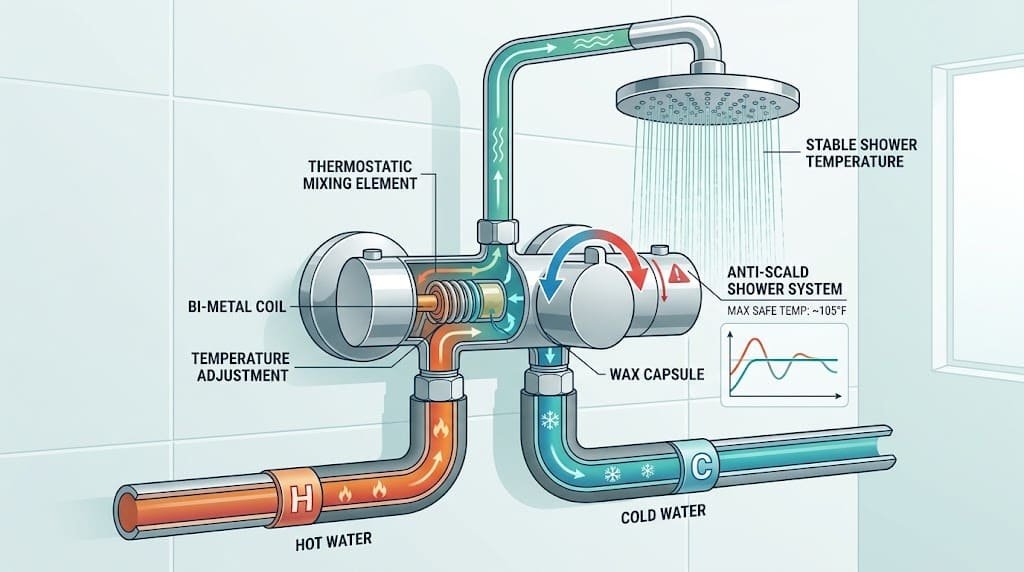
Depending on the plumbing system, relevant technologies can include:
- thermostatic mixing valves, which blend hot and cold water to maintain a controlled temperature;
- thermostatic shower valves, which respond to water temperature;
- pressure-balancing shower valves, which compensate for pressure changes;
- temperature limit stops, which restrict how far a shower control can be turned toward hot.
Plumbing Manufacturers International explains that pressure-balancing and thermostatic valves help reduce sudden temperature changes, scalding, and thermal shock in showers.
The correct device depends on the plumbing configuration and the fixture. If you are modifying a shower or bathtub system, follow the manufacturer’s installation requirements and applicable local plumbing requirements.
Reduce sudden temperature changes
A shower should not suddenly become much hotter because someone flushed a toilet or started another water-using fixture.
If that happens regularly, have the shower valve and plumbing system evaluated. Older or improperly configured systems may have less effective temperature control.
This matters for both hot-water scald prevention and fall prevention because an unexpected blast of hot or cold water can cause a person to move suddenly or lose balance.
7. How to Check Your Bathroom Water Temperature Safely
Checking the actual temperature at your bathroom fixtures is a practical way to identify a potential scald hazard.
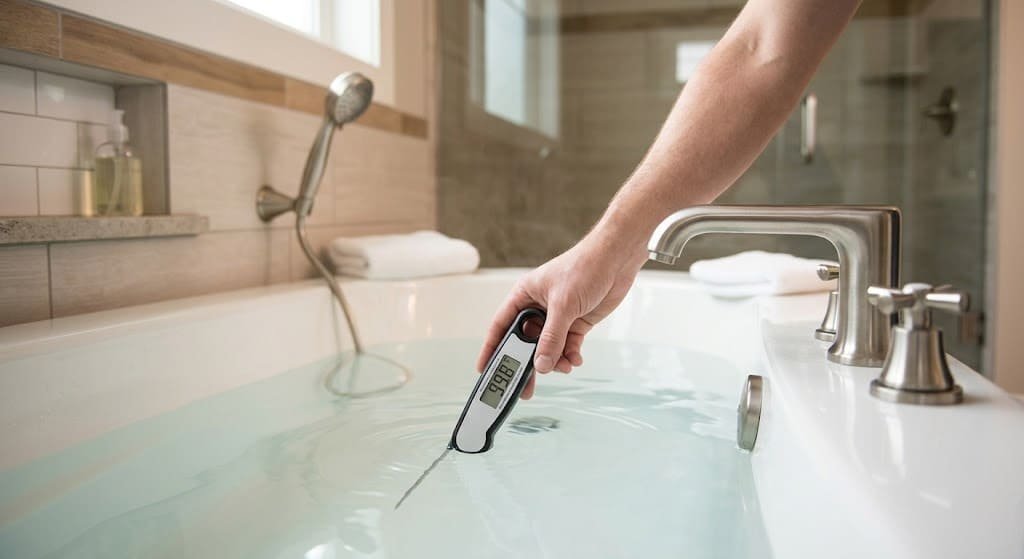
What you need
You may need:
- A suitable water thermometer
- A container if the thermometer requires one
- The manufacturer’s instructions for your water heater or fixture.
For an ordinary temperature check, avoid putting your body directly under water simply to judge whether it is safe. A thermometer gives you a more accurate and reliable reading of the water temperature.
Step-by-step temperature check
- Allow the water to flow for a few moments until the temperature becomes consistent. Avoid measuring only the first few seconds of flow.
- Measure at the actual fixture. This tells you more about delivered water temperature than the heater dial alone.
- Check the shower and bathtub separately. Different fixtures can have different controls and plumbing conditions.
- Check the sink if it supplies hot water. Bathroom safety should not focus only on the shower.
- Record the readings. This makes it easier to identify unusually high temperatures or differences between fixtures.
- Investigate unusually high or unstable readings. A large or unexpected temperature change can indicate a problem with temperature control.
- Recheck after adjustments. If a setting, valve, fixture, or water heater control is changed, verify the delivered temperature again.
Why a thermostat dial alone is not enough
A water heater thermostat setting and the temperature at a bathroom faucet are not necessarily the same measurement.
Water heater behavior, plumbing design, mixing devices, flow conditions, and temperature changes can affect what ultimately reaches a fixture. Hot Water Safety specifically warns that relying on the water heater thermostat alone does not provide precise control of the temperature leaving the heater.
That is why measure the water where people actually use it is a useful safety principle.
If your home’s hot-water system requires a temperature that differs substantially from ordinary household guidance, have the system evaluated by a qualified professional rather than relying on the heater dial alone.
8. Safe Bathroom Water Temperature for Different People
The right safety approach can vary depending on who uses the bathroom.
| User | Main consideration |
|---|---|
| Adults | Comfortable temperature plus scald prevention |
| Babies and young children | Careful supervision, temperature checking, and tap-water scald prevention |
| Older adults | Scald prevention plus protection against sudden temperature changes and falls |
| People with reduced temperature sensation | Measured temperature is more reliable than skin sensation alone |
| Caregivers | Verify the water temperature before another person enters the bath or shower |
Children
Children need particularly careful protection from hot tap water.
The AAP recommends keeping the hottest faucet temperature at 120°F or below to help prevent tap-water scalds. For bathing, check the water before placing a child in the tub and make sure it feels warm rather than hot.
For babies, supervision is also essential. Temperature control does not replace direct supervision around bathwater.
Older adults
Older adults can be more vulnerable to the consequences of a bathroom temperature problem, particularly when a sudden change in shower temperature causes an abrupt reaction.
A safer setup combines controlled water temperature with stable shower performance. This can reduce both scalding hazards and the possibility of losing balance when the water suddenly becomes much hotter or colder.
People who may not reliably sense heat
If someone cannot reliably judge temperature through skin sensation, do not make touch the primary safety test.
A thermometer and properly adjusted temperature-control equipment provide a more consistent way to verify the water. This is particularly important when a caregiver prepares water for another person.
9. Safe Bathroom Water Temperature Checklist
Use this quick checklist when reviewing your bathroom’s hot-water safety:
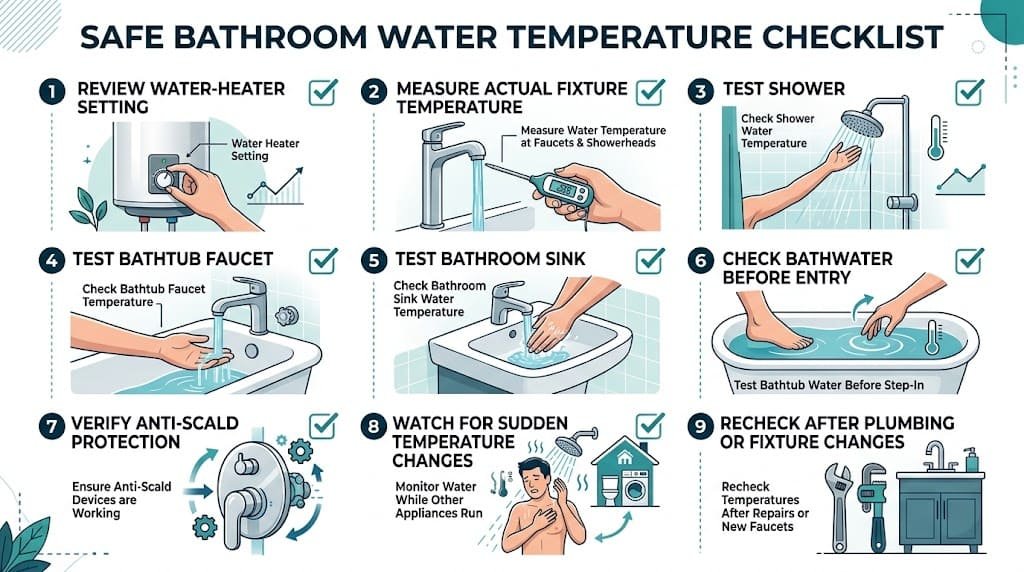
- Review the water heater temperature setting.
- Measure the actual hot-water temperature at the fixture.
- Test the shower outlet.
- Test the bathtub faucet.
- Test the bathroom sink if it supplies hot water.
- Mix bathwater thoroughly before entering.
- Check a child’s bathwater before the child enters.
- Check that anti-scald protection is present and functioning as intended.
- Make sure shower temperature remains reasonably stable during use.
- Recheck temperatures after plumbing or fixture changes.
A bathroom does not need to have a single temperature reading to be safe. The goal is controlled, predictable water temperature at the places where people actually use it.
10. Common Mistakes That Increase Bathroom Scald Risk
Assuming 120°F means the bathing water should be 120°F
This is one of the most important distinctions in the entire topic.
The 120°F recommendation commonly appears in U.S. scald-prevention guidance for residential hot water, but that does not mean 120°F is the desired temperature for sitting in a bath or standing under a shower. CPSC recommends 120°F for lowering residential water heater temperature, while actual bathing water should be comfortably warm.
Trusting the water heater dial without measuring the outlet
The dial indicates a setting within the water-heating system. It does not necessarily tell you exactly what temperature is coming from every bathroom fixture.
If you are concerned about scalding, measure the water at the point of use.
Testing only with your hand
Touch can provide a rough comfort check, but it is not a precise temperature measurement.
This matters particularly when preparing water for babies, children, older adults, or anyone who may not reliably sense heat. A thermometer gives you a more objective reading.
Adding very hot water while someone is already in the tub
Adding hot water can create a concentrated area of hotter water near the faucet before it has fully mixed with the rest of the tub.
If the bath needs more water, mix it carefully and check the temperature again before continuing bathing.
Ignoring sudden shower-temperature changes
A shower that suddenly becomes much hotter or colder is not simply a comfort problem.
Rapid temperature changes can cause thermal shock, potentially leading to an abrupt physical reaction, scalding, or a slip and fall.
If this happens repeatedly, the shower valve and plumbing system should be checked.
11. FAQs
What is the safest temperature for bathroom water?
There is no single temperature for every bathroom use. For U.S. homes, CPSC recommends a 120°F water heater setting to reduce tap-water scald risk, while actual bath and shower water should be comfortably warm rather than near that upper limit.
What temperature is recommended for your water heater?
CPSC recommends 120°F for residential water heaters as a way to reduce tap-water scald risk. However, household hot-water systems can have different requirements, and the temperature at the fixture should be verified rather than assumed from the heater dial alone.
How hot should shower water be?
Shower water should feel comfortably warm rather than very hot. Avoid treating 120°F as a target shower temperature; that figure is used in scald-prevention guidance as an upper-limit reference for hot-water delivery. Stable temperature is also important because sudden changes can cause thermal shock.
How hot should bath water be?
For adults, commonly cited bath-comfort guidance places the water around 90°F to 105°F. This is a comfort range, not a universal medical or regulatory threshold. Children require additional precautions, including checking the water before bathing and controlling the hottest faucet temperature.
Is 120°F too hot for a shower?
120°F is too hot to treat as a normal shower target. CPSC uses 120°F as a residential water heater safety recommendation, while water at that temperature can still cause serious burns with prolonged exposure.
How can I test my bathroom water temperature?
Use a suitable water thermometer and measure the water at the actual shower, bathtub, or sink outlet after the temperature has stabilized. Testing at the fixture provides more useful information about the water a person will actually encounter than relying only on the water heater dial.
Do I need an anti-scald device?
Anti-scald and temperature-compensating devices can provide an important layer of protection, particularly at showers and tubs where sudden temperature changes can create scalding or thermal-shock hazards. The appropriate device depends on the fixture and plumbing system.
Why does my shower suddenly become hotter or colder?
A common cause is a change in hot- or cold-water pressure when another fixture or appliance uses water. A pressure-balancing or thermostatic shower valve is designed to reduce these temperature swings. Persistent or extreme fluctuations should be evaluated rather than ignored.
12. Conclusion
A safe bathroom water temperature is not one number. The temperature stored in the water heater, the temperature delivered by a bathroom fixture, and the temperature of the water you actually use for bathing are three related but different measurements.
For U.S. homes, CPSC recommends a 120°F water heater setting to reduce tap-water scald risk. But 120°F should not be treated as a comfortable shower or bath temperature. Actual bathing water should be comfortably warm, and the temperature delivered at showers and tubs should be controlled to reduce the chance of scalding.
The safest approach combines appropriate water heater control, controlled fixture temperature, comfortable bathing water, actual temperature testing, stable shower performance, and suitable anti-scald protection.
If children, older adults, caregivers, or people who cannot reliably sense heat use the bathroom, temperature control becomes even more important. A quick thermometer check and a properly functioning temperature-control system can provide protection that simply relying on how the water feels cannot.
Water temperature is just one part of creating a safer bathroom, so review this complete guide to bathroom safety for additional ways to identify and reduce common risks.
4 Comments