
1. Introduction
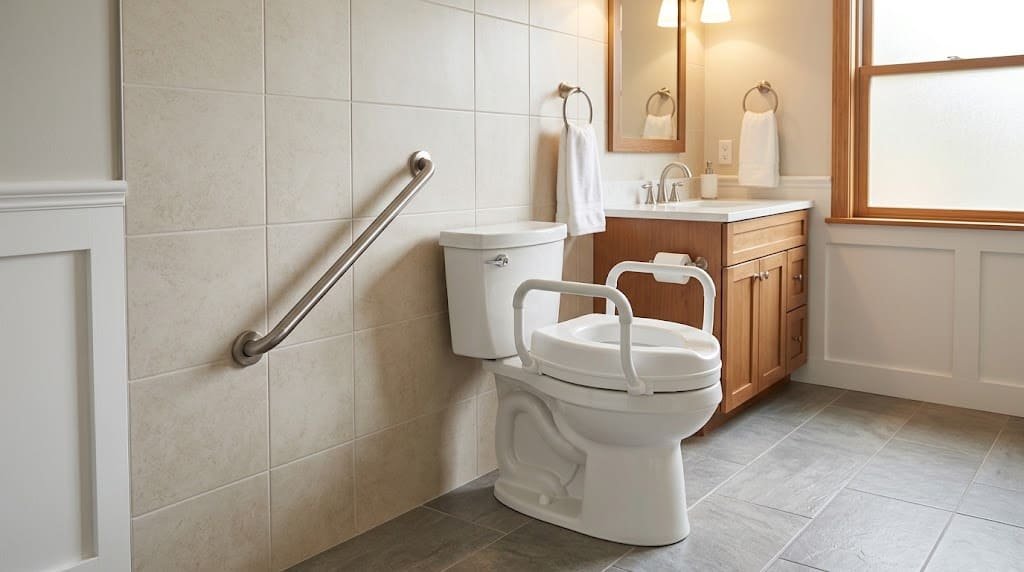
Toilet safety is about making the toilet area safer to approach, sit down, stand up, and move around without unnecessary hazards. A safe setup considers more than the toilet itself. The surrounding floor, lighting, available hand support, transfer space, and the needs of the person using the bathroom all matter.
Falls can happen when someone has difficulty lowering onto a low toilet, loses balance while standing, reaches for an unstable fixture, or encounters a wet or cluttered floor. These risks can become more important for older adults and people with mobility limitations, while young children have different risks around the toilet and bathroom.
This guide explains common toilet safety hazards, practical toilet fall prevention steps, useful safety equipment, and simple ways to check whether your toilet area is reasonably safe.
Table of Contents
2. What Is Toilet Safety?
Toilet safety means reducing hazards and making toilet-related movements as stable and predictable as reasonably possible. It includes the entire process of approaching the toilet, turning, sitting, standing, transferring, and leaving the area.
A safe toilet setup should provide enough space to move, a stable surface underfoot, adequate visibility, and appropriate support when a person needs help with balance or transfers.
Why the Toilet Area Can Become a Fall Hazard
The toilet creates a particular challenge because using it requires repeated changes in body position. A person may need to walk toward the toilet, turn around, lower their body, remain seated, and then stand again. Each movement can become harder when balance, strength, coordination, or mobility is limited.
Common factors that can increase risk include:
- Low toilet height: A low seat may require more effort to lower the body and stand back up.
- Wet or slippery floors: Water near the toilet can reduce traction and make movement less stable.
- Limited space: A narrow or cluttered area can make it harder to turn or position a walker.
- Poor lighting: Dim conditions can make changes in floor level, water, and obstacles harder to see.
- Unstable support: Reaching for a towel rack, shower door, or other fixture that was not designed to support body weight can create another hazard.
- Poor balance or strength: Changes in mobility can make sitting and standing more difficult.
- Rushing: Moving too quickly can reduce the time available to establish a stable position before sitting or walking away.
Historical CDC research on bathroom-related injuries found that falls accounted for most bathroom injuries in the 2008 U.S. dataset. The study also found that toilet-related activities were among the activities associated with bathroom injuries, with older adults particularly affected. These figures describe that historical dataset and should not be interpreted as a current annual estimate.
3. Common Toilet Safety Hazards
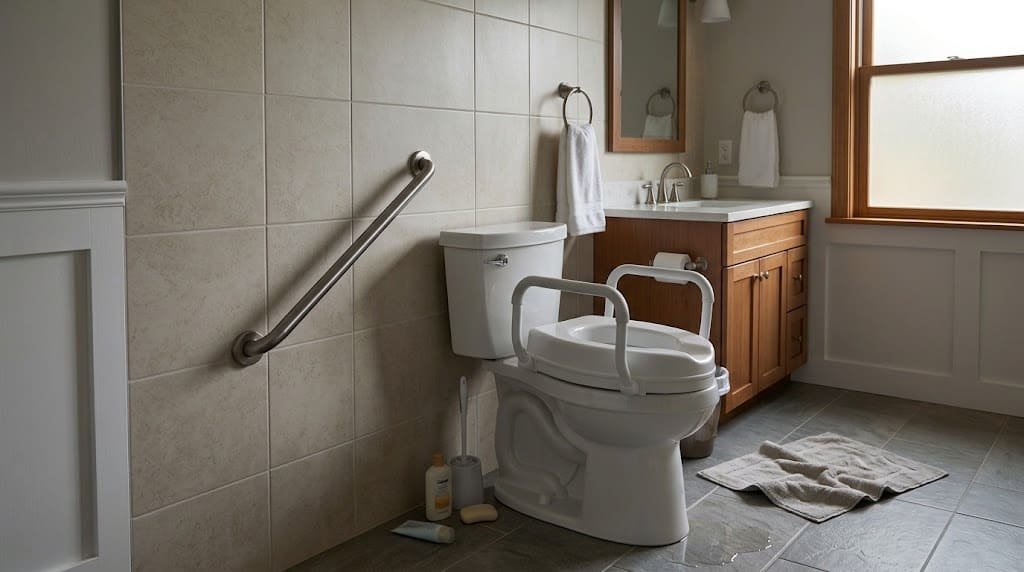
Many toilet-related risks are easy to overlook because they are part of the normal bathroom environment. A useful way to identify them is to look at the hazard, understand how it can affect movement, and then address the underlying problem.
| Hazard | Why it can be a problem | Practical prevention |
|---|---|---|
| Wet or slippery floor | Can reduce traction during sitting, standing, or walking | Clean up water promptly and maintain a suitably slip-resistant walking surface |
| Loose rugs | Can shift underfoot | Remove loose rugs or use only appropriately secured floor coverings |
| Low toilet | May make sitting and standing harder | Assess whether the toilet height suits the person using it |
| Unstable support | Can cause a person to lose balance when reaching for it | Use properly designed and securely installed support |
| Poor lighting | Makes hazards and obstacles harder to see | Improve general and nighttime lighting |
| Clutter | Can interfere with feet or mobility aids | Keep the toilet approach and transfer area clear |
Slippery Floors and Loose Rugs
Water around a toilet can come from handwashing, bathing, cleaning, or normal bathroom use. Even a small wet area can become an avoidable hazard when someone is turning, sitting, or standing.
Keep the floor around the toilet as dry and unobstructed as practical. Be especially careful with loose bath mats and rugs. If a floor covering is used, it should not slide or bunch underfoot.
The goal is not simply to make the floor look clean. It is to create a predictable surface that does not unexpectedly move or interfere with the person’s footing.
Low or Unstable Toilet Seating
Toilet height can affect how much effort a person needs to use during a transfer. Someone with reduced leg strength, joint limitations, or balance difficulties may find a low toilet harder to sit on or rise from.
The appropriate height depends on the individual. A higher seat is not automatically safer for everyone. The person’s feet should remain appropriately supported, and the setup should allow controlled sitting and standing rather than forcing an awkward position.
A toilet seat should also remain stable during normal use. If the seat moves unexpectedly, determine whether it needs adjustment or replacement rather than treating the movement as normal.
Missing or Unstable Hand Support
Some people need hand support to maintain balance while sitting down or standing up. The important distinction is whether the support is actually designed and installed for that purpose.
Do not use a towel rack, toilet-paper holder, shower door, or another fixture as a substitute for a grab bar unless it is specifically designed and rated for supporting a person’s weight. MedlinePlus specifically advises against using towel racks as grab bars.
If support is needed, consider an appropriately designed grab bar or toilet safety frame that matches the person’s needs and the bathroom layout.
Poor Lighting and Nighttime Trips
A bathroom can become more difficult to navigate at night when the main light is off. A person who is tired, has reduced vision, or needs to use the toilet frequently may have less time to identify obstacles.
Keep the route to the toilet reasonably well lit. A nightlight or other low-level lighting can help make the route and toilet easier to locate without requiring someone to navigate in darkness.
Lighting should also make the floor and surrounding area visible rather than creating strong glare or shadows that make obstacles difficult to recognize.
Clutter and Limited Transfer Space
The space immediately around the toilet should allow the person to approach, turn, sit, stand, and leave without having to work around unnecessary objects.
Move baskets, cleaning supplies, wastebaskets, and other items away from the transfer path when they interfere with movement. People who use walkers or wheelchairs may need additional space to position their mobility device safely.
A clear floor is particularly important when another person needs to assist with a transfer.
Reaching, Twisting, and Rushing
A person can become less stable when they have to reach too far for toilet paper, toiletries, clothing, or another item. Twisting while standing or trying to grab an unsuitable object for support can also make a transfer less controlled.
Keep frequently used items within a comfortable reach, but avoid positioning them where the person must lean significantly to one side.
Most importantly, avoid rushing the transfer. A controlled movement gives the person more opportunity to establish stable foot and hand positions.
4. How to Prevent Falls During Toilet Transfers
Toilet fall prevention starts with treating the transfer as a sequence of movements rather than one action. The basic process is to approach the toilet, establish a stable position, sit with control, and then reverse the process when standing.
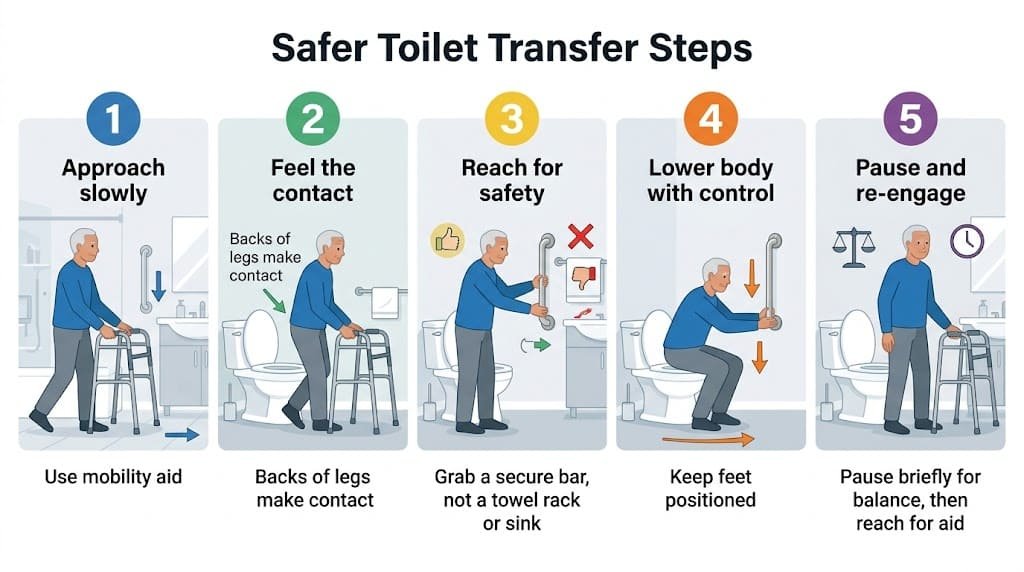
People with significant mobility limitations should use the transfer method taught by their physical therapist, occupational therapist, or other qualified professional. A general guide cannot account for every person’s strength, balance, surgical restrictions, wheelchair setup, or level of assistance.
Before Sitting Down
Before starting the transfer:
- Clear the immediate floor area. Make sure feet and mobility aids have a clear path.
- Approach the toilet at a controlled pace. Avoid turning or stopping abruptly.
- Position your mobility aid appropriately. Follow the instructions provided for the specific walker or other device.
- Identify designated support. Use an appropriate grab bar or safety frame if one is part of the person’s setup.
- Position yourself before beginning to sit. Avoid reaching backward blindly for the toilet.
The goal is to establish a stable position before lowering the body.
Sitting Down Safely
When appropriate for the person’s mobility and transfer plan:
- Approach the toilet and turn so that your back is toward the seat.
- Move back until you can feel the toilet seat behind your legs.
- Keep your feet positioned securely on the floor.
- Use designated support rather than reaching for an unstable fixture.
- Lower yourself slowly and with control.
- Once seated, allow yourself to become stable before making another movement.
The exact technique may differ for someone using a wheelchair, walker, or caregiver assistance. In those situations, the person’s individualized transfer plan should take priority over a generic sequence.
Standing Up Safely
Standing up from a toilet can require substantial effort because the person begins from a relatively low seated position.
When appropriate for the individual’s transfer plan:
- Place your feet in a stable position.
- Move forward on the seat as appropriate for your ability and setup.
- Lean forward in a controlled manner rather than pulling suddenly on an unstable object.
- Use designated support.
- Rise steadily.
- Regain your balance before beginning to walk.
If standing requires significant assistance, repeated attempts, or unsafe pulling and twisting, the issue should be assessed rather than solved simply by telling the person to “be more careful.”
5. Toilet Safety Equipment: What Helps and When?
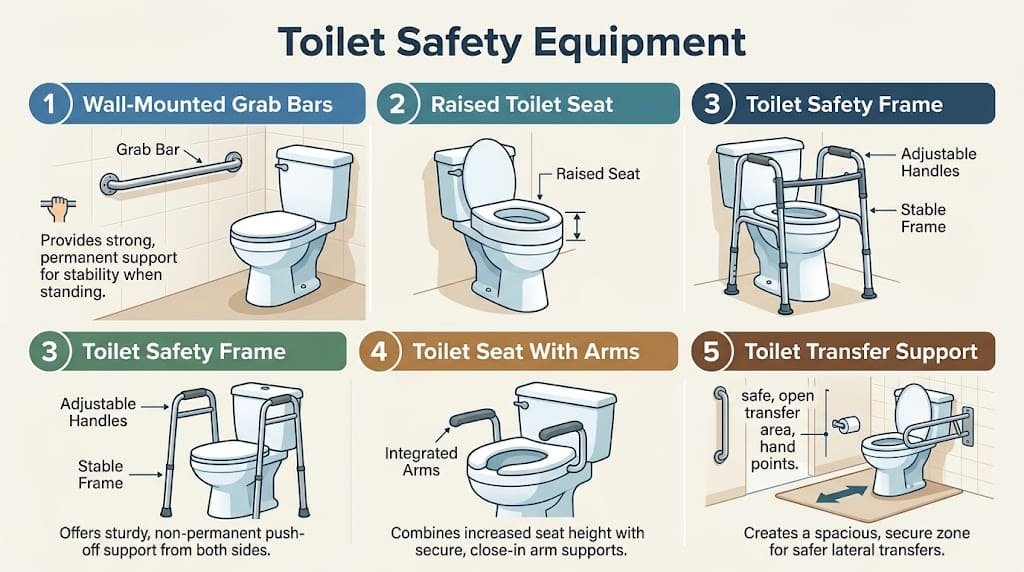
Toilet safety equipment can make a bathroom easier to use, but the right option depends on the person’s needs, the toilet, and the available space.
| Safety option | What it addresses | Important consideration |
|---|---|---|
| Raised toilet seat | Increases seating height | Must fit securely and provide an appropriate height |
| Comfort-height toilet | Provides a permanently higher seat | Requires replacing the existing toilet |
| Toilet safety frame | Provides nearby arm support | Must remain stable during use |
| Wall-mounted grab bar | Provides fixed hand support | Requires appropriate installation and placement |
| Over-toilet commode | Can provide increased height and arm support | Must be appropriately sized and positioned |
Raised Toilet Seats
A raised toilet seat can reduce the distance a person needs to lower and raise their body. This may be useful for someone who finds a standard-height toilet difficult to use.
However, simply choosing the highest available seat is not the goal. The height should suit the person’s body position and ability to keep their feet appropriately supported. The seat also needs to be compatible with the toilet and securely attached according to the manufacturer’s instructions.
Check for movement before relying on the seat during a transfer. If it shifts, rocks, or does not fit correctly, it should not be treated as secure support.
Grab Bars and Toilet Safety Frames
A grab bar is generally a fixed support designed to provide a handhold. A toilet safety frame typically sits around the toilet and provides armrests or handles close to the user.
Neither is automatically better for every bathroom. The useful choice depends on the person’s movement pattern, available wall structure and space, transfer needs, and whether permanent or movable equipment is appropriate.
For wall-mounted equipment, proper installation matters. A grab bar that is poorly installed or attached to an unsuitable surface may not provide dependable support. Follow applicable installation instructions and, when needed, seek qualified help.
Properly positioned grab bars can provide support when sitting down on the toilet or standing up. Learn where to place bathroom grab bars for practical guidance on positioning them around toilets, showers, and bathtubs.
What Not to Use for Body-Weight Support
A common mistake is assuming that anything within arm’s reach can serve as a support.
Do not rely on objects such as:
- towel racks
- toilet-paper holders
- shower doors
- unstable furniture
- decorative bathroom fixtures
- other items not designed to support a person’s weight
These objects may move, detach, or break when used to catch or support a person’s body.
A safer approach is to identify where support is actually needed and use equipment designed for that purpose.
6. Toilet Safety for Seniors and People With Mobility Challenges
Toilet safety can become especially important for older adults and people whose strength, balance, joint movement, or mobility has changed. The right solution is not necessarily more equipment; it is equipment and layout that match the person’s actual movement needs.
When Toilet Height May Need Attention
A toilet may deserve closer attention when someone consistently struggles to sit down or stand up.
Signs that the height may be difficult to manage can include:
- needing substantial effort to rise
- difficulty controlling the descent onto the seat
- using unstable objects to pull up
- difficulty maintaining balance during the transfer
- joint or leg limitations that make a low seated position difficult
A raised toilet seat or different toilet height may help in some situations, but it should be selected based on the person’s needs rather than height alone.
Make Room for Walkers, Wheelchairs, and Caregivers
A safe transfer requires enough room to position the body and, when applicable, a mobility device.
Keep the approach to the toilet clear and consider where a walker, wheelchair, or caregiver will be positioned. A person should not have to squeeze between furniture or move a wastebasket every time they need to use the toilet.
For wheelchair users or people who require hands-on assistance, transfer space can be particularly important. The best arrangement depends on the person’s mobility device and individual transfer method.
When Professional Assessment Makes Sense
A professional assessment can be useful when a person has repeated difficulty with toilet transfers, has fallen or nearly fallen, cannot determine an appropriate equipment setup, or requires substantial assistance.
An occupational therapist or physical therapist can assess movement and recommend changes that fit the individual’s abilities and limitations. A qualified accessibility professional may also help when the bathroom requires more extensive physical modifications.
CDC fall-prevention resources recommend assessing fall risks and addressing hazards in the home for older adults. The important principle is to match the intervention to the person’s actual risk and abilities rather than adding equipment without considering how it will be used.
7. Toilet Safety for Children
Children have different toilet safety needs from adults. For young children, the concern is not primarily toilet transfers but access to water, bathroom hazards, and the child’s ability to recognize danger.
Prevent Unsupervised Bathroom Access
Young children should not be assumed to understand the risks associated with a bathroom simply because they can walk or use the toilet independently.
Keep bathroom access appropriately supervised for young children, particularly when water is present. Store potentially hazardous products securely and avoid leaving a child alone in a bathroom when supervision is needed.
Use Toilet-Lid Safety Measures When Appropriate
For households with young toddlers, a toilet-lid lock can be one way to restrict access to the toilet.
The American Academy of Pediatrics notes that toilets can pose a drowning hazard for young children and recommends keeping young children from accessing bathrooms without supervision. A toilet-lid lock may provide an additional barrier, but it does not replace active supervision.
Choose a product that is appropriate for the toilet and child, and follow its installation instructions.
Supervise Young Children Around Bathroom Water
Toilet water is only one part of the concern. Young children can also encounter water in sinks, tubs, buckets, and other bathroom containers.
Keep children within appropriate supervision when they are around bathroom water. Do not assume that a child who can stand, walk, or use the toilet independently can safely manage every bathroom hazard.
Toilet safety involves more than preventing slips or making it easier to sit down and stand up. Bathroom accessibility also depends on toilet placement, transfer space, reachable fixtures, and the user’s ability to move around the room. Read our guide to bathroom accessibility for more information about accessible toilet design and layout.
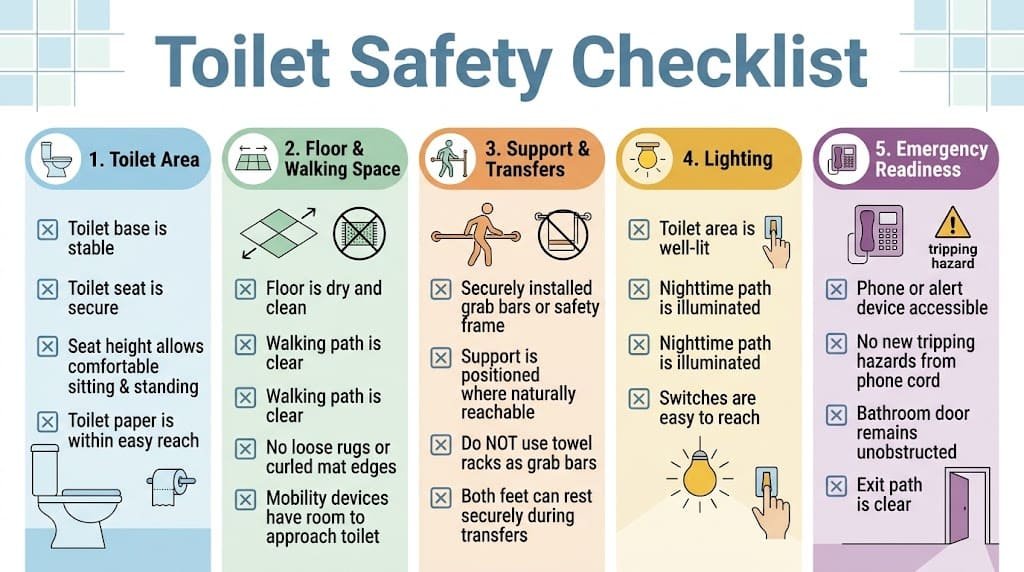
8. Toilet Safety Checklist: A Quick Home Inspection
Use this checklist to identify simple problems around the toilet before they contribute to an unsafe transfer.
Toilet
- The toilet seat is stable and does not move unexpectedly.
- The toilet height is appropriate for the person using it.
- Any raised toilet seat is securely fitted according to its instructions.
- The person can sit down and stand up without relying on unstable objects.
Floor
- The floor is dry.
- The path around the toilet is clear.
- There are no loose rugs or mats that can shift underfoot.
- The walking surface provides appropriate traction for normal bathroom use.
Support
- A grab bar or toilet safety frame is available when needed.
- Fixed support is securely installed.
- Support can be reached without excessive leaning or twisting.
- No towel rack, shower door, or other unsuitable fixture is being used as a grab bar.
Space
- There is enough room to approach and turn toward the toilet.
- A walker or wheelchair can be positioned appropriately when needed.
- A caregiver has enough room to assist safely when assistance is required.
Lighting
- The toilet and surrounding floor are adequately visible.
- The route to the bathroom can be safely navigated at night.
- A nightlight or other suitable low-level lighting is available when needed.
- Light switches or controls can be reached without an awkward maneuver.
Children
- Young children cannot access the bathroom unsupervised when supervision is required.
- A toilet-lid lock is used when appropriate for the household.
- Young children are supervised around bathroom water.
- Bathroom products and other hazards are kept out of a child’s reach.
9. FAQs
What are the most common toilet safety hazards?
Common toilet safety hazards include wet or slippery floors, loose rugs, low or unstable seating, inadequate hand support, poor lighting, cluttered transfer areas, and movements that require excessive reaching or twisting. The safest approach is to address the specific hazard rather than relying on one piece of equipment to solve every problem.
Does a raised toilet seat help prevent falls?
A raised toilet seat may make sitting down and standing up easier for some people by increasing the seat height. It does not automatically prevent falls, however. The seat must fit securely, the height must suit the person, and the surrounding floor and support setup must also be appropriate.
Are toilet safety frames better than grab bars?
Neither option is universally better. A toilet safety frame generally provides arm support around the toilet, while a grab bar provides fixed hand support. The appropriate choice depends on the person’s mobility, bathroom layout, installation conditions, and transfer needs.
What should you never use as a grab bar?
Do not rely on towel racks, toilet-paper holders, shower doors, unstable furniture, or decorative fixtures for body-weight support unless the item is specifically designed and rated for that purpose. A purpose-designed support should be used when a person needs assistance with balance or transfers.
How can I make a toilet safer for an older adult?
Start by checking the floor, lighting, toilet height, transfer space, and available support. Remove loose rugs and clutter, keep the route well lit, and consider appropriately installed equipment if sitting or standing is difficult. If the person has significant balance or mobility problems, an occupational or physical therapist can help determine which changes fit their needs.
How can I make a toilet safer for a toddler?
Limit unsupervised bathroom access, supervise young children around bathroom water, and consider a toilet-lid lock when appropriate. Keep bathroom products and other hazards secured. A toilet-lid lock is an additional safety measure, not a replacement for supervision.
10. Final Toilet Safety Check
A safer toilet area is not created by one product alone. Effective toilet safety comes from reducing hazards, providing stable support when needed, maintaining enough space for movement, improving visibility, and matching the setup to the person using it.
Before considering the area finished, check five things:
- Floor: Is it dry and clear?
- Toilet: Is the seat stable and the height appropriate?
- Support: Is suitable support available and secure?
- Space: Can the person approach, turn, sit, and stand safely?
- Lighting: Can the route and toilet be seen clearly, including at night?
Small changes can address simple hazards, while significant mobility difficulties may require an individualized professional assessment.
11. Conclusion
Toilet safety is about making every part of the toilet area work together. A stable toilet, clear floor, appropriate lighting, suitable support, and enough transfer space can make routine bathroom movements more predictable and manageable.
For older adults and people with mobility challenges, pay particular attention to toilet height, transfer technique, and access to stable support. For young children, focus on supervision, bathroom access, and preventing access to toilet water.
The best safety changes are the ones that address the person’s actual needs rather than adding equipment simply because it is available. A quick inspection of the toilet, floor, support, space, and lighting can reveal practical problems before they become more serious hazards.
Toilet safety is one part of creating a safer bathroom overall, so it helps to look at the wider risks and prevention measures covered in our complete guide to bathroom safety.
3 Comments