
1. Introduction
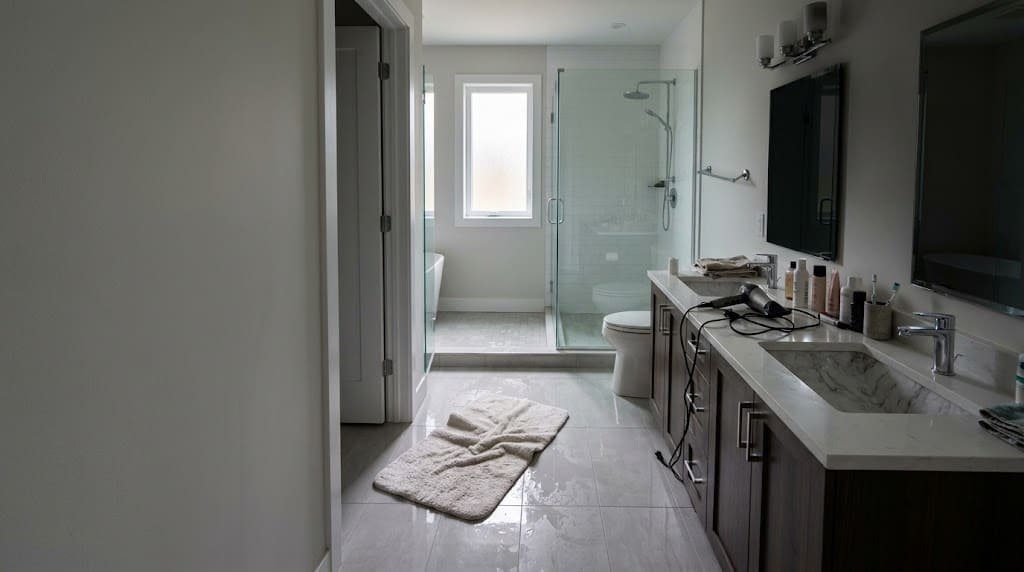
Bathrooms combine water, smooth surfaces, heat, electricity, hard fixtures, and limited walking space. That combination makes them one of the areas in a home where a small environmental problem can quickly become a safety risk.
Bathroom safety hazards include conditions that can contribute to slips and falls, burns or scalds, drowning, electrical shock, poisoning, and other injuries. Some are obvious, such as a wet floor. Others are easier to overlook, such as poor nighttime lighting, a loose toilet seat, an appliance left near water, or medications stored within a child’s reach.
The safest approach is not to look for one single dangerous feature. Instead, inspect the bathroom systematically, identify the hazards that apply to the people using it, and make practical changes that reduce those risks.y
Table of Contents
2. What Are Bathroom Safety Hazards?
Bathroom safety hazards are physical conditions, objects, environmental factors, or situations in a bathroom that can increase the likelihood of an injury or other safety problem.
Common examples include slippery floors, difficult tub entry, poor lighting, excessive hot water, unsafe electrical appliances, unsecured medicines and chemicals, and bathroom moisture problems.
Why Bathrooms Can Be Risky
A bathroom brings several different risks together in a relatively small space.
Water can reduce traction on floors and bathing surfaces. Hard tile, tubs, toilets, countertops, and other fixtures can increase the consequences of a fall. Hot water can cause scalding, while electrical appliances and outlets create additional hazards when used incorrectly around water.
Movement also matters. Stepping over a tub wall, getting into a shower, standing from a toilet, or walking to the bathroom at night can be more difficult for someone with reduced balance, limited mobility, poor vision, or muscle weakness.
For this reason, bathroom safety is not only about the condition of the room. It also depends on how the room is used and who uses it.
The Main Categories of Bathroom Hazards
Most bathroom safety risks fall into six broad groups:
- Fall and physical hazards: Wet floors, slippery tubs, loose rugs, clutter, difficult transfers, and unstable fixtures.
- Water and temperature hazards: Hot water, scalding, standing water, and drowning risks.
- Electrical hazards: Appliances, damaged cords, and electrical equipment used too close to water.
- Chemical hazards: Cleaning products, medications, and other substances that can cause poisoning or injury.
- Moisture and biological hazards: Excess humidity, leaks, recurring mold, and inadequate ventilation.
- User-specific hazards: Risks that become more significant for young children, older adults, or people with mobility, balance, vision, or other functional limitations.
Thinking about hazards this way makes it easier to inspect the entire bathroom rather than focusing only on slippery floors.
3. Common Bathroom Safety Hazards to Look For
Some bathroom hazards are common because bathrooms naturally contain water and smooth surfaces. Others develop from clutter, poor maintenance, or a setup that does not match the needs of the people using the room.
Wet and Slippery Floors
Wet flooring is one of the most obvious bathroom fall hazards, but the problem is not limited to a large puddle.
Water can collect around the shower or bathtub, near the sink, or on the floor after someone steps out of the shower. Soap and shampoo residue can also make surfaces less predictable underfoot.
Pay particular attention to the transition from a wet bathing area to a dry walking area. A person may step out of a shower expecting the floor to provide normal traction when it is actually wet.
Keep walking surfaces as dry and clear as practical. Address leaks, wipe up standing water, and make sure mats or other floor coverings do not introduce a new slipping or tripping problem.
Slippery Tubs and Showers
The tub or shower combines several potential fall hazards: water, soap, smooth surfaces, and the need to step over or around a threshold.
The risk can increase when a person has difficulty maintaining balance or getting into and out of the bathing area.
Look at:
- The level of grip provided by the tub or shower floor
- The area where a person steps in and out
- Water that remains on the surface
- The location and condition of any bath mat
- Whether the person has adequate support for entering, exiting, or transferring
A surface that feels manageable when dry may behave differently when covered with water or soap.
Trips From Rugs, Clutter, and Cords
Not every bathroom fall starts with a slippery surface. Objects in a walking path can also create trip hazards.
Common examples include:
- Loose bath mats
- Towels left on the floor
- Laundry baskets
- Toiletries or other objects left in walking areas
- Electrical cords
- Small items near the toilet or vanity
- Objects that make the route to the shower or toilet narrower
Keep frequently used walking paths clear. If a floor covering is used, it should not slide or create an unstable edge.
Unsafe Tub and Shower Entry
Getting into or out of a tub or shower can be difficult when there is a high tub wall, limited space, a wet edge, or insufficient support.
The challenge is particularly important for someone who has reduced balance or mobility. The person may have to shift weight, step over a threshold, turn, and lower or raise their body while standing on a potentially wet surface.
If entering or exiting the bathing area feels unstable, that is a sign that the bathroom setup may need to be changed rather than simply relying on the person to “be more careful.”
Poor Lighting and Nighttime Hazards
A bathroom that is adequately lit during the day can still be difficult to navigate at night.
Low lighting can make it harder to see wet spots, objects on the floor, changes in floor level, or the location of fixtures. A nighttime trip between the bedroom and bathroom also creates a different safety situation from normal daytime use.
Consider:
- Whether the route to the bathroom is clearly visible
- Whether switches are easy to reach
- Whether the bathroom itself is adequately illuminated
- Whether a night light would improve visibility
- Whether shadows make steps, thresholds, or objects difficult to see
The National Institute on Aging recommends measures such as improving lighting and using night lights as part of home fall prevention.
Loose or Unstable Bathroom Fixtures
A fixture can become a hazard when it is loose, damaged, or mistakenly treated as a source of support.
Check for:
- Loose toilet seats
- Unstable fixtures
- Damaged flooring
- Sharp or hard edges that create an avoidable injury risk
- Fixtures that someone may instinctively grab when losing balance
One important distinction is between a fixture designed to provide support and one that merely happens to be within reach. A towel rack should not be used as a grab bar because it is not designed to support a person’s weight. MedlinePlus specifically warns against using towel racks for this purpose.
4. Hot Water and Scalding Hazards
Hot water is another important bathroom safety risk. A person can be injured by water that is hotter than expected, particularly when they cannot react quickly enough or have difficulty sensing temperature.
Why Hot Water Can Become a Bathroom Safety Hazard
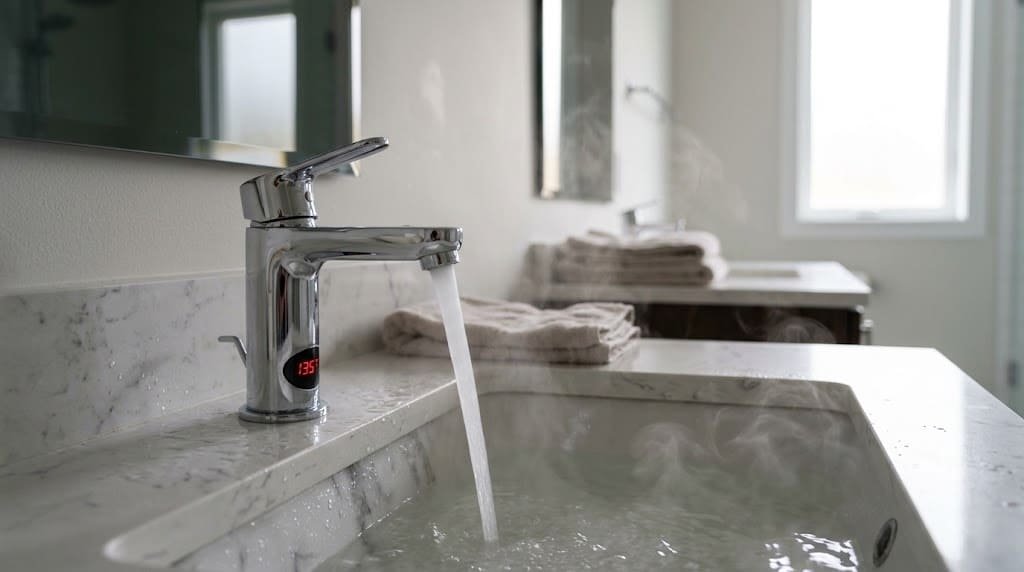
Hot water can cause scalding in a short period of time. The risk is especially important for young children because their skin can be more vulnerable to burns and they may not recognize the danger.
A bathroom can also contain several sources of hot water, including sinks, bathtubs, and showers. A person may encounter a sudden temperature change if the plumbing or controls are not working properly.
Do not assume that a faucet is safe simply because the water normally feels comfortable. Temperature should be controlled at the source and checked before bathing, especially when children or people with reduced sensation are using the bathroom.
Water Heater Temperature and Anti-Scald Protection
MedlinePlus recommends setting a home’s water heater to no more than 120°F (49°C) to help prevent burns. It also discusses anti-scald measures for bathroom use.
Useful precautions include:
- Set the water heater to a safe temperature to help prevent scalding.
- Test bath or shower water before use.
- Pay attention to sudden temperature changes.
- Consider appropriate anti-scald protection where needed.
- Make sure shower and faucet controls are functioning properly.
The exact temperature experienced at a fixture can depend on the plumbing system and controls, so a water-heater setting should not be treated as a substitute for checking the water itself.
Who Is Most Vulnerable to Scalding?
Young children are particularly vulnerable because they may not understand hot-water hazards or be able to move away quickly.
Older adults and people with reduced sensation or slower reactions may also have difficulty detecting or responding to excessively hot water.
This is why temperature control becomes especially important when a bathroom is used by people with different abilities and levels of independence.
5. Electrical Hazards in the Bathroom
Water and electricity require particular caution. Bathroom electrical hazards can involve appliances, cords, outlets, or equipment that is damaged or used inappropriately.
Common Bathroom Electrical Hazards
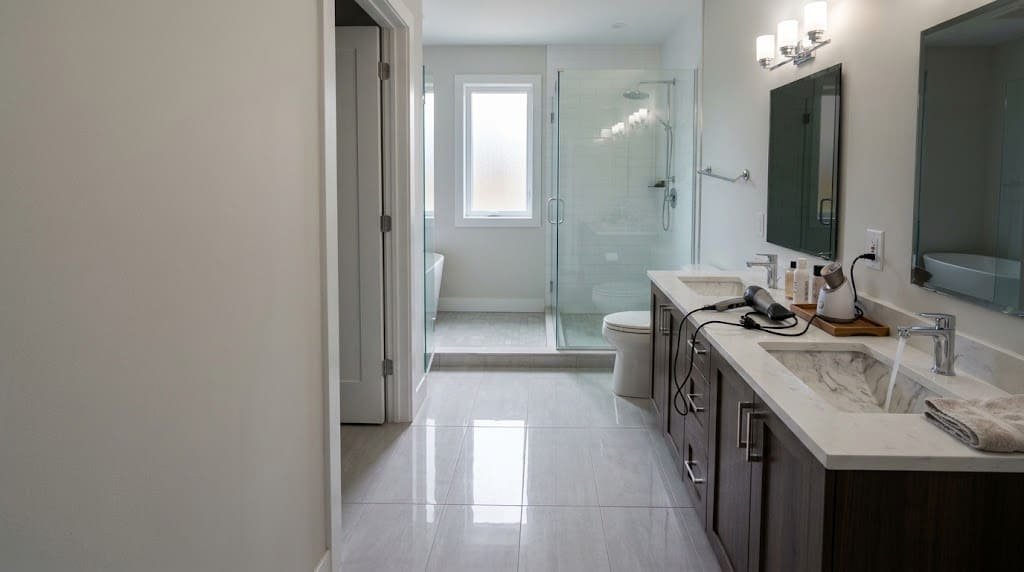
Potential problems include:
- Hair dryers
- Curling irons
- Electric shavers
- Damaged electrical cords
- Appliances placed close to sinks or tubs
- Portable heaters
- Improper use of electrical outlets
Keep electrical appliances away from water and follow the safety instructions supplied with the equipment.
Never use a damaged cord simply because the damage appears minor. A frayed or compromised cord can create a shock or fire hazard.
GFCI Protection and Bathroom Outlets
A ground-fault circuit interrupter (GFCI) is designed to interrupt electrical power when it detects a ground fault, helping reduce the risk of serious electrical shock.
GFCI protection is particularly important in locations where electricity and water may come into close proximity. Bathroom electrical requirements can also depend on the applicable electrical code and the specific installation, so homeowners should not treat a general online explanation as a substitute for professional electrical work.
If a new outlet needs to be installed, wiring needs to be changed, or there is a suspected electrical fault, use a qualified electrician rather than attempting unfamiliar electrical work.
Safer Everyday Electrical Habits
A few simple habits can reduce unnecessary electrical risk:
- Keep electrical appliances away from water.
- Unplug devices when appropriate and according to the manufacturer’s instructions.
- Do not use damaged cords or damaged appliances.
- Keep portable electric heaters out of bathrooms unless the equipment and installation are specifically designed and approved for the application.
- Do not use electrical equipment in a way that conflicts with its instructions.
The goal is to prevent water and electricity from becoming part of the same accident.
6. Bathroom Hazards for Children
Children face some bathroom hazards differently from adults. A toddler can reach or interact with objects that an adult would never consider dangerous, and young children may not recognize risks involving water, heat, chemicals, or electrical appliances.
Drowning Hazards
Bathtubs and toilets can present drowning hazards for young children, particularly when bathroom access is unsupervised.
The American Academy of Pediatrics recommends close, constant supervision around water and describes bathroom access control as another layer of protection. Young children should not be left alone in or near bath water, even briefly.
Practical precautions include:
- Keep young children within arm’s reach during bathing.
- Do not rely on bath seats or rings as a substitute for supervision.
- Keep bathroom doors closed or use appropriate access controls when the room is not in use.
- Consider a toilet lid lock where appropriate.
- Empty the tub completely after each use.
Supervision is the primary protection, while physical barriers can provide an additional layer.
Scalding and Hot Faucets
Children can be burned by hot water from a bathtub, shower, or sink.
Keep water temperatures appropriately controlled and test bath water before placing a child in it. Young children may also grab or lean against a faucet, so consider whether the fixture itself presents an impact or burn hazard.
HealthyChildren.org recommends setting the hottest temperature at the faucet to no more than 120°F (48.9°C) as a child-safety measure.
Medicines, Cleaning Products, and Chemicals
Medications, cleaning products, disinfectants, cosmetics, and other substances can become poisoning hazards when they are accessible to children.
Store medicines and hazardous products where children cannot reach them. A high shelf alone may not be sufficient for a determined or mobile child; locked storage can provide an additional barrier.
Store products in their original packaging and use them according to the instructions provided. Do not transfer chemicals into containers that could be mistaken for something else.
Razors, Small Objects, and Electrical Appliances
Razors, scissors, small personal-care items, hair dryers, curling irons, and similar objects can create different risks ranging from cuts to burns and electrical injury.
Store sharp or hazardous objects out of children’s reach. Electrical appliances should be unplugged and stored safely when not in use, particularly when young children are present. MedlinePlus specifically advises keeping items such as razors, hair dryers, and curling irons away from children and storing cleaning products securely.
Childproofing the Bathroom
Effective childproofing combines supervision with environmental controls.
Consider:
- Supervising young children around water.
- Limiting unsupervised bathroom access.
- Using appropriate latches or locks.
- Keeping medicines and chemicals in locked storage.
- Keeping sharp objects and electrical appliances out of reach.
- Securing toilet lids where appropriate.
- Removing unnecessary water from tubs when they are not being used.
No single childproofing device eliminates every risk, so use several layers of protection.
7. Bathroom Fall Hazards for Older Adults and People With Mobility Needs
Bathrooms can be particularly challenging for older adults and people with mobility or balance limitations because many routine activities require standing, stepping, turning, lowering, or rising.
Why Bathroom Transfers Can Be Difficult
A transfer is any movement between positions or surfaces, such as getting into or out of a tub or sitting down and standing up from a toilet.
These movements can become harder when:
- The tub has a high wall.
- The shower entrance is difficult to navigate.
- The floor is wet.
- There is limited maneuvering space.
- A person has reduced strength or balance.
- Support is difficult to reach.
The safest setup depends on the individual. A modification that works well for one person may not work equally well for another.
Common Accessibility Hazards
Look for features that make normal bathroom tasks unnecessarily difficult:
- High thresholds
- Low toilet height
- Lack of stable support
- Limited maneuvering space
- Poorly positioned fixtures
- Controls that are difficult to reach
- Insufficient lighting
The CDC’s fall-prevention guidance recommends removing trip hazards, adding grab bars in and around tubs or showers and near toilets, and improving lighting as part of making a home safer.
Bathroom Safety Features That Can Reduce Risk
Depending on the person’s needs, useful safety features may include:
- Properly installed grab bars
- Shower chairs or benches
- Handheld showerheads
- Appropriate nonslip surfaces
- Improved lighting
- Toilet-height modifications
Grab bars should be securely installed for their intended use. They should not be confused with towel racks or other fixtures that were not designed to support body weight. MedlinePlus recommends grab bars for situations such as getting into and out of a tub and standing from a toilet.
The important point is fit. A bathroom should be adapted to the person using it, rather than assuming that a particular product or modification is automatically appropriate for everyone.
8. Chemical, Medication, and Poisoning Hazards
Not all bathroom safety risks involve falls or physical movement. Bathrooms often contain substances that can be harmful if swallowed, mixed incorrectly, inhaled, or exposed to skin or eyes.
Cleaning Products and Disinfectants
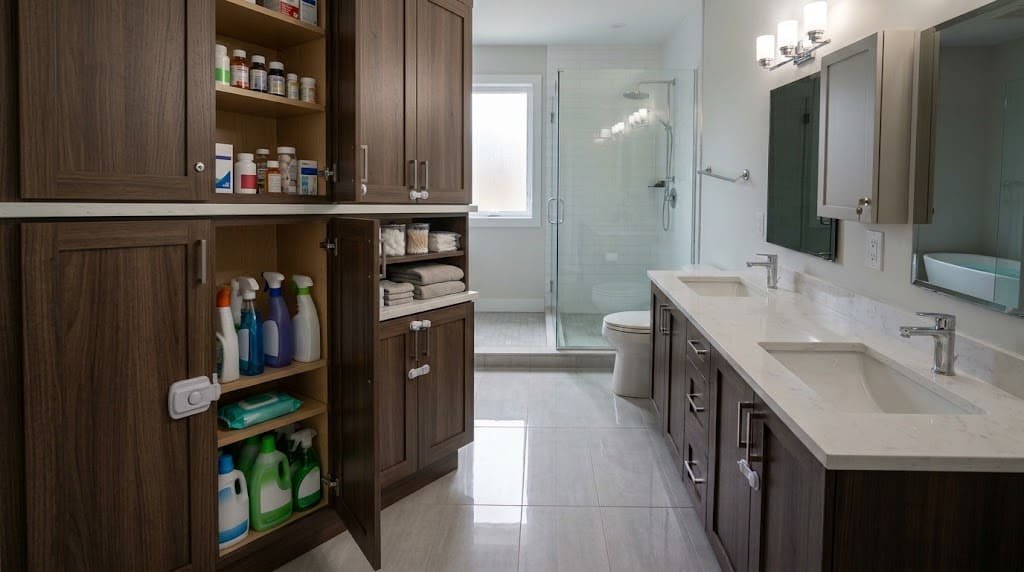
Bleach, disinfectants, drain products, and other cleaners should be stored and used according to their labels.
Keep hazardous cleaning products away from children and avoid mixing products unless the manufacturer’s instructions specifically permit it. Store chemicals in their original, clearly labeled containers.
Medicines and Personal-Care Products
Bathrooms may contain prescription medicines, over-the-counter medicines, cosmetics, and other personal-care products.
For households with young children, medications should be stored securely. MedlinePlus recommends keeping medicines in their original bottles and using locked storage for medicines kept in the bathroom.
Also consider who else uses the bathroom. A product that seems harmless to an adult may present a serious problem for a child or another person who could accidentally ingest it.
Safer Bathroom Storage
A safer storage system should make hazardous items difficult to access and easy to identify.
Consider:
- Locked storage when children or vulnerable users have access.
- Keeping products in their original containers.
- Keeping incompatible chemicals separated according to label instructions.
- Following product labels for storage and use.
- Keeping medicines and cleaning products away from ordinary toiletries.
Good storage reduces the chance that an everyday bathroom activity turns into an accidental exposure.
9. Moisture, Mold, and Ventilation Hazards
Moisture-related problems are different from immediate fall or electrical hazards, but they still matter for bathroom safety and the condition of the home.
How Excess Moisture Creates Problems
Showers and baths release moisture into the bathroom. When moisture remains trapped, condensation and damp surfaces can become recurring problems.
Leaks can create another source of moisture. Ongoing moisture can encourage mold to develop and gradually deteriorate bathroom surfaces.
The EPA recommends controlling moisture, fixing water problems, and using bathroom ventilation to reduce conditions that support mold growth.
Signs of a Bathroom Moisture Problem
Watch for:
- Persistent condensation
- Damp surfaces that do not dry normally
- Recurring mold
- Musty odors
- Water leaks
- Repeated moisture around fixtures or ceilings
One isolated instance of condensation does not necessarily mean there is a major moisture problem. Repeated or persistent signs deserve closer attention.
How Bathroom Ventilation Helps
Bathroom ventilation helps remove moisture produced during bathing.
Practical measures include:
- Run the exhaust fan while showering and as needed afterward.
- Make sure the bathroom exhaust system actually vents moisture outside rather than into an enclosed space such as an attic.
- Dry persistently wet surfaces.
- Address plumbing leaks promptly.
- Keep ventilation paths clear.
EPA guidance specifically recommends using bathroom exhaust fans to remove moisture to the outside.
The objective is not to make the bathroom completely free of moisture. It is to prevent moisture from remaining uncontrolled long enough to create recurring problems.
10. Bathroom Safety Hazards by Area
A room-by-room inspection can be more practical than trying to remember a long list of hazards. Walk through the bathroom and assess each area based on how people actually use it.
Bathroom Entry and Floor
Check:
- Lighting
- Rugs and mats
- Clutter
- Wet areas
- Floor condition
- Thresholds and changes in floor level
The entrance should provide a clear, well-lit route into the bathroom.
Sink and Vanity
Check:
- Water spills
- Electrical appliances
- Sharp objects
- Medicines and cosmetics
- Storage
Look at what is left on the counter as well as what is stored in drawers and cabinets.
Toilet Area
Check:
- Toilet stability
- Seat stability
- Support needs
- Floor condition
- Nighttime visibility
If someone has difficulty sitting down or standing up, consider whether the toilet height, surrounding space, and available support match that person’s needs.
Tub and Shower
Check:
- Floor traction
- Entry and exit
- Grab-bar needs
- Water temperature
- Shower seating
- Standing water
This is usually the area where water, balance, temperature, and transfer hazards overlap most strongly.
Storage and Electrical Areas
Check:
- Chemicals
- Medicines
- Cords
- Appliances
- Outlet safety
The goal is to keep hazardous substances and electrical equipment appropriately separated from normal walking and bathing activities.
Once you know which hazards to look for, use our bathroom safety checklist to systematically inspect your bathroom and prioritize the problems that need attention first.
11. Bathroom Safety Hazards Checklist
Use this checklist as a quick inspection tool. If an item cannot be checked safely or you are unsure whether an electrical, structural, or accessibility issue is being handled correctly, seek appropriate professional help.
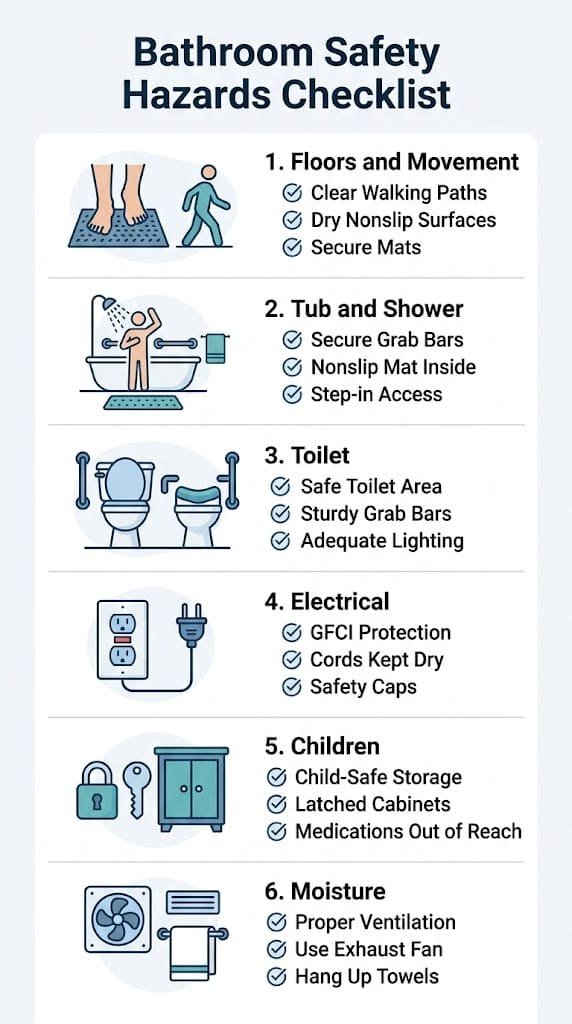
Floors and movement
- ☐ Floors are free of standing water.
- ☐ There are no loose rugs or unsecured mats.
- ☐ Walking paths are clear.
- ☐ Cords are not creating trip hazards.
Tub/shower
- ☐ The bathing surface provides appropriate traction.
- ☐ Entry and exit are manageable for the person using the bathroom.
- ☐ Stable support is available where needed.
- ☐ Water temperature is controlled.
Toilet
- ☐ The toilet seat is secure.
- ☐ The user can sit down and stand up safely.
- ☐ Adequate lighting is available.
Electrical
- ☐ Appliances are kept away from water.
- ☐ Cords are intact.
- ☐ Appropriate GFCI protection is present where required.
Children
- ☐ Medicines are secured.
- ☐ Cleaning chemicals are secured.
- ☐ Bathroom access is controlled when young children are not supervised.
- ☐ Children are supervised around water.
Moisture
- ☐ The exhaust fan works properly.
- ☐ Moisture is vented appropriately.
- ☐ Leaks are addressed.
- ☐ Recurring mold or moisture is investigated.
A checklist is most useful when you act on what you find. If an item fails inspection, identify the underlying cause before choosing a solution.
12. How to Fix Bathroom Safety Hazards: A Simple Priority Plan
Once you identify bathroom hazards, fix the problems according to their practical importance rather than trying to change everything at once.
Step 1 — Remove Immediate Hazards
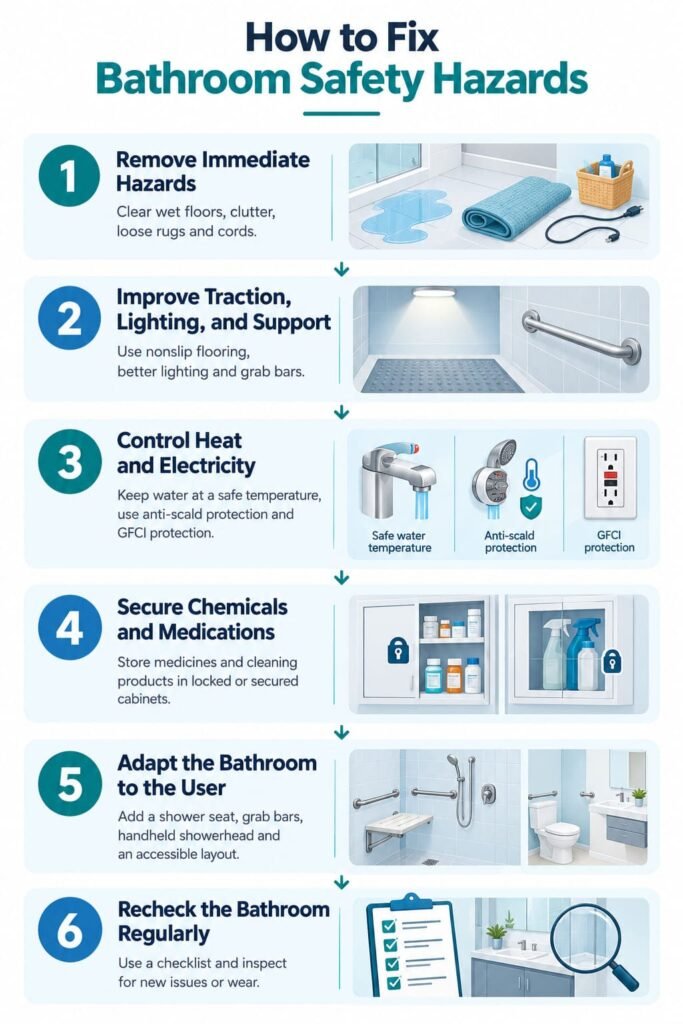
Start with problems that can be addressed without remodeling.
For example:
- Remove standing water.
- Clear clutter from walking paths.
- Remove or secure problematic rugs.
- Stop using damaged electrical cords or appliances.
- Move unsafe appliances away from water.
- Secure hazardous chemicals and medicines.
These changes can often reduce obvious risks immediately.
Step 2 — Improve Traction, Lighting, and Support
Next, look at the physical environment.
Improve visibility where the bathroom or route to it is too dark. Address slippery surfaces and consider whether appropriate support is needed around the tub, shower, or toilet.
For someone with mobility limitations, do not wait for a fall before reconsidering whether transfers are safe.
Step 3 — Control Heat and Electricity
Check the water temperature and address electrical risks.
Make sure electrical equipment is used appropriately and that damaged equipment is removed from service. If electrical installation or wiring needs to be changed, use a qualified electrician.
Step 4 — Secure Chemicals and Medications
Move hazardous products out of easy reach and use locked storage when appropriate.
Keep medications and chemicals in their original containers and follow their storage instructions.
Step 5 — Adapt the Bathroom to the User
A safe bathroom should match the person using it.
Consider:
- Mobility
- Balance
- Vision
- Strength
- Age
- Daily routines
- Ability to get in and out of the tub or shower
- Being able to lower onto and rise safely from the toilet
For someone with significant mobility or functional limitations, an occupational or physical therapist may be able to help identify appropriate home modifications. MedlinePlus also recommends seeking professional guidance when someone is unsure what bathroom changes are needed.
Step 6 — Recheck the Bathroom Regularly
Bathroom safety is not a one-time project.
Recheck the room after:
- A change in who uses the bathroom
- A change in mobility or balance
- A new appliance or fixture
- A renovation
- A plumbing problem
- A near miss or fall
- A change in nighttime routines
The practical framework is simple:
Identify → Prioritize → Fix → Recheck.
That approach helps keep safety changes connected to real conditions instead of treating a checklist as something that only needs to be completed once.
13. When Should You Get Professional Help With Bathroom Safety?
Some bathroom safety problems are appropriate for simple household changes. Others require professional assessment.
Consider professional help when:
- A person has difficulty getting into or out of the tub.
- Mobility limitations make transfers unsafe.
- Major accessibility changes are needed.
- Electrical installation or wiring work is involved.
- Persistent water leaks exist.
- Structural or flooring problems are present.
- The bathroom cannot be made reasonably safe with simple changes.
Potential professionals may include:
- A qualified electrician for electrical installation or electrical faults
- A plumber for plumbing problems and leaks
- An occupational therapist for individualized functional and accessibility assessment
- An appropriate accessibility or remodeling professional for major modifications
The right professional depends on the problem. Do not attempt unfamiliar electrical, structural, or major plumbing work simply because the problem appears to be located in a bathroom.
14. FAQs
What safety risks are commonly found in bathrooms?
Common bathroom safety hazards include wet and slippery floors, slippery tubs and showers, loose rugs, clutter, difficult tub entry, poor lighting, hot water, electrical hazards, unsecured medicines and chemicals, and moisture problems. The most relevant risks depend on the bathroom and the people who use it.
What is a common bathroom fall hazard?
Wet or slippery surfaces are a common bathroom fall hazard, particularly around tubs, showers, and bathroom floors. Other fall hazards include loose rugs, clutter, cords, poor lighting, difficult tub entry, and a lack of appropriate support.
What bathroom hazards are dangerous for seniors?
For older adults, common concerns include slippery surfaces, poor lighting, difficult tub or shower transfers, low or difficult-to-use toilets, inadequate support, and trip hazards. The CDC recommends measures such as removing things people can trip over, improving lighting, and adding appropriate grab bars in bathrooms.
What bathroom hazards are dangerous for children?
Young children are particularly vulnerable to drowning, scalding, poisoning, falls, and injuries involving sharp or electrical objects. The American Academy of Pediatrics recommends close, constant supervision around water and using barriers or access controls as additional layers of protection.
How can I identify hazards in my bathroom?
Walk through the bathroom by area and look for problems involving floors, lighting, the toilet, tub or shower, electrical equipment, storage, and moisture. Then consider whether the setup is appropriate for the people using the bathroom. A practical checklist can help prevent easy-to-miss hazards.
How hot should bathroom water be?
MedlinePlus recommends setting the water heater to no more than 120°F (49°C) as a measure to help prevent burns. HealthyChildren.org gives the same maximum temperature for the hottest water at the faucet when discussing child safety.
Why are GFCI outlets important in bathrooms?
GFCI protection is designed to interrupt electrical power when a ground fault is detected, helping reduce the risk of serious electrical shock. Bathrooms deserve particular attention because electrical equipment and water may be present in the same area. Electrical installations should comply with the applicable requirements and be handled by a qualified professional when wiring work is needed.
How can I make my bathroom safer?
Start by removing immediate hazards such as standing water, clutter, loose rugs, damaged electrical equipment, and unsecured chemicals. Then address traction, lighting, support, temperature, electrical safety, storage, and accessibility based on the needs of the people using the bathroom.
15. Final Thoughts
Bathroom safety involves more than simply keeping the floor free from slipping hazards. Water, heat, electricity, hard surfaces, chemicals, moisture, lighting, and human movement can interact in ways that create different risks for different people.
The most useful approach is to inspect the bathroom systematically: identify the hazard, understand the risk, fix the environment, adapt it to the user, and check it regularly.
With that approach, common bathroom safety hazards become easier to recognize and address before they lead to an accident.
For a broader overview of bathroom safety and practical ways to make your bathroom safer, see our complete guide to bathroom safety.
6 Comments