
1. Introduction
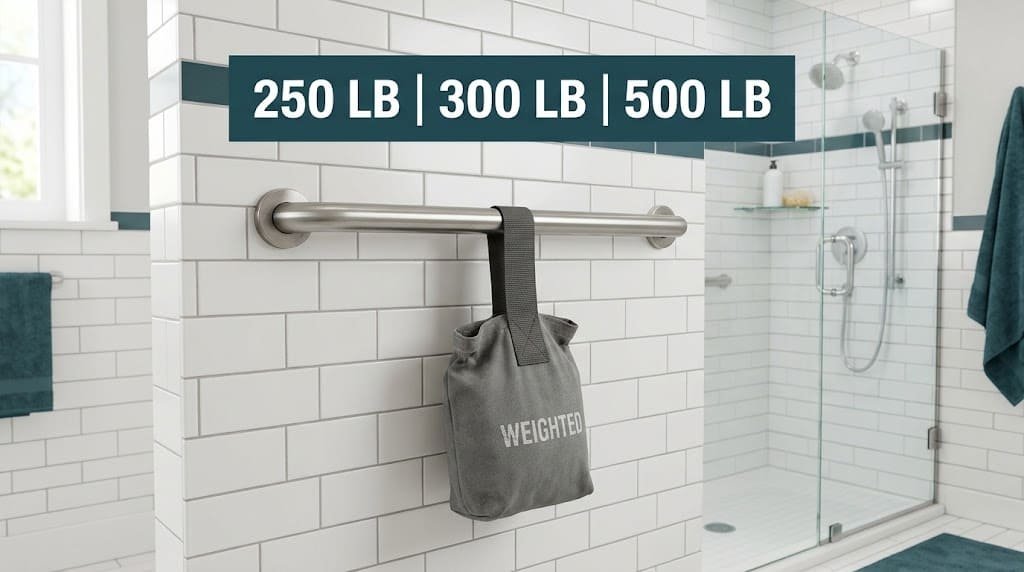
Bathroom grab bar weight capacity depends on the specific product, its mounting system, and the strength of the wall structure supporting it. Some grab bars advertise ratings of 250, 300, or 500 pounds, but these figures should not be treated as interchangeable guarantees of how much weight every installed bar can safely support.
The U.S. Americans with Disabilities Act (ADA) includes a structural-strength requirement for grab bars in covered accessible facilities. Section 609.8 requires grab bars and their supporting components to withstand a 250-pound applied force without placing the materials under stress beyond permitted limits. This is not a universal maximum user weight or a guarantee that every grab bar installation will safely support a 250-pound person.
Before choosing a bathroom grab bar, check the manufacturer’s stated weight rating, approved mounting method, required hardware, and installation instructions. Understanding how these factors work together can help you compare products and recognize when an existing grab bar may need professional attention.
Choosing a safe grab bar involves more than checking its weight rating. Read our complete guide to bathroom grab bars to learn about grab bar types, placement, sizing, and secure installation.
Table of Contents
2. How Much Weight Can a Bathroom Grab Bar Hold?
A bathroom grab bar’s weight capacity varies by model and installation method. Products may advertise capacities such as 250, 300, or 500 pounds, but the exact rating and the conditions required to achieve it must be verified in the manufacturer’s documentation.
A product’s advertised capacity alone does not establish the strength of the complete installation. The bar, mounting brackets, fasteners, and supporting wall structure all contribute to whether it provides reliable support.
Typical bathroom grab bar weight ratings
Bathroom grab bars do not have one universal weight limit. Manufacturers specify ratings for particular products and mounting configurations, so two bars with similar appearances may have different published capacities.
The following table illustrates how to interpret commonly advertised ratings. These are examples of rating labels, not verified specifications for every product in each category.
| Advertised rating | What it tells you | What to verify |
|---|---|---|
| 250 lb | The product is advertised with a 250-pound capacity or rating. | How the manufacturer defines the rating and which installation method is required. |
| 300 lb | The product is advertised with a 300-pound capacity or rating. | Whether the rating applies to the complete installed system and under what conditions. |
| 500 lb | The product is advertised with a 500-pound capacity or rating. | The specific model, mounting hardware, supporting structure, and stated limitations. |
A grab bar’s stated rating should not be interpreted as the maximum body weight it can support unless the manufacturer clearly identifies it as a user-weight limit. A load capacity, a force applied to the bar, and a maximum supported user weight are different measurements and should not be treated as interchangeable.
The distinction is especially important for a shower grab bar. A person may pull, push, or lean against a bar at different angles while entering or leaving a tub or maintaining balance. The forces placed on the bar and its mounting points can differ from a simple downward load.
Why the stated capacity varies by model and mounting system
A grab bar’s advertised capacity depends on the product’s design and the mounting conditions specified by its manufacturer. A grab bar’s weight capacity may depend on its design, length, mounting hardware, screws, and the strength of the surface supporting it.
For example, a bar secured to appropriate structural backing using its specified hardware may perform differently from a similar-looking bar attached to an unsuitable surface. Even a well-made grab bar can become unreliable if its mounting points loosen or the surrounding wall deteriorates.
The complete load path matters:
Grab bar → mounting brackets or flanges → fasteners → wall structure.
Every component in the mounting assembly must be appropriate for the specific installation. A high product rating cannot compensate for inadequate wall support, incompatible hardware, incorrect installation, or damage around the mounting points.
When comparing products, use the manufacturer’s installation instructions alongside the advertised weight rating. This provides a more meaningful basis for comparison than the headline number alone.
3. What Does the 250 lb ADA Grab Bar Requirement Mean?
The ADA grab bar requirement is a structural-strength standard, not a universal user-weight rating. Under Section 609.8 of the U.S. Access Board’s ADA Accessibility Standards, a grab bar and its associated fasteners, mounting hardware, and supporting structure must withstand a 250-pound force applied vertically or horizontally at any point without exceeding the allowable stress limits of the materials.
This requirement considers the strength of the components that make up the installation. It should not be interpreted as proof that every grab bar sold in the United States has a 250-pound user-weight capacity or that any installation meeting a product’s advertised rating automatically complies with the ADA.
The difference between applied force and user body weight
Applied force and body weight are related, but they are not interchangeable.
A person’s body mass creates a gravitational force that is commonly referred to as their weight. The force placed on a grab bar depends on how the person uses it, including whether they pull, push, lean, or use it to help transfer between sitting and standing.
For example, a person who weighs 200 pounds does not necessarily place exactly 200 pounds of force on a grab bar. They may use the bar for light balance support, or they may place a greater share of their weight on it during a difficult movement. The force can also act horizontally or vertically rather than straight down.
This distinction matters when reading a product page that states a grab bar supports 250 pounds. Unless the manufacturer explains otherwise, do not assume that the number means the bar can safely support every person weighing up to 250 pounds in every situation.
Practical takeaway: Choose a grab bar that meets the manufacturer’s specified weight and load limits for its intended purpose, and follow all installation instructions precisely. The ADA’s 250-pound applied-force criterion is a separate structural requirement.
How the Grab Bar, Mounting Hardware, and Wall Support Work Together to Meet the Requirement
The ADA structural-strength provision considers more than the metal bar itself. It also covers the fasteners, mounting devices, and supporting structure. A strong bar attached to a weak or unsuitable wall connection cannot provide a dependable installation.
Consider a wall-mounted grab bar with a high advertised rating. If its mounting screws are loose, its brackets are incompatible with the installation, or the wall structure cannot support the connection, the finished installation may not provide the intended support.
The relevant components include:
- Grab bar: The bar’s design and build quality should match the level of support it is intended to provide.
- Fasteners: Screws or other specified fasteners must be appropriate for the supporting material and installed as directed.
- Mounting devices: Flanges, brackets, or approved mounting systems must be compatible with the bar and installation.
- Supporting structure: Studs, wood blocking, or another specifically approved structural mounting system must provide adequate support.
The standard is particularly relevant to covered accessible facilities. For a private home, the applicable requirements can depend on the building and circumstances; the ADA provision should not be presented as a blanket statement about every residential installation. Regardless of the setting, following the manufacturer’s instructions and providing suitable structural support are essential.
4. Is a 500 lb Grab Bar Stronger Than a 250 lb Model?
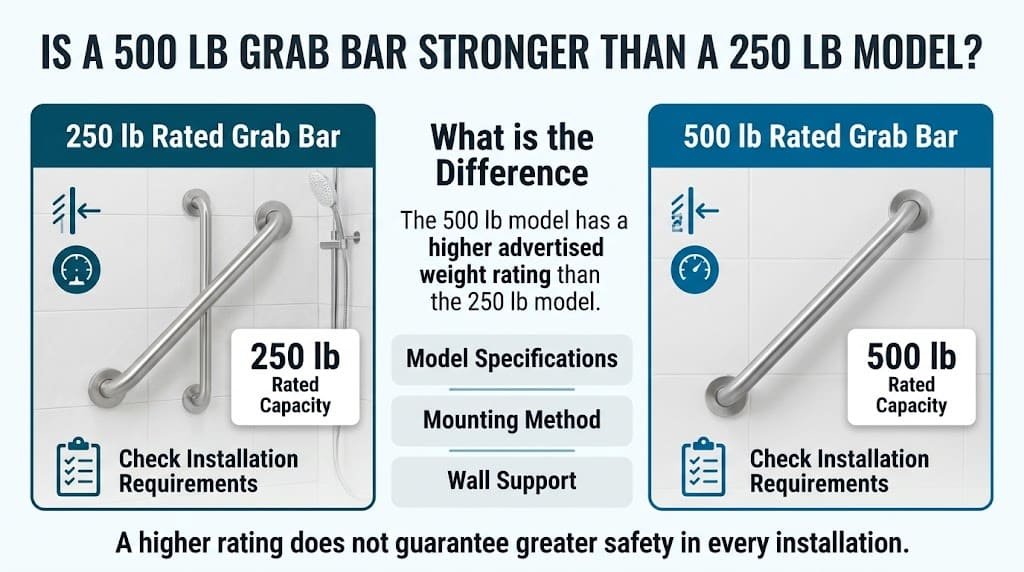
A grab bar advertised at 500 pounds has a higher stated numerical rating than one advertised at 250 pounds, but that does not automatically make it safer in every installation. You need to know what each rating measures, which mounting system is required, and whether the products are intended for the same type of use.
Manufacturer specifications illustrate why the details matter. For example, Moen advertises its Genta 18-inch grab bar, model MBHG3818CH, as supporting up to 500 pounds. Moen lists its Home Care 24-inch grab bar with towel bar, model LR2350DBN, at up to 250 pounds. These are different products, so the numbers alone do not establish a controlled, like-for-like comparison.
What 250 lb, 300 lb, and 500 lb product ratings tell you
A published rating gives you information about a particular product under the conditions defined by its manufacturer. However, the meaning of that number can vary.
One important distinction is whether the manufacturer specifies a maximum user weight, a supported load, or another capacity measure. These terms should not be treated as synonyms without checking the documentation.
For example, HealthCraft’s Easy Mount grab bar instructions specify a maximum user weight of 500 pounds for certain shorter bar lengths and 400 pounds for longer listed lengths. The same instructions state that the product is not intended to support full body weight. This illustrates why a large number on a specification sheet does not tell the whole story.
Use this table to understand the key differences between the available products.
| Comparison point | What to look for |
|---|---|
| Advertised capacity | The exact number and the manufacturer’s definition of it |
| Intended use | Whether the bar is designed for balance, sitting and standing assistance, or another stated purpose |
| Approved mounting method | The required studs, blocking, anchors, brackets, or other mounting system |
| Bar length | Whether the capacity changes with the length or configuration |
| Limitations | Warnings about body-weight support, wall materials, or installation conditions |
A higher rating may be useful when it fits your needs and installation, but it should not be the only selection criterion.
Why you must compare the same type of rating and installation conditions
Comparisons are meaningful only when you understand what each manufacturer is measuring and the conditions under which the stated capacity applies.
For instance, a 500-pound maximum user-weight rating is not necessarily equivalent to a 500-pound applied-load rating. One may describe a limit on the intended user’s weight, while the other may refer to a load applied to a component or installed system. The manufacturer’s definitions determine how the figures should be interpreted.
Installation conditions also matter. One bar may require screws installed into structural wood backing, while another may permit a specific manufacturer-approved mounting system for certain wall types. If the installation does not meet the stated requirements, you cannot assume the advertised capacity still applies.
Before treating a 250-pound and a 500-pound grab bar as alternatives, compare their full product specifications and installation instructions. A suitable bar with correct mounting is more important than choosing the largest number on the product page.
5. What Affects Bathroom Grab Bar Weight Capacity?
Bathroom grab bar weight capacity depends on the complete installed assembly: the bar, fasteners, mounting hardware, and supporting structure. A grab bar’s ability to provide dependable support depends on the wall’s structural strength and whether it is installed according to the manufacturer’s guidelines.
Wall studs, wood blocking, and supporting structure
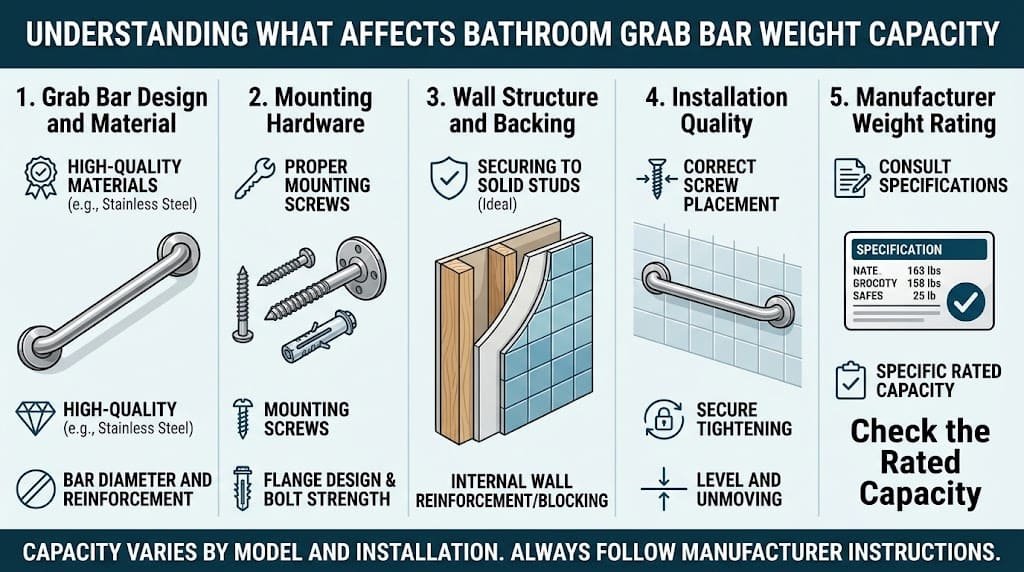
Wall studs and wood blocking can provide structural backing for a wall-mounted grab bar when they are appropriate for the installation and used as specified.
A stud is a structural framing member behind the wall surface. Wood blocking is additional structural material installed between framing members to create a suitable mounting location. Both can provide a more appropriate fastening base than relying on an unsupported wall finish.
However, finding a stud does not automatically guarantee a safe installation. The stud must be suitable, the fasteners must be correct, and the bar’s mounting points must align with the required support. The manufacturer’s instructions determine the acceptable arrangement.
If the intended location lacks adequate backing, do not compensate by using random screws or generic wall anchors. The wall might require additional structural support or another manufacturer-approved installation method.
Fasteners, mounting brackets, and approved anchors
Fasteners transfer force from the grab bar’s mounting brackets into the supporting structure. Incorrect screws, incompatible hardware, missing fasteners, or poorly secured brackets can undermine the installation even when the bar itself is well made.
Install the grab bar using the included mounting hardware or an approved substitute recommended by the manufacturer. Do not substitute fasteners simply because they fit the mounting holes.
Some products have manufacturer-approved anchor systems for particular wall constructions. Those systems must be used within their stated limitations and installed according to their instructions. An anchor approved for one product or wall type should not be assumed suitable for another.
Also, do not assume that ordinary plastic drywall anchors can safely support a bathroom grab bar used for body-weight assistance. The required mounting system depends on the product and the structure behind the wall.
Bar length and model-specific installation requirements
The length of a grab bar can affect its capacity or the conditions under which the manufacturer permits it to be used. The mounting configuration, bracket placement, and supporting structure may also differ between models or lengths.
HealthCraft’s Easy Mount instructions, for example, specify different maximum user weights for certain shorter and longer versions of the same product family. This is a product-specific example, not a universal rule that all longer bars have lower capacities.
When selecting a bar, confirm the rating for the exact length and model number you intend to buy. Do not transfer the capacity of a 12- or 18-inch version to a 36-inch version unless the manufacturer confirms that the rating applies.
Wall condition, moisture damage, and mounting deterioration
A structurally suitable wall can become less reliable if moisture damage, deterioration, or repeated movement affects the mounting area. Bathrooms deserve particular attention because water can enter damaged seals or wall openings and contribute to deterioration around the installation.
Check for visible warning signs such as:
- Soft, swollen, or crumbling wall material near the mounting points.
- Cracks or damaged surfaces around the flanges.
- Rust or corrosion on exposed hardware.
- Gaps between the mounting flange and wall.
- Mounting screws that seem to be backing out or a grab bar that moves when touched gently.
These signs do not tell you the exact remaining capacity, but they indicate that the installation needs assessment. Do not attempt to establish its strength by pulling on it with your full body weight. Stop relying on a questionable bar until it has been inspected and, if necessary, repaired or reinstalled correctly.
Even a grab bar with a high weight rating may not provide reliable support if it is installed incorrectly. Read our guide to bathroom grab bar installation to understand the importance of proper mounting and following the manufacturer’s instructions.
6. Do Bathroom Grab Bars Need to Be Installed in Studs?
Not every grab bar uses the same mounting system, so the answer depends on the specific product and its approved installation method. Many conventional wall-mounted grab bars are designed to be secured to structural framing or wood blocking. Some products permit manufacturer-approved alternative mounting systems for specified wall types.
The important point is that a grab bar must be secured to a support system suitable for its intended use. Attaching a bar to drywall alone with generic anchors is not a safe default.
When studs or wood blocking are appropriate
Studs or wood blocking are commonly used to provide structural support for permanently mounted bathroom grab bars. Before installation, the installer must determine where suitable backing is located and whether it aligns with the bar’s mounting points.
If the existing framing does not provide adequate support at the desired location, wood blocking or another approved structural solution may be needed. The installation should account for the wall construction, fastener requirements, mounting-flange design, and manufacturer’s instructions.
Tile or another finished wall surface does not replace the structural support behind it. The mounting system must transfer the force through the finish and into an appropriate supporting structure without damaging the wall or compromising the connection.
If you’re unsure about the wall’s internal structure, review the manufacturer’s installation guidelines and seek help from a qualified installer instead of making assumptions.
When a manufacturer-approved alternative mounting system may be used
Some grab bars are designed for specific mounting systems that do not rely on the same arrangement as a conventional bar fastened directly to wood studs. These systems may be suitable for certain hollow walls or other approved surfaces, but their use depends on the product’s design, compatible wall construction, and stated capacity.
For example, HealthCraft’s Easy Mount instructions identify particular anchor options for specified hollow-wall and fiberglass installations, while also warning against installation in certain unsuitable conditions. Those instructions apply to that product, not to grab bars generally.
Before using an alternative mounting system, confirm all of the following:
- The manufacturer confirms that it is suitable for your specific grab bar model.
- Your wall material and construction are permitted by the instructions.
- The required hardware and installation procedure are followed.
- The manufacturer’s stated capacity and use limitations still apply.
- The wall and surrounding area are in suitable condition.
If any of these points is uncertain, have a qualified installer assess the installation. Do not assume that an anchor’s advertised strength alone establishes the capacity of the complete grab bar system.
7. How to Check a Grab Bar’s Weight Rating Before Buying
To evaluate a bathroom grab bar’s weight rating, identify the exact model, read the manufacturer’s capacity statement, and verify the approved mounting method. A product page headline is a useful starting point, but the specification sheet and installation manual provide the context needed to interpret the number.
Find the exact model’s published weight rating
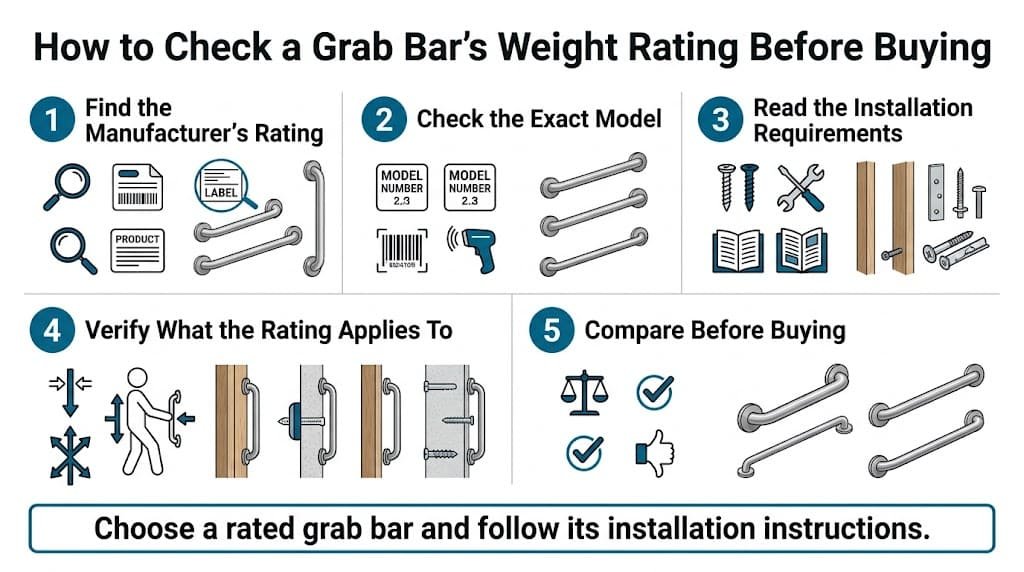
Start with the manufacturer’s product page or technical documentation. Confirm the model number, bar length, and any variation in finish or design that could affect the applicable instructions.
Look for the manufacturer’s precise description of capacity. Determine whether it specifies maximum user weight, supported load, or another measure. If the terminology is unclear, contact the manufacturer before relying on the figure to make a safety decision.
Avoid choosing a bar solely because it advertises a 500-pound capacity. A lower-rated product with a clearly defined, suitable application may be a better match than a higher-rated product whose mounting requirements cannot be met.
Confirm the approved mounting method and required hardware
Next, check how the bar must be installed. Review the required fasteners, mounting brackets, structural backing, and any approved alternative mounting system.
Use this pre-purchase checklist when comparing models:
- The exact model has a clearly stated capacity.
- The manufacturer explains what that capacity means.
- The intended use matches the product’s stated purpose and limitations.
- The approved mounting method is compatible with the wall.
- Required fasteners and mounting hardware are available.
- The bar length and configuration match the published rating.
- The installation instructions and safety warnings are accessible.
- Any required reinforcement can be provided.
If the product page does not explain its rating or installation conditions, check the manufacturer’s documentation or ask for clarification rather than assuming.
Check installation limitations, length, and manufacturer warnings
Read the installation instructions before buying, not just after opening the package. Look for restrictions involving bar length, wall materials, fastener selection, and whether the product is intended to support full body weight.
The term shower grab bar weight capacity can be especially misleading when a product is described as a shower accessory but is intended only for a limited type of support. Confirm that its stated purpose matches how the person will use it.
Also check whether the manufacturer requires professional installation or warns against mounting into particular wall constructions. These details can determine whether the product is suitable for your bathroom.
A useful buying decision follows three steps: verify the rating, verify the installation, and verify the intended use. If any of those remains unclear, choose a product with better documentation or seek guidance from the manufacturer or a qualified installer.
8. Signs a Bathroom Grab Bar May Be Unsecure
A grab bar may need attention if it moves, its mounting hardware loosens, or the surrounding wall shows signs of damage. Visible warning signs cannot tell you how much weight the grab bar can still support, but they mean you should stop using it for support until the issue has been properly inspected.
Loose screws, shifting flanges, or a moving bar
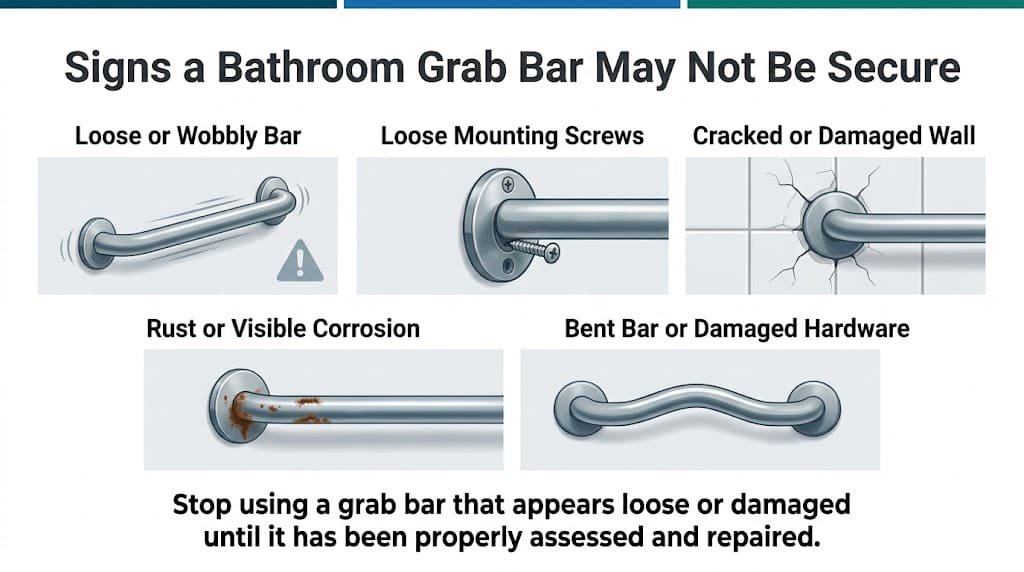
Loose screws, a shifting mounting flange, or movement at the bar’s connection to the wall can indicate a problem with the fasteners, mounting system, or supporting structure.
A grab bar should not rotate within its fittings under the applicable ADA requirements for covered facilities. If the grab bar twists, moves out of position, or seems to loosen from the wall, treat it as a potential safety concern rather than an ordinary occurrence.
Do not deliberately pull hard on the bar or hang your body weight from it to determine whether it is secure. If it appears loose, stop relying on it and arrange an appropriate inspection.
Cracked surrounding surfaces, corrosion, or damaged mounting components
Inspect the area around the mounting points for signs that the wall or hardware may have deteriorated.
| Warning sign | Why it matters | Appropriate next step |
|---|---|---|
| Cracked or crumbling wall surface | The surrounding material or mounting area may be damaged. | Stop relying on the bar until the mounting area is assessed. |
| Rust or significant corrosion | Hardware or components may have deteriorated. | Have the affected components inspected and replaced if needed. |
| Gaps around mounting flanges | The bar or mounting connection may have shifted. | Arrange an inspection before further use. |
| Loose or missing fasteners | The connection may not be secure. | Have the correct hardware and mounting system checked. |
| A bar that moves or rotates | The mounting system or fitting may be compromised. | Stop using it for support until it is repaired or reinstalled. |
| Soft or swollen wall material | Moisture may have damaged the supporting area. | Investigate the moisture source and assess the structure. |
A visual inspection cannot establish that an installation meets its original capacity rating. Likewise, the absence of visible damage does not guarantee that every hidden fastener or structural component is sound.
What to do if a grab bar moves or appears damaged
If a bathroom grab bar moves, has loose mounting hardware, or shows signs of damage, stop relying on it for balance or body-weight assistance until it has been assessed.
Have a qualified installer determine whether the problem involves the fasteners, mounting brackets, wall structure, moisture damage, or the bar itself. Depending on the findings, the solution may require new hardware, structural reinforcement, replacement of damaged components, or complete reinstallation.
Do not simply tighten a screw without first determining why it loosened. If the wall or mounting point has deteriorated, tightening the same hardware may not restore the installation’s strength.
After repairs, follow the manufacturer’s instructions for inspection and maintenance. Do not use an improvised body-weight test as proof that the bar is safe.
9. FAQs
Can a 250 lb grab bar support a person weighing 250 pounds?
Not necessarily. A 250-pound product rating does not automatically mean that the installed bar can safely support every person weighing 250 pounds under all conditions. The meaning of the rating, the intended use, the mounting system, and the wall structure all matter.
The ADA’s 250-pound structural-strength criterion refers to an applied vertical or horizontal force, not a universal maximum user weight. Check the product’s own specifications and ensure that the installation follows the manufacturer’s requirements.
Can a grab bar support more than its advertised rating?
You should not assume that a grab bar can safely support more than its published rating. The advertised figure may represent a defined limit under particular conditions, and exceeding that limit can create a risk of failure.
Never test a grab bar’s load limit by gradually increasing the weight placed on it. Use the product within its stated limitations and consult the manufacturer if you need clarification about a particular application.
Are suction-cup grab bars suitable for full body-weight support?
Do not assume that a suction-cup grab bar is suitable for full body-weight support. Its permitted use depends on the exact product and the manufacturer’s instructions, including any restrictions on loading, surfaces, and installation.
A suction-cup bar may be intended for limited balance assistance rather than supporting a person’s weight during a transfer or a loss of balance. Follow the manufacturer’s stated use and limitations, and choose a properly installed grab bar specifically suitable for the support required when full body-weight assistance is needed.
10. Conclusion
Bathroom grab bar weight capacity depends on more than the number printed on the package. A product advertised at 250, 300, or 500 pounds must be evaluated according to its rating definition, intended use, approved mounting method, and installation conditions.
Before buying or relying on a grab bar:
- Check the exact model’s published weight rating and what it measures.
- Verify that the mounting method and hardware meet the manufacturer’s requirements.
- Confirm that the wall structure is suitable and in good condition.
- If the grab bar feels unstable, shows signs of rust, or has damaged surrounding wall surfaces, do not use it for support again until the problem has been properly inspected.
- Understand that the ADA’s 250-pound structural-strength requirement is not a universal user-weight limit.
The safest choice is a grab bar whose stated capacity, intended use, and approved installation method match your needs—not simply the model with the highest advertised number.
2 Comments