
1. Introduction
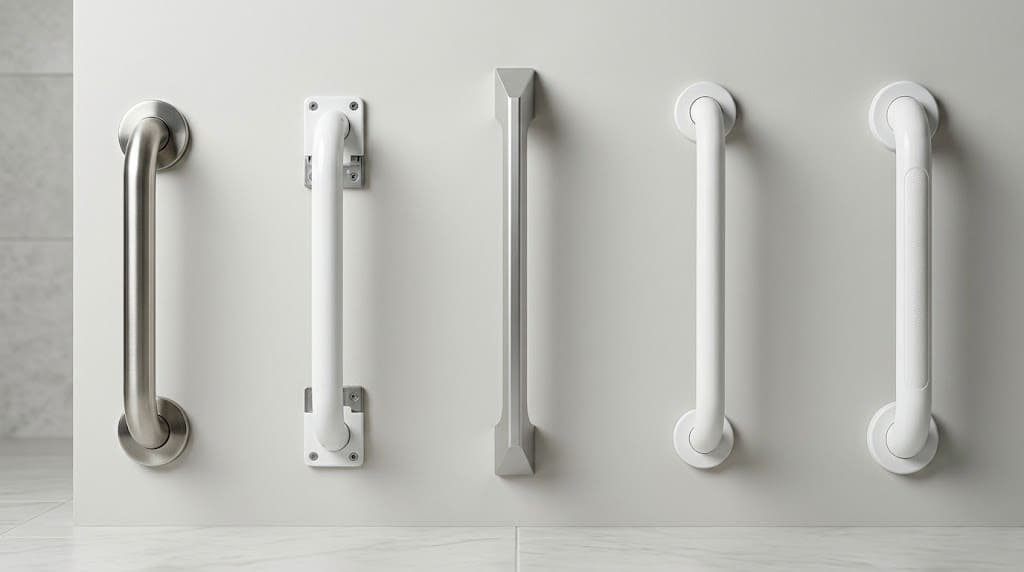
Bathroom grab bar materials affect how a grab bar handles moisture, feels in your hand, withstands everyday use, and holds up over time. Common options include stainless steel, nylon-coated steel, aluminum, coated metal, and engineered plastics. The best choice depends on the product’s construction, surface finish, bathroom environment, maintenance requirements, and verified load rating.
If you are choosing a grab bar for a shower, bathtub, or toilet area, looking at its appearance alone is not enough. Two bars that look similar may have different underlying materials, protective coatings, and mounting requirements. Understanding these differences can help you select a suitable product for your bathroom without assuming that any single material is automatically the safest.
Table of Contents
2. What Materials Are Bathroom Grab Bars Made Of?
Bathroom grab bars are commonly made from stainless steel, coated steel, aluminum, or engineered polymers. Some products combine materials, such as a metal core covered by a nylon sleeve or another protective finish. The product specification is the most reliable way to identify its actual construction.
1) Stainless Steel Grab Bars
Stainless steel grab bars are a common option for bathrooms because stainless steel offers useful corrosion resistance and can provide a durable structural material when appropriately designed. These bars are available in different grades, diameters, finishes, and mounting configurations.
Stainless steel contains chromium, which helps form a thin protective oxide layer on its surface. This layer contributes to corrosion resistance, although it does not make the material completely immune to corrosion under every condition.
Important considerations include:
- Corrosion resistance: Performance depends on the stainless steel grade, surface condition, cleaning routine, and exposure to moisture or corrosive substances.
- Surface feel: Brushed and polished finishes can feel different in the hand. Neither finish automatically guarantees a secure grip when wet.
- Maintenance: Routine cleaning according to the manufacturer’s instructions helps remove soap residue, mineral deposits, and other contaminants.
- Appearance: Stainless steel is available in finishes that suit many modern and traditional bathroom designs.
Stainless steel may be a practical choice for a permanently installed shower or bathtub grab bar. However, the grade and product specifications still matter. A stainless steel bar must also have an appropriate load rating and mounting system for its intended use.
2) Nylon-Coated Steel Grab Bars
Nylon-coated grab bars typically use a metal core, often steel, with a nylon or polyamide outer surface. This construction combines the structural properties of the underlying metal with a polymer surface that can feel warmer and less cold than exposed metal.
The coating changes the user experience, but it does not eliminate the need to evaluate the complete product.
Potential advantages include:
- A warmer-feeling surface when first touched.
- A choice of colors and surface textures.
- A grip experience that some users may prefer over exposed metal.
- A protective outer layer that separates the hand from the metal core.
The main consideration is the condition of the coating. Cracks, peeling, deep scratches, or other damage may expose the underlying metal and create areas that are harder to clean or inspect.
Not every nylon-coated product has the same coating thickness, texture, or construction. Check the manufacturer’s specifications and care instructions before choosing one for a frequently used shower or bathtub.
3) Aluminum Grab Bars
Aluminum grab bars are another option, particularly where a lightweight metal construction is desirable. Aluminum naturally forms an oxide layer that provides some corrosion protection, but performance varies with the alloy, surface treatment, and environment.
A lightweight product is not necessarily weak, and a heavier product is not necessarily stronger. Structural performance depends on the bar’s design, material thickness, manufacturing quality, mounting hardware, and installation.
Before selecting an aluminum grab bar, check that:
- The manufacturer identifies it as a load-bearing grab bar.
- Its load rating and intended use are documented.
- The mounting instructions match the wall or supporting structure.
- The surface treatment and cleaning requirements are suitable for the intended bathroom location.
Aluminum can be a suitable choice when the complete product is properly designed and rated. Do not assume that all aluminum rails or handles are intended to support body weight.
4) Powder-Coated or Epoxy-Coated Metal Grab Bars
Coated metal grab bars use a metal base with an additional surface layer. Depending on the product, that layer may be powder coating, epoxy coating, or another protective finish.
The underlying metal provides the structural body, while the coating affects the appearance, surface feel, and resistance to environmental exposure.
A coating can help protect the base metal, but its effectiveness depends on the coating system, manufacturing quality, and condition during use.
Pay attention to three factors:
- Coating integrity: Chips, scratches, or peeling can expose the underlying metal.
- Cleaning compatibility: Abrasive cleaners or unsuitable chemicals may damage some finishes.
- Core material matters: Two grab bars may have a similar coated finish, but one can be made from steel and the other from aluminum, giving them different properties.
A colored or matte finish should never be treated as proof of a particular base material or level of corrosion resistance. Verify both details in the product documentation.
5) Plastic and Polymer Grab Bars
Plastic and polymer grab bars use engineered materials such as ABS plastic or other polymers, depending on the design. Some products are made primarily from polymer, while others combine plastic components with a metal core or internal reinforcement.
Plastic itself does not rust like steel, but that fact alone does not establish whether a complete grab bar is suitable for weight-bearing support. Structural strength depends on the material formulation, design, dimensions, reinforcement, manufacturing quality, and mounting arrangement.
Before choosing a plastic or polymer grab bar, confirm that the manufacturer explicitly identifies it as a load-bearing product and provides appropriate specifications for its intended use.
Do not confuse a decorative bathroom handle, suction-cup balance aid, or lightweight accessory with a properly rated grab bar. If a person will rely on the bar to support body weight during transfers or to recover balance, its intended use and installation requirements are particularly important.
3. How Do Bathroom Grab Bar Materials Compare?
The main differences between grab bar materials involve corrosion resistance, surface feel, coating durability, cleaning requirements, and the construction of the complete product. No material category performs identically across all products, so comparisons should be based on specifications rather than material names alone.
| Material or construction | Corrosion considerations | Grip and feel | Maintenance considerations |
|---|---|---|---|
| Stainless steel | Depends on grade, surface condition, and exposure | Depends on the finish and bar design | Clean according to manufacturer guidance |
| Nylon-coated steel | Depends on the coating’s condition and the underlying metal | Often warmer to the touch than exposed metal | Inspect the coating for cracks, peeling, and damage |
| Aluminum | Depends on alloy, surface treatment, and exposure | Depends on the surface finish and design | Follow product-specific cleaning instructions |
| Powder- or epoxy-coated metal | Depends on the coating system and base metal | Varies with coating texture | Check for chips, peeling, and exposed metal |
| Plastic or polymer construction | Polymer does not rust, but the complete product still needs assessment | Varies by material and design | Check for wear and follow the manufacturer’s care instructions |
Use this comparison as a general guide rather than a definitive ranking of performance. A well-designed product with documented specifications may be a better choice than another product made from a material that appears superior on paper.
Corrosion Resistance and Performance in Wet Bathrooms
Corrosion resistance matters because bathroom grab bars may be exposed to water, humidity, soap residue, cleaning chemicals, and mineral deposits.
Stainless steel resists corrosion through a protective surface layer, but its performance varies by grade and environment. Aluminum also forms a protective oxide layer, although its suitability depends on the alloy and surface treatment. Coated steel relies partly on the integrity of its protective finish.
For nylon-coated steel, the outer sleeve and the underlying metal must both be considered. An intact coating can separate the hand from the metal surface, but damaged areas may expose the core to moisture.
When comparing products, consider where the bar will be installed:
- Inside a frequently used shower: Prioritize a product specifically designed for wet-area use, with documented corrosion resistance and appropriate mounting specifications.
- Near a bathtub: Consider repeated splashing, cleaning routines, and how the finish holds up over time.
- Beside a toilet: The bar may experience less direct water exposure, but it still needs to withstand routine bathroom cleaning and provide reliable support.
A rust-resistant label is not a guarantee that corrosion can never occur. Product construction, environmental exposure, installation, and maintenance all affect long-term performance.
Grip, Surface Feel, and Cleaning
A grab bar’s material and finish influence how it feels in the hand, but neither alone guarantees a secure grip.
Exposed metal can feel cool to the touch. Nylon-covered surfaces often feel warmer, while textured finishes may provide a different tactile experience from smooth or polished surfaces. Individual comfort and grip preferences also vary.
When evaluating a surface, consider:
- Texture: Is the surface comfortable to grasp without feeling excessively slippery or abrasive?
- Diameter and shape: Can the intended user comfortably wrap their hand around the bar?
- Wet conditions: Does the manufacturer identify the product as suitable for the intended wet-area application?
- Cleaning: Can soap residue and other buildup be removed without damaging the surface?
- Wear: Will the finish remain in suitable condition with the recommended cleaning routine?
Do not assume that a rough surface is automatically safer or that a smooth metal bar is necessarily slippery. Grip depends on the complete design and the conditions in which the bar is used.
Durability, Coating Wear, and Maintenance
Durability depends on more than the material name. Material grade, wall thickness, manufacturing quality, protective coatings, mounting components, and everyday use all contribute to how a grab bar performs over time.
Stainless steel can be durable in suitable conditions, while aluminum and coated metal can also provide long-term service when properly specified and maintained. Nylon-covered bars require attention to the condition of their outer surface. Plastic or polymer products need to be evaluated according to their design and documented load-bearing purpose.
A practical approach is to inspect the entire assembly, not just the part you hold. Look for visible corrosion, coating damage, loose fasteners, movement at the mounting points, or changes in the surrounding wall.
If the bar becomes loose or shows signs of structural damage, do not rely on it for support until it has been properly assessed and repaired or replaced. Routine cleaning cannot compensate for an unsuitable installation or damaged mounting system.
4. Is Stainless Steel the Best Material for Bathroom Grab Bars?
Stainless steel is a strong candidate for many bathroom applications because it combines useful corrosion resistance with a durable metal construction. However, it is not automatically the best option for every person, bathroom, or budget. The best option depends on the type of stainless steel, the bar’s construction and finish, the conditions where it will be used, and its documented safety ratings.
What Makes Stainless Steel a Common Choice?
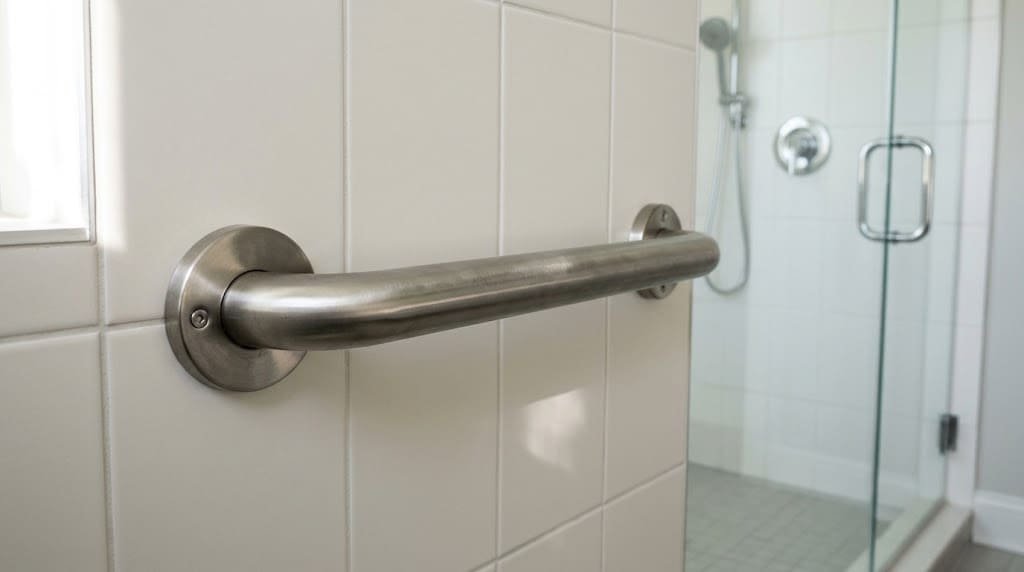
Stainless steel is widely used in bathroom hardware because it offers a combination of durability, cleanability, and resistance to corrosion. It is available in multiple finishes and designs, making it suitable for many residential and commercial settings.
Its practical advantages include:
- Corrosion resistance: Chromium in stainless steel helps form a protective oxide layer.
- Durable construction: Properly designed stainless steel bars can withstand repeated use when correctly installed and maintained.
- Finish options: Brushed and polished surfaces allow users to choose an appearance that suits their bathroom.
- Cleaning: Many stainless steel products can be maintained with routine cleaning, provided the manufacturer’s instructions are followed.
There are limitations. Stainless steel can still corrode under unfavorable conditions, and a polished appearance does not prove that a product has a particular alloy grade or load rating.
When shopping, verify the stated grade, material specifications, mounting requirements, and intended use. These details provide a more useful basis for comparison than a product title that simply says “stainless steel.”
304 vs. 316 Stainless Steel Grab Bars
304 and 316 are grades of stainless steel, not surface finishes. Both are used in many applications, but their alloy compositions differ, affecting how they perform in certain corrosive environments.
Grade 316 contains molybdenum, which generally improves resistance to chloride-related corrosion compared with grade 304. Chlorides can contribute to localized corrosion under certain conditions, depending on the environment and material condition.
| Feature | 304 stainless steel | 316 stainless steel |
|---|---|---|
| General characteristics | Common stainless steel grade with useful corrosion resistance | Stainless steel grade with enhanced resistance to many chloride-related corrosion conditions |
| Molybdenum | Not a defining alloy addition in standard 304 | Contains molybdenum |
| Typical consideration | May be suitable for many ordinary indoor bathroom environments | May be worth considering where additional chloride resistance is important |
| What to verify | Actual grade, finish, intended use, and product specifications | Actual grade, finish, intended use, and product specifications |
Which grade should you choose? In many homes, a well-made 304 stainless steel grab bar can be a practical choice when it is properly maintained and suited to the bathroom environment. Grade 316 may offer an advantage in more corrosive environments, but the decision should account for actual exposure, product quality, and manufacturer guidance.
Neither grade should be treated as corrosion-proof. Also, the alloy grade alone does not establish whether the grab bar can safely support a person.
When Other Materials May Be Worth Considering
Stainless steel is not the only reasonable option. A different construction may better suit a user’s preferences or the bathroom’s requirements.
- Choose nylon-coated steel for consideration if a warmer-feeling surface or a particular grip texture is important, provided the complete product meets the required safety specifications.
- Consider aluminum when a suitable lightweight design is available with documented load-bearing performance.
- Consider coated metal if you prefer a particular color or finish and can maintain it according to the manufacturer’s instructions.
- Choose a polymer-based grab bar only if the manufacturer confirms that it is engineered and rated to provide the level of support you need.
The best material is not necessarily the most expensive, the heaviest, or the one with the most attractive finish. Select a complete grab bar that meets the user’s needs and can be installed securely in the intended location.
5. Does the Grab Bar Finish Affect Safety and Durability?
Yes. A grab bar’s finish can affect surface feel, cleanability, appearance, and the protection provided to its underlying material. However, the finish does not independently determine structural strength, and no finish should be assumed to guarantee a secure grip in wet conditions.
Brushed, Polished, and Textured Finishes
Brushed, polished, and textured finishes describe surface characteristics rather than necessarily identifying the base material.
A brushed stainless steel grab bar typically has a directional surface appearance, while a polished finish has a smoother, more reflective look. Textured surfaces vary by product and may be designed to change how the bar feels in the hand.
Consider the following when comparing finishes:
- Brushed finishes: Often chosen for their understated appearance and ability to complement other bathroom hardware.
- Polished finishes: Provide a reflective appearance but may show fingerprints or water spots more readily, depending on the product.
- Textured finishes: May offer a different tactile experience, but the actual grip performance must be evaluated rather than assumed.
Surface texture, hand size, grip strength, moisture, and soap residue can all affect how securely someone holds a grab bar. A finish that feels comfortable to one person may not feel as comfortable to another.
If grip is a concern, assess the actual product where possible and check the manufacturer’s description of its intended use.
Chrome-Plated, Powder-Coated, and Nylon-Covered Surfaces
These surface treatments and coverings are not interchangeable.
Chrome plating is a surface layer applied to a base material. A chrome-looking grab bar may have a different underlying construction from a solid stainless steel bar.
Powder coating is a finish applied to a product’s surface. Its protective performance depends on the coating system, preparation, application, and condition during use.
Nylon covering typically provides a polymer outer surface over another material, often metal. It can change the surface feel and appearance, but the core material remains relevant to the product’s structural design.
Before purchasing, check the product specifications for both the base material and the finish. If the listing mentions only “chrome,” “matte black,” or “white,” do not assume you know what the grab bar itself is made from.
Why Grip Cannot Be Judged by Appearance Alone
A grab bar that looks rough, rubberized, or textured is not automatically slip-proof. Similarly, a smooth surface is not automatically unsuitable for safe use.
Grip depends on the interaction between the surface, the user’s hand, and the surrounding conditions. Water, soap, oils, hand strength, and the bar’s diameter can affect how securely it can be held.
The finish is only one part of the safety decision. A suitable grab bar must also have the right design, verified load-bearing specifications, and secure installation.
If someone has limited hand strength or difficulty grasping objects, consider their specific needs when selecting the surface and bar design. For personalized accessibility decisions, an occupational therapist may help assess which features are appropriate.
6. How to Choose the Right Bathroom Grab Bar Material
Selecting a suitable material for a bathroom grab bar begins with identifying where it will be installed, followed by evaluating its build quality, grip comfort, cleaning needs, and manufacturer-confirmed weight capacity. The goal is to find a complete grab bar suited to the intended use not simply a material that sounds durable.
Consider the Shower, Bathtub, or Toilet Location
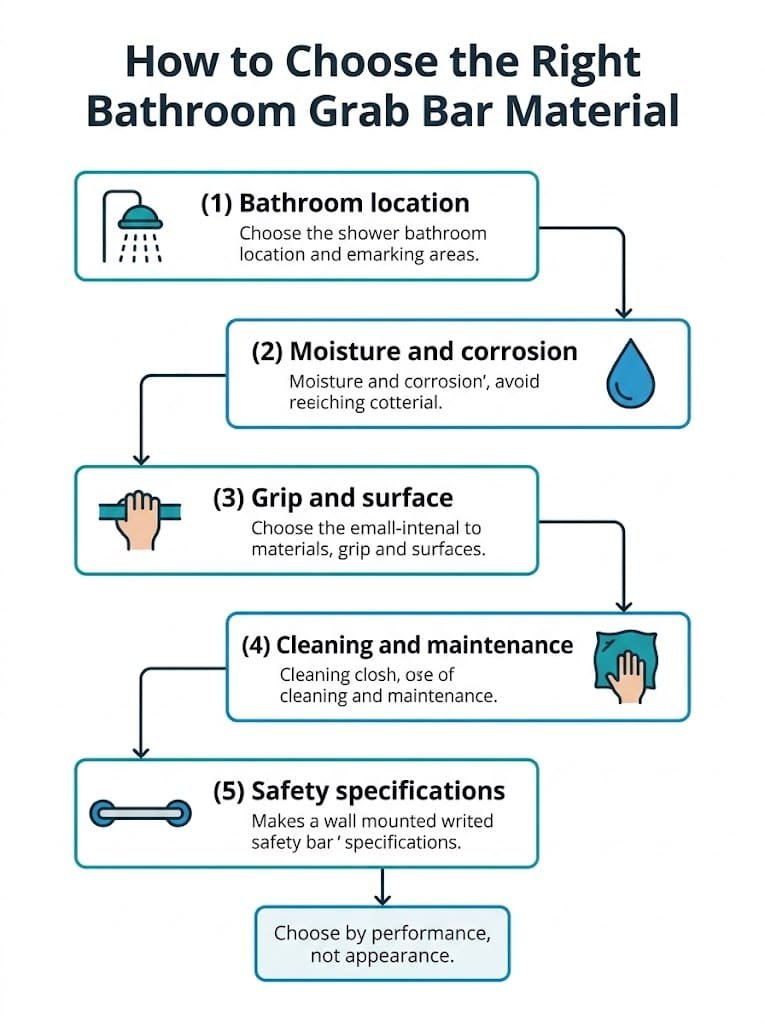
The bathroom location affects how much moisture, splashing, cleaning, and everyday wear the grab bar may experience.
For a shower: Look for a grab bar specifically designed for wet-area use. Review its corrosion-resistance information, surface characteristics, cleaning requirements, and mounting instructions.
For a bathtub: Consider repeated water exposure, the user’s grip preferences, and where the bar will be installed to assist with entering, exiting, or maintaining balance.
Beside a toilet: Consider the type of support needed during sitting, standing, and transfers. Material is only one part of the decision; the bar’s shape, positioning, mounting system, and intended use also matter.
A material that works well in one setting is not automatically the right choice in another. Check the manufacturer’s guidance for the specific product and installation environment.
Check the Load Rating and Mounting Requirements
A grab bar must be designed to provide the type of support the user needs and installed according to its manufacturer’s instructions. Material alone does not establish how much force a bar can safely withstand.
Before buying, verify:
- The product is explicitly identified as a load-bearing grab bar.
- The manufacturer provides applicable load-rating or testing information.
- The installation instructions identify suitable mounting surfaces and anchoring requirements.
- The mounting hardware is appropriate for the intended installation.
- The supporting wall or structure can accommodate the specified mounting system.
Do not assume that a stainless steel bar is safe simply because steel is strong, or that a plastic bar is suitable merely because it looks sturdy.
A securely installed bar can provide support only when the complete assembly including the bar, fasteners, and supporting structure is appropriate for its intended use.
Match the Surface to Grip and Cleaning Needs
The most suitable surface is one that the intended user can grasp comfortably and that can be maintained properly.
If the user dislikes the cold feel of exposed metal, a nylon-covered surface may be worth evaluating. If straightforward cleaning and a metal finish are priorities, a stainless steel product may be a good candidate. Textured surfaces can also be considered, but their actual grip characteristics should not be inferred from appearance alone.
Think about daily use:
- Will the bar regularly be wet?
- Can the user comfortably grasp its diameter and shape?
- Can the surface be cleaned using products already suitable for the bathroom?
- Could the user’s grip, dexterity, or mobility affect which design works best?
Choose based on the user’s needs and the manufacturer’s specifications rather than a universal claim that one surface is always safer.
Review the Product Specifications Before Buying
Product listings can emphasize appearance while leaving important construction details unclear. Read the specifications and installation documentation before deciding.
Use this checklist:
- Base material: Is the underlying material identified?
- Surface finish: Is the coating, plating, sleeve, or finish clearly described?
- Load-bearing purpose: Is the product explicitly designed to support a person?
- Load rating: Does the manufacturer provide relevant load-bearing or testing information?
- Mounting requirements: Are the required wall support, fasteners, and installation method explained?
- Care instructions: Are the cleaning and inspection requirements suitable for the intended bathroom location?
If a product’s load rating, construction, or mounting requirements are unclear, ask the manufacturer before relying on it for support.
7. How to Maintain and Inspect Different Grab Bar Materials
Regular cleaning and visual inspection help identify surface damage, corrosion, and other warning signs. A grab bar may look well-maintained, but its appearance alone cannot confirm that the bar and its mounting hardware are secure and reliable.
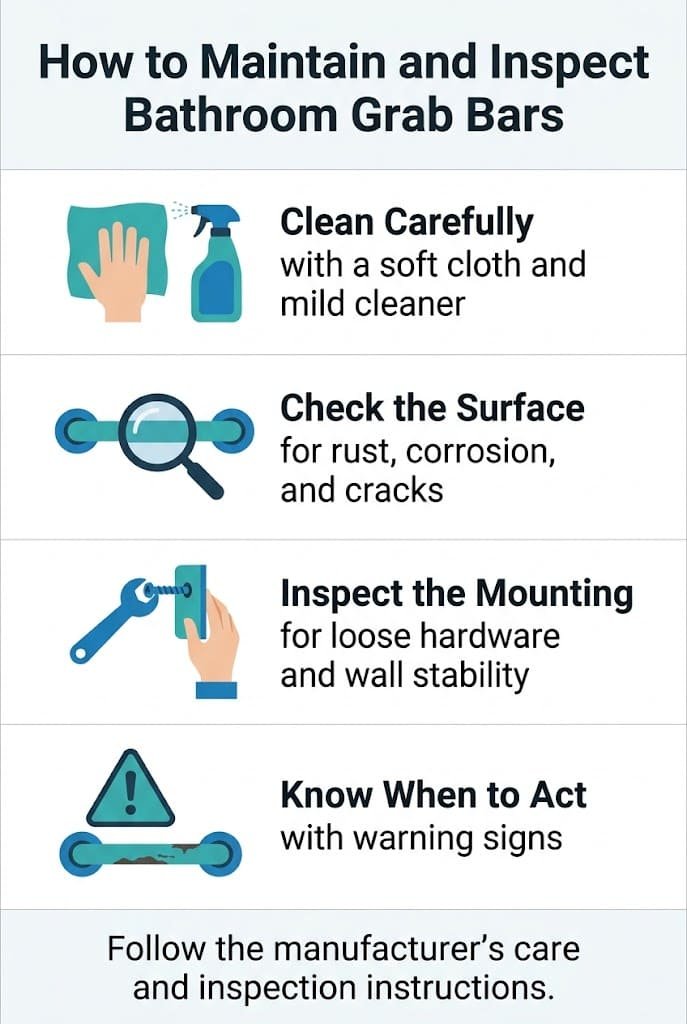
Follow the manufacturer’s instructions for cleaning, maintenance, and inspection. Avoid using a generic cleaning method on every material, because some chemicals and abrasive tools can damage particular finishes or coatings.
Cleaning Stainless Steel and Aluminum
For stainless steel and aluminum grab bars, use cleaning products approved by the manufacturer. Routine cleaning can remove soap residue, fingerprints, and mineral deposits that build up in bathrooms.
Keep these principles in mind:
- Use a soft cloth or other cleaning tool recommended for the surface.
- Avoid abrasive pads or harsh chemicals unless the manufacturer specifically permits them.
- Rinse and dry the surface as directed to reduce residue and water spotting.
- Check for discoloration, pitting, or other changes that may indicate surface damage.
Stainless steel and aluminum have different material properties, so the same cleaner should not automatically be assumed suitable for both. The product’s care instructions should take priority.
Inspecting Coated and Nylon-Covered Grab Bars
Coated and nylon-covered grab bars need particular attention to the condition of their outer surfaces.
Inspect for:
- Cracked, flaking, or heavily scratched protective finishes.
- Exposed metal or signs of corrosion beneath a damaged surface.
- Areas that have become difficult to clean.
- Changes in the surface that may affect comfortable gripping.
Do not ignore coating damage simply because the bar still appears firmly attached. If damage exposes the core or raises concerns about hygiene, corrosion, or structural integrity, follow the manufacturer’s guidance and have the product assessed before relying on it.
Do not attempt an improvised coating repair unless the manufacturer confirms that the repair method is appropriate.
Signs That a Grab Bar Needs Further Inspection
Regardless of material, a grab bar needs further assessment if you notice movement, visible damage, or changes around its mounting points.
Warning signs include:
- The bar moves, rotates, or feels loose when lightly checked.
- Fasteners appear loose or mounting components are damaged.
- Corrosion, cracks, or deformation are visible.
- The surrounding tile, wall, or supporting surface shows damage.
- The grab bar appears to have loosened from its mounting points.
Do not test a questionable bar by pulling hard on it or putting your body weight on it. Stop relying on it for support until the cause has been assessed and corrected by a qualified person.
For more detailed guidance, read BathSmartly’s Bathroom Grab Bar Maintenance guide.
8. FAQs
What Is the Most Durable Material for a Bathroom Grab Bar?
Stainless steel is a durable option for many bathroom applications, but there is no universal winner across every product. Durability depends on the alloy grade, construction, surface treatment, exposure, maintenance, and mounting system. Compare documented product specifications rather than relying on the material name alone.
Are Stainless Steel Grab Bars Rust-Proof?
No. Stainless steel is corrosion-resistant, not completely rust-proof under all conditions. Corrosion can occur depending on the grade, surface condition, moisture, chloride exposure, and cleaning practices. Proper maintenance and selecting a product suited to its environment help reduce the risk.
Are Nylon-Coated Grab Bars Better Than Stainless Steel?
Not necessarily. Nylon-coated steel may offer a warmer-feeling surface, while exposed stainless steel offers a metal surface that may be easier to evaluate for visible corrosion. The better option depends on grip preferences, product construction, maintenance needs, and intended use. Both must meet appropriate load-bearing and installation requirements.
Is Aluminum Strong Enough for a Bathroom Grab Bar?
It can be, provided the complete product is engineered and rated for its intended load-bearing use. Aluminum grab bars vary in alloy, thickness, design, and mounting system. Confirm the manufacturer’s specifications rather than judging strength by weight or appearance.
Are Plastic Grab Bars Safe for Supporting Body Weight?
Only products specifically designed and rated for the intended load-bearing application should be considered for body-weight support. Plastic or polymer construction alone does not establish safety. Verify the product’s load rating, mounting instructions, and intended use, and do not substitute an ordinary plastic handle or decorative rail for a proper grab bar.
How Does 304 Stainless Steel Differ From 316 Stainless Steel?
Both are stainless steel grades, but 316 contains molybdenum, which generally improves resistance to chloride-related corrosion compared with 304. Grade 316 may be beneficial in more corrosive environments, while properly specified 304 stainless steel may suit many ordinary residential bathrooms. Neither grade guarantees that a product will never corrode, and the grade does not determine its load-bearing capacity by itself.
9. Conclusion
Choosing the right bathroom grab bar materials involves more than deciding between stainless steel, aluminum, or a coated surface. The underlying construction, corrosion resistance, grip characteristics, maintenance requirements, and mounting system all contribute to how suitable a product is for a particular bathroom.
Stainless steel is a durable option for many applications, while nylon-coated steel may appeal to users who prefer a warmer-feeling surface. Aluminum and coated metal can also be suitable when the complete product is appropriately designed and specified. Plastic and polymer products require the same careful verification of their intended use and load-bearing capabilities.
Before buying, identify the base material, understand the finish, review the manufacturer’s specifications, and confirm that the grab bar can be securely installed in the intended location. The safest choice is a properly rated grab bar that meets the user’s needs and is installed according to its manufacturer’s requirements not simply the bar made from a particular material.
For more guidance, explore BathSmartly’s Complete Guide to Bathroom Grab Bars and learn how different bar designs and installation locations affect bathroom safety.
1 Comment