
1. Introduction
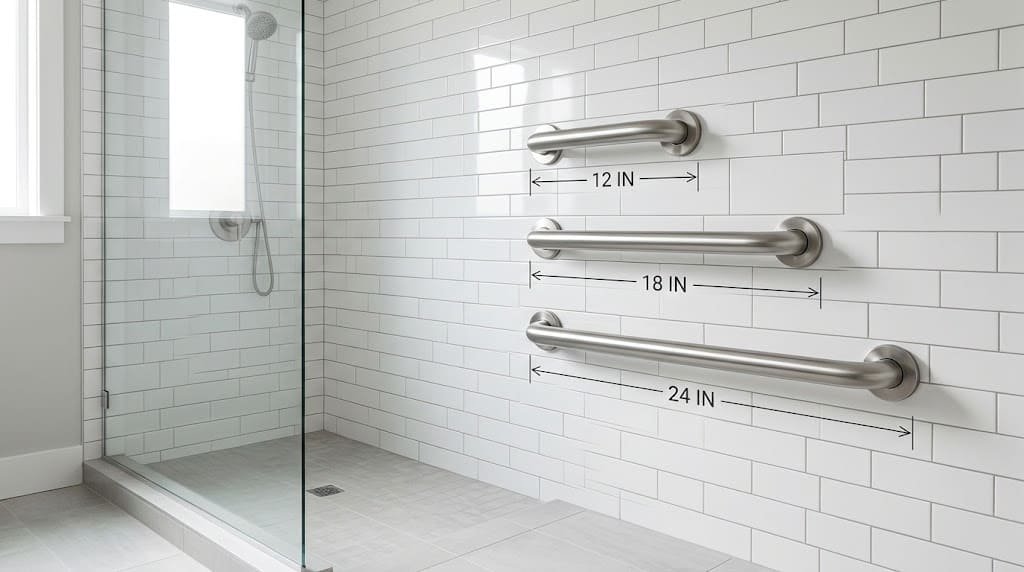
Choosing the right bathroom grab bar size is important for creating a safer and more accessible bathroom. Grab bars are available in different lengths, including 12, 16, 18, 24, 30, 32, 36, 42, and 48 inches. However, the best size depends on where you plan to install the bar, how much wall space is available, and the type of support needed.
A short grab bar may work well in a compact area, while a longer model can provide more gripping space along a shower or bathtub wall. You should also consider the bar’s diameter, mounting dimensions, and compatibility with the wall structure before purchasing.
This guide explains common bathroom grab bar sizes, compares popular lengths, covers shower, bathtub, and toilet applications, and explains how to choose a suitable size for your bathroom.
Table of Contents
2. What Sizes Do Bathroom Grab Bars Come In?
Bathroom grab bars are available in several standard product lengths, commonly ranging from 12 to 48 inches. Popular options include 12, 16, 18, 24, 30, 32, 36, 42, and 48 inches, although availability varies by manufacturer, model, and finish.
The appropriate length depends on the intended installation location and the amount of gripping space needed. A compact bar may suit a narrow wall section, while a longer model may provide more support positions along a shower or bathtub wall.
Common Standard Grab Bar Lengths
The following table shows common bathroom grab bar lengths and their general applications.
| Grab bar length | General application |
|---|---|
| 12 inches | Compact wall sections and selected support locations |
| 16 inches | Short mounting areas and limited wall space |
| 18 inches | Compact shower and bathtub support areas |
| 24 inches | Shower walls, bathtub areas, and general bathroom support |
| 30 inches | Wider gripping coverage along bathroom walls |
| 32 inches | Extended support in suitable wall locations |
| 36 inches | Longer shower and bathtub wall coverage |
| 42 inches | Extended side-wall support, including accessible toilet installations |
| 48 inches | Large wall sections requiring extended gripping coverage |
These are commonly available product lengths, not universal recommendations for every bathroom. For example, a 24-inch grab bar may fit a shower wall, but a longer or differently positioned bar may be more appropriate depending on the user’s movement and the available mounting space.
Some manufacturers offer additional lengths or different combinations of finishes and diameters. Always check the manufacturer’s product specifications before choosing a particular size.
Nominal Length vs. Actual Grab Bar Length
Nominal grab bar length is the advertised size used to identify a product, while the actual overall dimension describes the physical space occupied by the complete bar, including its mounting components when applicable.
These measurements may differ because grab bars have mounting flanges or end plates that extend beyond the gripping section.
For example, a grab bar advertised as 24 inches may have an overall outside dimension greater than 24 inches, depending on its design. This difference matters when installing a bar between a shower fixture, doorway, or other bathroom obstruction.
Before purchasing, check:
- Advertised length: The nominal size listed in the product description.
- Gripping length: The usable portion of the bar intended for holding.
- Overall length: The complete end-to-end measurement, including projecting mounting components where applicable.
- Mounting dimensions: The size and position of the mounting flanges and screw holes.
Do not assume that two grab bars with the same advertised length will occupy exactly the same amount of wall space. Compare their technical drawings and installation dimensions to make sure the selected model fits.
3. Bathroom Grab Bar Size Chart: Lengths and Common Uses
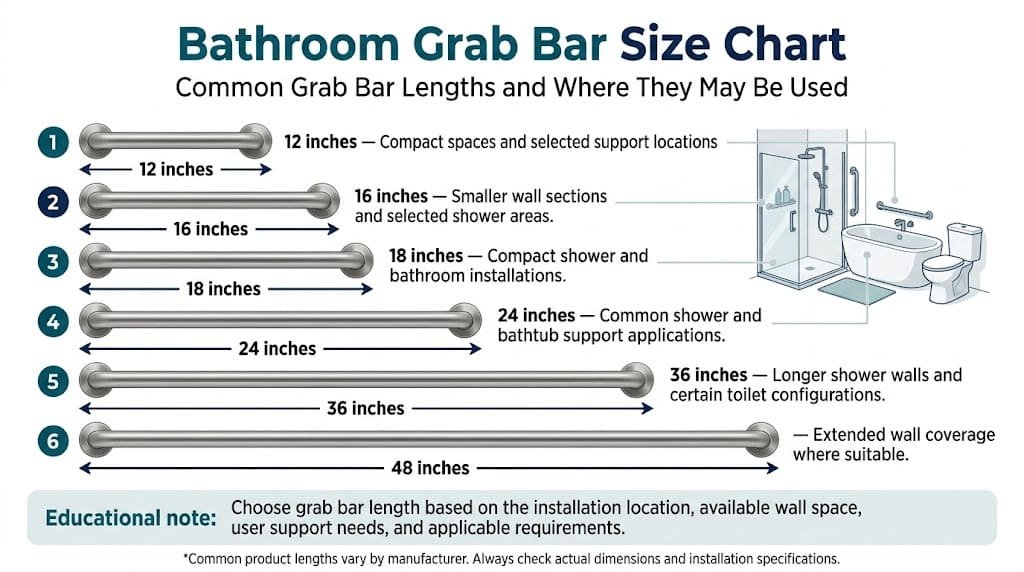
A bathroom grab bar size chart makes it easier to compare available lengths and understand where different models may be useful.
The following chart provides a general starting point for selecting a size.
| Size | Typical use | Main consideration |
|---|---|---|
| 12 inches | Compact support areas | Limited gripping space |
| 16 inches | Narrow wall sections | Check mounting-point compatibility |
| 18 inches | Smaller shower or tub areas | Consider the user’s reach |
| 24 inches | Shower and bathtub walls | Offers more gripping space |
| 30 inches | Wider bathroom wall sections | Requires adequate mounting space |
| 32 inches | Extended wall support | Check fixture clearance |
| 36 inches | Longer shower and bathtub walls | Allows a wider gripping area |
| 42 inches | Accessible toilet side-wall applications | Follow applicable dimensional requirements |
| 48 inches | Extended bathroom wall coverage | Requires sufficient wall support |
A longer grab bar is not automatically better for every installation. The goal is to provide a secure gripping surface in the locations where the user needs support.
For example, a person entering a bathtub may benefit from a vertical grab bar positioned near the entry point, while someone who needs support while standing under a shower may benefit from a longer horizontal bar along the back wall.
Consider the user’s movement, the bathroom layout, and the wall structure together rather than selecting a size based only on its length.
4. How to Choose the Right Grab Bar Length for Each Bathroom Location
The right grab bar length depends heavily on its installation location. Shower entrances, bathtub walls, and toilet areas have different space requirements and support needs.
A suitable size should provide enough gripping area for the intended movement without interfering with bathroom fixtures or creating installation problems.
Shower Grab Bar Lengths
Shower grab bars are available in several lengths, with 18, 24, 30, and 36-inch models among the options commonly considered for residential installations. The appropriate size depends on the shower’s dimensions, the user’s reach, and the location where support is needed.
Different shower locations may require different grab bar configurations.
- Shower entrance: A vertical grab bar near the entrance can provide a gripping point when stepping into or out of the shower. A shorter model may fit a limited wall section if it provides sufficient gripping space.
- Shower back wall: A horizontal grab bar can provide support while standing, turning, or adjusting position. A longer model may be useful when the wall has enough space.
- Shower beside a seat: A grab bar near a shower seat can help with sitting down, standing up, and repositioning. Its length and position should match the user’s reach and movement.
When selecting shower grab bar lengths, consider the position of the showerhead, controls, doors, and any built-in seating.
For accessible shower compartments covered by the ADA, the applicable grab bar dimensions depend on the shower type and configuration. A general residential product recommendation should not be confused with an ADA-compliant installation.
Bathtub Grab Bar Sizes
Bathtub grab bar sizes depend on the tub’s dimensions, the location of the faucet controls, and the movements involved in entering, exiting, and using the bathtub.
A combination of horizontal and vertical grab bars may provide support at different stages of bathing.
Consider these locations:
- Back wall: A horizontal grab bar can provide support while sitting, standing, or changing position inside the bathtub.
- Control-end wall: A grab bar near the faucet controls can provide a gripping point when reaching toward the water controls.
- Head-end wall: A shorter or longer bar may be appropriate depending on the tub configuration and the user’s support needs.
For an ordinary residential bathtub, 18- and 24-inch products may be worth comparing for compact wall areas, while longer bars may suit larger installations.
However, the appropriate size should be determined by the available mounting area and the user’s needs rather than by a fixed product-length recommendation.
The ADA also specifies different bathtub grab bar configurations depending on whether the tub has a permanent seat or a removable in-tub seat. These requirements should be checked when planning an accessible facility.
Toilet Grab Bar Lengths
Toilet grab bar lengths depend on the wall location and the type of support required when sitting down, standing up, or transferring between a wheelchair and the toilet.
The two main locations are the side wall and rear wall.
Side-wall grab bars: A longer horizontal bar can provide support beside the toilet. For toilet installations covered by the applicable ADA requirements, the side-wall grab bar must be at least 42 inches long.
Rear-wall grab bars: A horizontal bar behind the toilet provides support from the rear. Under the ADA Standards, the standard minimum length is 36 inches, with a specific exception permitting a 24-inch minimum bar in certain circumstances.
For a typical home bathroom, the best size depends on the user’s movement, the available wall area, and the mounting structure.
Do not assume that a shorter residential grab bar automatically meets ADA requirements. Accessible toilet installations must also satisfy applicable positioning, clearance, and structural requirements.
Grab Bar Sizes for Small Bathrooms
Small bathrooms can make grab bar selection more challenging because the available wall space may be limited by toilets, sinks, shower controls, doors, and other fixtures.
A 12-, 16-, or 18-inch grab bar may be worth considering for a compact installation, but the selected length must still provide an appropriate gripping area.
Before choosing a shorter bar:
- Measure the available wall space.
- Identify where the user needs support.
- Check the position of nearby fixtures and obstructions.
- Locate suitable wall studs or reinforcement.
- Compare the product’s overall dimensions and mounting requirements.
Avoid choosing a small grab bar simply because it is easier to fit. A shorter product may not provide enough gripping space for the intended movement.
If the wall cannot accommodate a suitable grab bar, consider whether the mounting location or bathroom layout needs to be changed. Secure attachment and appropriate positioning are more important than fitting a particular product into a limited space.
5. What Is the Difference Between 12, 16, 18, 24 and 36-Inch Grab Bars?
Although these grab bar lengths may look similar in product listings, they provide different amounts of gripping space and suit different wall conditions.
The best option depends on the intended use, the user’s reach, and the available mounting area.
12-Inch Grab Bars
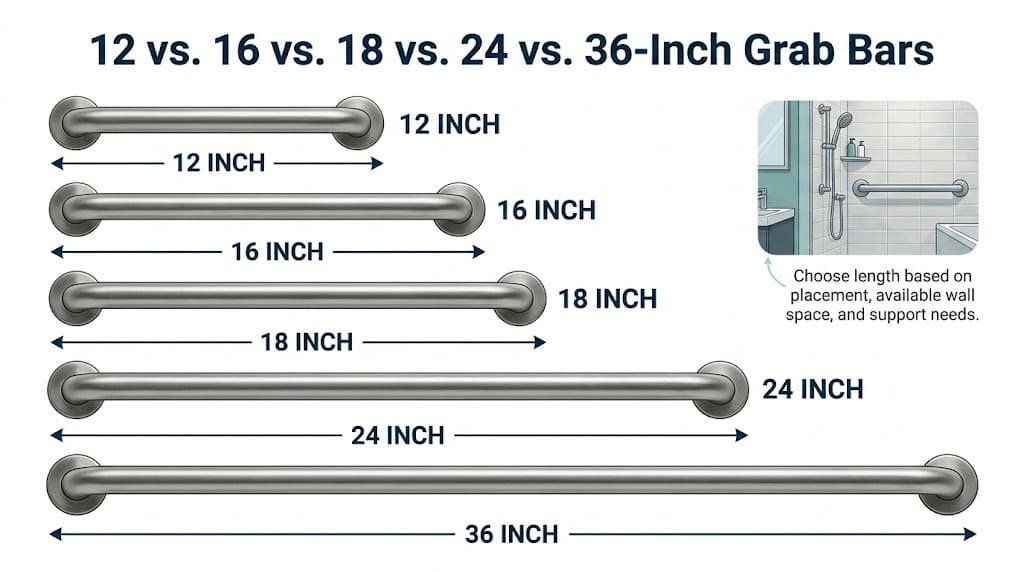
A 12-inch grab bar is a compact option for bathroom areas where a longer model may not fit.
It may be suitable for selected support locations near a bathtub or shower entrance, provided the gripping area and mounting arrangement meet the user’s needs.
Consider a 12-inch grab bar when:
- The available wall section is limited.
- A compact gripping surface is sufficient for the intended movement.
- The mounting points can be securely supported.
Its main limitation is the smaller gripping area. It may not provide enough space for someone who needs to reposition their hand or maintain support across a wider movement.
16-Inch Grab Bars
A 16-inch grab bar provides more gripping space than a 12-inch model while remaining relatively compact.
It can be considered for smaller bathroom wall sections where additional hand placement is useful but a longer bar would interfere with nearby fixtures.
Before purchasing, check the distance between mounting points and confirm that the wall can support the installation.
A 16-inch bar should not be selected solely because it matches a particular stud spacing. The manufacturer’s mounting design and the availability of suitable structural support must also be considered.
18-Inch Grab Bars
An 18-inch grab bar offers a balance between compact dimensions and usable gripping space.
It may be useful in smaller shower or bathtub areas where the user needs a longer gripping surface than a 12- or 16-inch model provides.
This length can also be considered when installing support near a shower entrance or along a limited wall section.
However, an 18-inch bar is not automatically suitable for every shower or bathtub. Check the user’s reach, the intended hand position, and the available wall structure before deciding.
24-Inch Grab Bars
A 24-inch grab bar provides a wider gripping area than shorter models and can be useful along shower and bathtub walls.
It may offer more flexibility for users who need to change hand positions while standing, turning, or moving between bathing positions.
Common considerations include:
- Available wall space.
- Distance from shower controls and other fixtures.
- Mounting flange dimensions.
- User reach and preferred gripping position.
- Whether the installation has specific accessibility requirements.
A 24-inch grab bar is also relevant to certain ADA applications, including the control-end wall of an accessible bathtub and the specific exception for a toilet rear-wall bar.
However, a 24-inch product does not automatically satisfy every ADA grab bar requirement.
36-Inch Grab Bars
A 36-inch grab bar offers an extended gripping surface for wider wall areas.
It may be appropriate for larger shower or bathtub installations where the user needs support across a greater portion of the wall.
It is also the standard minimum length specified for the rear-wall grab bar at an accessible toilet under the applicable ADA requirements.
Before choosing a 36-inch model, check that the entire installation area is suitable. The bar must not interfere with fixtures, and its mounting points must have adequate structural support.
A longer bar can provide more gripping positions, but its effectiveness still depends on correct placement and secure installation.
6. What Other Grab Bar Dimensions Should You Check?
Length is only one measurement to consider when choosing a bathroom grab bar. Diameter, mounting flange dimensions, overall length, and installation height can also affect usability and compatibility.
Understanding these measurements helps prevent confusion when comparing products.
Grab Bar Diameter
Grab bar diameter refers to the outside thickness of the gripping tube. It affects how comfortably a person can wrap their hand around the bar.
Common residential grab bar diameters include 1¼ inches and 1½ inches, although other product designs are available.
The appropriate diameter depends on the user’s hand size, grip strength, and comfort.
Under Section 609.2 of the 2010 ADA Standards, circular grab bars in covered accessible facilities must have an outside diameter between 1¼ and 2 inches.
A comfortable diameter matters because a bar that is difficult to grip may not provide the intended support.
When comparing products, check:
- Outside tube diameter.
- Grip shape and surface texture.
- Distance between the bar and the wall.
- Whether the user’s hand can comfortably wrap around the gripping surface.
For accessible installations, the applicable ADA cross-section and clearance requirements must also be considered.
Mounting Flange and Overall Dimensions
The mounting flange is the end component used to attach a grab bar to the wall. Its dimensions affect how much wall space the complete product occupies.
Two grab bars with the same advertised length may have different flange sizes, screw-hole arrangements, and overall dimensions.
Check the following product details:
- Flange diameter or mounting plate dimensions.
- Number and position of mounting holes.
- Distance between mounting points.
- Overall outside length.
- Required fasteners and mounting method.
These details become particularly important when installing a grab bar in a narrow area or near bathroom fixtures.
A product’s nominal length alone is not enough to determine whether it will fit your intended mounting location.
Grab Bar Installation Height and Wall Clearance
Installation height is different from grab bar length. Length measures the bar itself, while installation height describes how far above the finished floor the gripping surface is positioned.
For horizontal grab bars in applicable ADA-covered facilities, the 2010 Standards generally specify a height of 33 to 36 inches above the finished floor, measured to the top of the gripping surface. Different provisions apply to certain bathtub configurations and other specialized applications.
The ADA also specifies a 1½-inch minimum clearance between the grab bar and the adjacent wall in covered installations.
These dimensions are important because a grab bar must provide sufficient hand clearance without interfering with nearby objects.
For more detailed guidance, see our guide to recommended grab bar mounting height and proper grab bar placement.
7. How to Measure Your Bathroom Before Choosing a Grab Bar
Measuring the installation area before purchasing a grab bar helps you select a product that fits the wall and provides support where it is needed.
A few simple checks can prevent problems with product dimensions, mounting locations, and nearby fixtures.
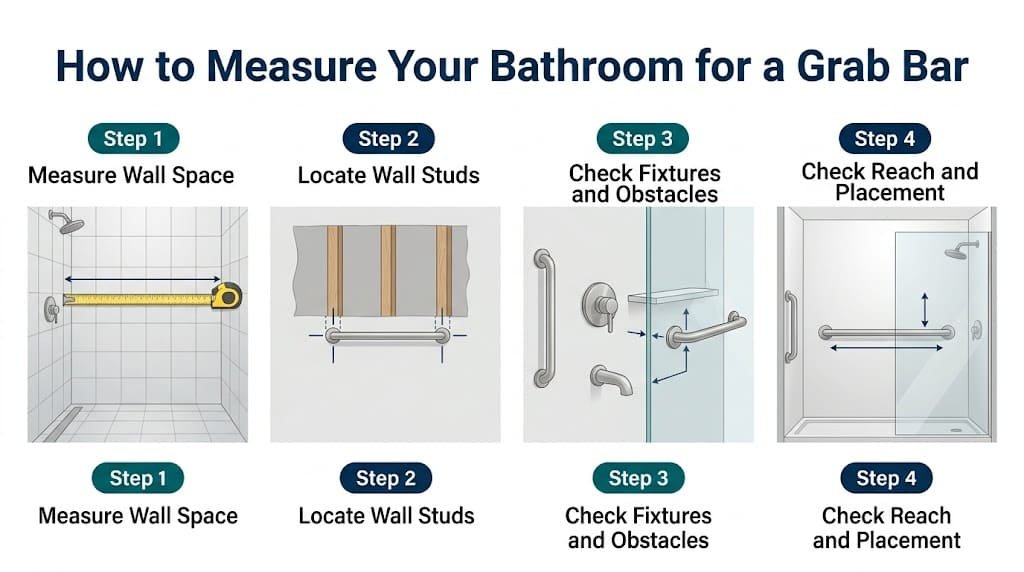
Measure the Available Wall Space
Start by measuring the wall section where you intend to install the grab bar.
Use a tape measure to check the available horizontal or vertical space, depending on the planned orientation.
Account for:
- Shower doors and enclosures.
- Bathtub edges.
- Toilet fixtures.
- Shower controls.
- Nearby walls and corners.
- Mounting flange dimensions.
Compare the available space with the manufacturer’s overall product dimensions rather than relying only on the advertised length.
Check the Location of Wall Studs and Reinforcement
A grab bar must be securely attached to a suitable supporting structure.
Before selecting a product, identify the location of wall studs or installed reinforcement behind the finished wall.
Standard residential stud spacing is often 16 inches on center, although other spacing arrangements are used. This does not mean every grab bar must be 16 inches long or that every bar will align with two studs.
The manufacturer’s mounting pattern and the actual wall construction determine the appropriate installation method.
If the intended mounting points do not align with adequate structural support, a qualified installer may need to add suitable reinforcement or use an approved mounting system for that wall type.
Do not rely on ordinary drywall anchors alone unless the specific mounting system is designed and rated for the intended application.
Account for Fixtures and Mounting Flanges
A grab bar should fit without interfering with bathroom fixtures or reducing necessary clearance.
Check the distance between the intended mounting area and:
- Shower valves and handles.
- Showerheads.
- Bathtub faucets.
- Toilet accessories.
- Shower doors.
- Nearby grab bars.
Also account for the mounting flanges, which may extend beyond the advertised gripping length.
This step is particularly important in small bathrooms, where a few inches can affect whether the bar fits comfortably and safely.
Match the Bar Length to the User’s Reach and Movement
The appropriate length should support the movement the user needs to perform.
Think about how the person will use the bathroom:
- Entering or exiting: A vertical or angled gripping surface may help provide support during a change in position.
- Standing in the shower: A horizontal bar may provide a longer gripping area.
- Sitting or standing near a bathtub: The user may need a bar positioned within comfortable reach during the movement.
- Using the toilet: Side-wall and rear-wall support may serve different purposes.
Consider the person’s hand size, reach, mobility, and preferred gripping position.
A grab bar should be placed where the user can reach it naturally without stretching, twisting awkwardly, or losing balance.
8. ADA Grab Bar Size Requirements vs. Residential Bathroom Recommendations
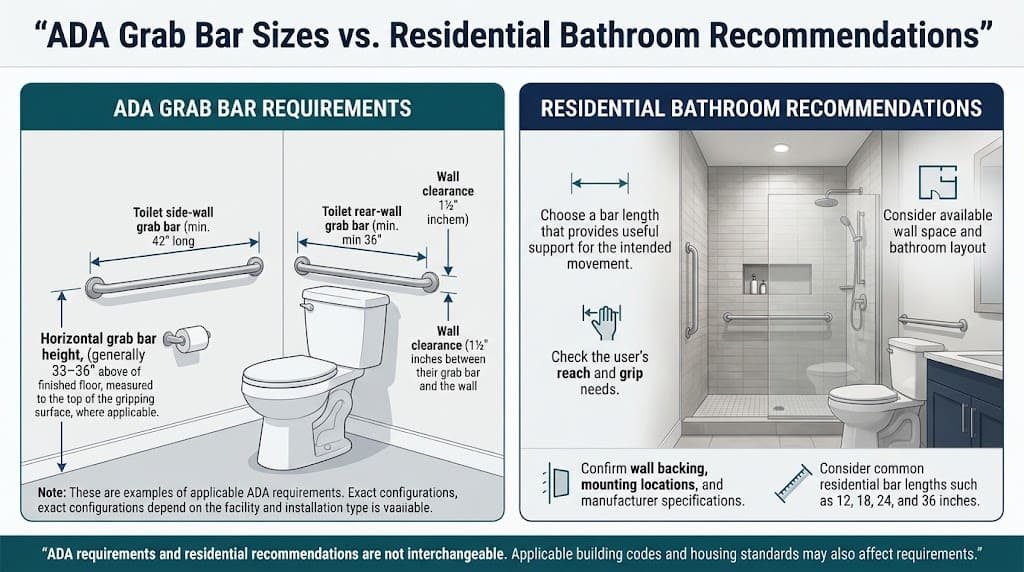
The Americans with Disabilities Act (ADA) establishes grab bar requirements for specific accessible facilities covered by the law. These requirements include minimum lengths, positioning, clearances, and structural strength.
They are not universal size requirements for every residential bathroom.
For accurate planning, it is important to distinguish the official ADA dimensions from general home grab bar recommendations.
ADA Grab Bar Length Requirements for Toilets
Under Sections 604.5.1 and 604.5.2 of the 2010 ADA Standards, accessible toilet installations generally require grab bars on both the side wall and rear wall.
The specified minimum lengths are:
| Location | ADA minimum length |
|---|---|
| Side wall | 42 inches |
| Rear wall | 36 inches |
| Rear wall under a specific exception | 24 inches |
The 42-inch side-wall grab bar must be positioned no more than 12 inches from the rear wall and extend at least 54 inches from the rear wall.
The 36-inch grab bar on the rear wall must extend a minimum of 12 inches to one side of the toilet’s centerline and 24 inches to the opposite side.
When is a 24-inch rear grab bar permitted?
The ADA permits a 24-inch minimum rear-wall grab bar, centered on the toilet, when the location of a recessed fixture adjacent to the toilet prevents installation of the required 36-inch bar.
There is also a separate exception allowing a rear grab bar to be split or shifted when an administrative authority requires flush controls in a position that conflicts with the bar.
These are specific exceptions, not general permission to substitute a shorter grab bar whenever wall space is limited.
You can review the requirements in the official 2010 ADA Standards for Accessible Design.
ADA Grab Bar Length Requirements for Bathtubs
ADA bathtub grab bar requirements depend on whether the bathtub has a permanent seat or a removable in-tub seat.
For bathtubs without permanent seats, Section 607.4.2 specifies the following minimum lengths:
| Location | Minimum grab bar length |
|---|---|
| Back wall | 24 inches per required bar |
| Control-end wall | 24 inches |
| Head-end wall | 12 inches |
The two required back-wall grab bars have specific positioning requirements. One is installed at the height specified by the applicable grab bar provisions, while the other is positioned 8 to 10 inches above the bathtub rim.
The control-end wall bar must be installed at the front edge of the bathtub. The head-end wall bar must also be positioned at the front edge.
For bathtubs with permanent seats, Section 607.4.1 specifies a different arrangement, including two grab bars on the back wall and a minimum 24-inch grab bar on the control-end wall. The back-wall bars have specific positioning requirements that should be checked in the official standard rather than assuming the same length rules apply to every bathtub configuration.
These measurements apply to the specific accessible bathtub configurations covered by the ADA. A typical home bathtub does not automatically need to follow the same arrangement.
For the complete technical requirements, consult ADA Section 607: Bathtubs.
Do Residential Bathrooms Have to Follow ADA Grab Bar Sizes?
Not every private residential bathroom is required to follow the ADA grab bar dimensions.
The 2010 ADA Standards primarily establish accessibility requirements for covered state and local government facilities, public accommodations, and commercial facilities. Ordinary private homes are generally not treated as public accommodations simply because they contain bathrooms.
However, some residential facilities and particular areas within residential properties may be subject to accessibility requirements depending on their use, ownership, and applicable laws.
The ADA Standards also include an important exception for certain residential dwelling units. Under Sections 604.5 and 607.4, grab bars are not required to be installed in specified residential bathrooms and bathtubs when adequate wall reinforcement has been provided to permit later installation of compliant grab bars.
This distinction is important: the exception concerns the requirement to install the bars, not permission to disregard the required dimensions when compliant grab bars are installed.
State and local building codes may impose additional accessibility or construction requirements. Some housing programs and federally funded residential projects may also have separate accessibility obligations.
For homeowners, ADA measurements can still serve as useful planning references, especially when designing a bathroom for long-term accessibility. However, the appropriate residential installation should account for the user’s needs, the bathroom layout, and applicable local requirements.
9. How to Choose the Best Bathroom Grab Bar Size
Choosing the best bathroom grab bar size involves more than comparing product lengths. You should consider the installation location, the user’s support needs, the wall structure, and the manufacturer’s specifications.
The right combination helps ensure that the bar is practical to use and can be securely installed.
Consider the Intended Bathroom Location
Start by identifying where the grab bar will be installed.
Different locations require different support arrangements:
- Shower: Consider whether the user needs support when entering, standing, turning, or using a shower seat.
- Bathtub: Think about the movements involved in stepping over the tub edge, sitting, and standing.
- Toilet: Consider whether the person needs support from the side wall, rear wall, or both.
- Small bathroom: Account for limited wall space and nearby fixtures before choosing a compact model.
Do not choose a 12-, 18-, or 24-inch grab bar simply because it is a popular size. Match the product to the actual installation location and intended use.
Consider the User’s Grip and Support Needs
The user’s physical needs should influence both the grab bar length and diameter.
Consider:
- How far the person can comfortably reach.
- Whether they need a short or extended gripping surface.
- Their hand size and preferred grip.
- Whether they need support while standing, sitting, or transferring.
- Whether a horizontal, vertical, or angled bar is more suitable.
For example, someone who needs support while stepping into a bathtub may benefit from a different configuration than someone who needs a stable gripping surface while standing under a shower.
If the user has specific mobility limitations or requires assistance with transfers, an occupational therapist or qualified accessibility professional can help determine appropriate locations and configurations.
Check the Wall Structure and Manufacturer Specifications
Before purchasing, confirm that the selected grab bar can be installed securely at the intended location.
Review the product’s:
- Overall length.
- Gripping diameter.
- Mounting flange dimensions.
- Screw-hole pattern.
- Required fasteners.
- Approved wall types and installation methods.
- Manufacturer’s installation instructions.
A longer grab bar is not necessarily safer than a shorter one. Its structural performance depends on the bar, fasteners, mounting devices, and supporting wall structure.
The ADA’s 250-pound structural-strength provision is a design requirement for covered installations. It concerns the ability of the grab bar assembly and supporting structure to withstand an applied force. It should not be interpreted as a universal user-weight rating for every residential grab bar.
For additional guidance, read our article on secure bathroom grab bar installation.
Avoid Choosing a Bar Based Only on Appearance
Bathroom grab bars are available in finishes such as brushed stainless steel, polished stainless steel, white, and matte black.
Although appearance can help you match the bathroom’s design, it should not be the main factor when selecting a size.
Prioritize:
- Appropriate length for the intended movement.
- Comfortable gripping diameter.
- Suitable mounting locations.
- Secure attachment to adequate wall support.
- Compatibility with the bathroom layout.
- Manufacturer-approved installation requirements.
A decorative grab bar that does not fit the user’s reach or cannot be mounted securely is not a suitable choice.
Pre-purchase checklist
Before ordering a grab bar, confirm the following:
- I have identified the correct installation location.
- I have measured the available wall space.
- I have checked the advertised and overall product dimensions.
- I have considered the user’s reach and grip comfort.
- I have identified suitable wall studs or reinforcement.
- I have checked nearby fixtures and required clearances.
- I have reviewed the manufacturer’s installation instructions.
- I have checked applicable accessibility and building requirements.
10. FAQs
What are standard bathroom grab bar sizes?
Common bathroom grab bar lengths include 12, 16, 18, 24, 30, 32, 36, 42, and 48 inches. The available sizes depend on the manufacturer and product model. The appropriate length depends on the installation location, wall space, and the user’s support needs.
How long should a grab bar be?
A grab bar should be long enough to provide a comfortable and accessible gripping area for the intended movement. Shorter bars may work in compact locations, while longer models may be more suitable for extended shower or bathtub walls. The required length also depends on whether the installation must meet specific accessibility standards.
What size grab bar is best for a shower?
An 18-, 24-, or 36-inch grab bar may be suitable for different residential shower applications. The best size depends on the shower dimensions, mounting location, and whether the user needs support while entering, standing, or repositioning. Always check wall support and fixture clearance before choosing.
Is an 18-inch or 24-inch grab bar better?
A 24-inch grab bar provides more gripping space than an 18-inch model. However, an 18-inch bar may fit better in a compact shower or bathtub area. The better option depends on the available wall space, user’s reach, and intended use.
Is a 12-inch grab bar long enough?
A 12-inch grab bar can be sufficient for certain compact support applications, provided it offers enough gripping space for the intended movement and can be securely mounted. It may be too short when the user needs to reposition their hand or maintain support over a wider area.
What size grab bar is needed beside a toilet?
For an accessible toilet installation covered by the ADA, the side-wall grab bar must be at least 42 inches long. Residential installations may use different configurations depending on the user’s needs and applicable requirements. A shorter bar should not be assumed to satisfy ADA specifications.
Are 36-inch grab bars available for residential bathrooms?
Yes. Many manufacturers offer 36-inch grab bars for residential bathrooms. They can provide extended gripping space along suitable shower, bathtub, or toilet walls. Before purchasing, check the overall dimensions and confirm that the mounting locations have adequate structural support.
Does grab bar diameter matter as much as length?
Yes. Diameter affects how comfortably a person can grip the bar, while length determines how much gripping space is available. Both measurements matter when choosing a suitable grab bar. Consider the user’s hand size and grip strength, along with the installation location and applicable accessibility requirements.
11. Conclusion
Choosing the right bathroom grab bar sizes starts with understanding the available lengths and how they relate to different bathroom locations. Common options range from compact 12-inch models to extended 48-inch products, with 18-, 24-, and 36-inch bars also widely available.
The best size depends on where the bar will be installed, the user’s reach and support needs, and the amount of suitable wall space. You should also check the gripping diameter, mounting flange dimensions, and overall product length before purchasing.
For accessible installations, review the applicable ADA requirements rather than assuming that a commonly available product size automatically meets the standard.
Most importantly, choose a grab bar that provides a comfortable gripping area and can be securely mounted to adequate wall support. For a broader understanding of product types, placement, installation, and other important considerations, explore our complete guide to bathroom grab bars.
2 Comments