
1. Introduction
Choosing between smooth and textured grab bars involves more than appearance. The surface you hold can affect comfort, how securely you can grasp the bar under different conditions, and how easily you can clean it.
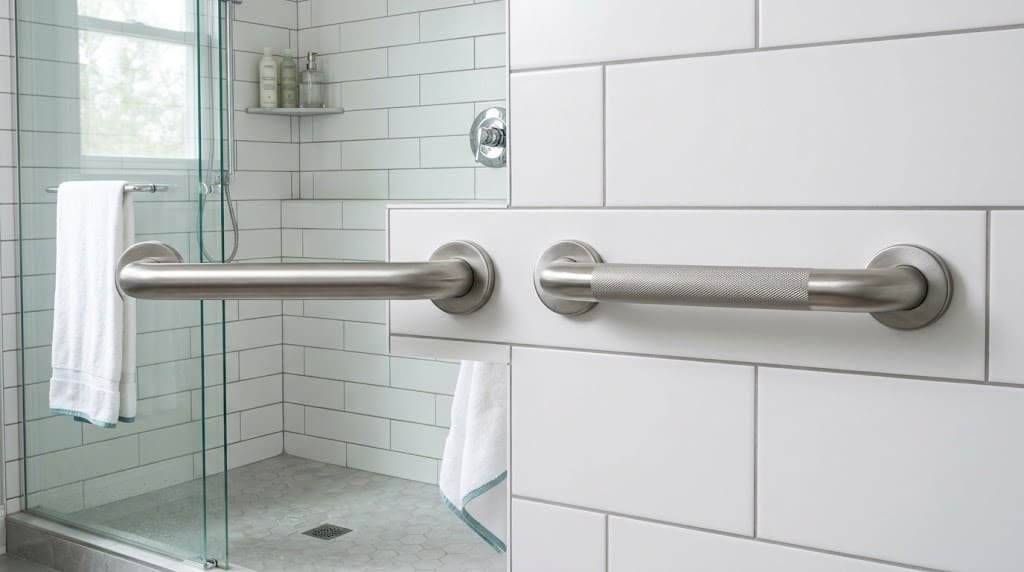
The main difference between smooth and textured grab bars is the feel and pattern of the gripping surface. Neither type is automatically safer than the other. Actual grip performance depends on the specific finish, whether your hands are dry, wet, or soapy, the bar’s design, and your ability to grasp it comfortably.
For a bathroom in a U.S. home, the best choice is one that provides a comfortable, dependable grip under the conditions in which you will use it. Understanding the differences between polished, satin, brushed, peened, and knurled finishes can help you compare products more accurately and avoid choosing a grab bar based on appearance alone.
Table of Contents
2. What Is the Difference Between Smooth and Textured Grab Bars?
Smooth grab bars generally have an even-feeling surface, while textured grab bars have a more noticeable pattern or surface treatment. These differences influence how a bar feels in the hand, but the finish alone does not establish how well it performs when wet or soapy.
What Is a Smooth Grab Bar?
A smooth grab bar has a relatively even gripping surface without pronounced grooves, raised patterns, or rough texture. Depending on the product, its finish may be polished, satin, or brushed.
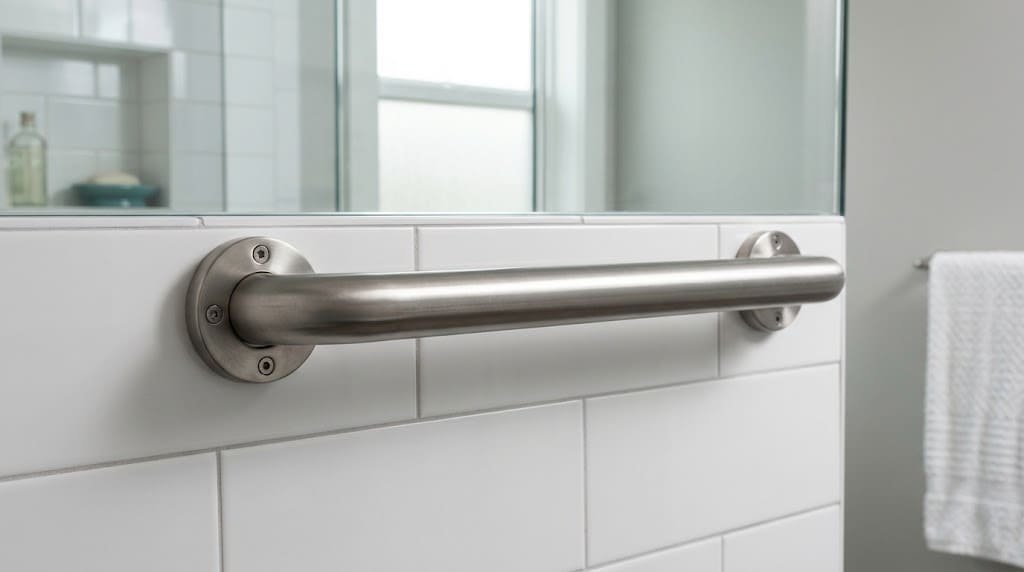
These finishes are not interchangeable:
- Polished finish: Often has a shiny, reflective appearance and a relatively smooth feel.
- Satin finish: Usually has a softer sheen and a less mirror-like appearance.
- Brushed finish: Typically has fine, directional surface lines that create a distinctive appearance and feel.
Smooth grab bars are often attractive to people who prefer a more uniform gripping surface. Their relatively even surfaces may also be easier to wipe clean, depending on the finish and product design.
However, a smooth-looking grab bar is not necessarily slippery, just as a shiny appearance does not reliably indicate grip performance. The finish, material, surface treatment, and conditions of use all matter.
What Is a Textured Grab Bar?
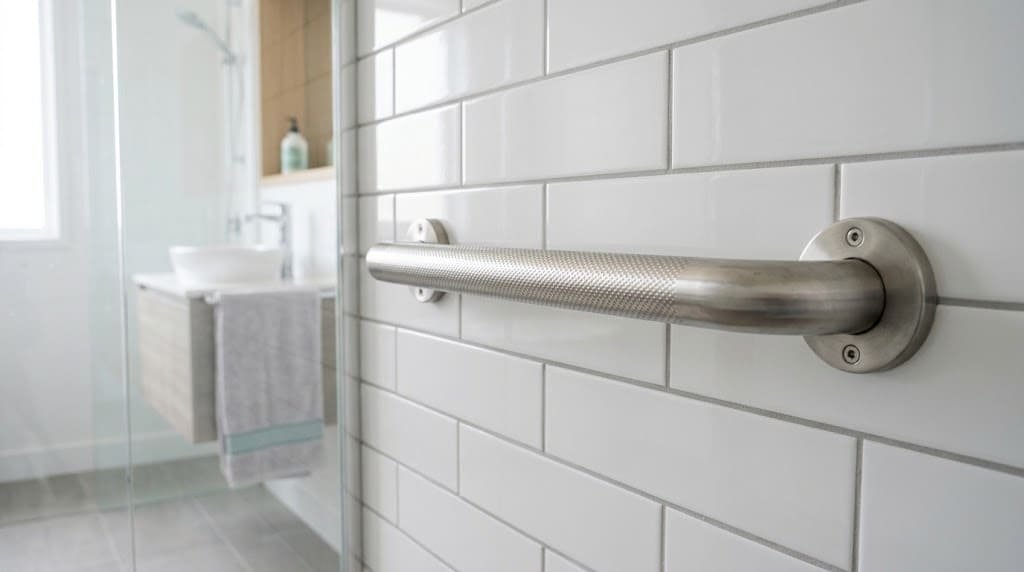
A textured grab bar has a gripping surface with a noticeable pattern, raised features, indentations, or another treatment intended to change its tactile characteristics.
Common examples include:
- Peened finish: A pattern of small, closely spaced surface impressions that creates a more textured feel.
- Knurled finish: A deliberately patterned surface, often featuring intersecting lines or a diamond-like design.
- Ribbed or molded grip: Raised ridges or molded patterns that create a more pronounced tactile surface.
- Textured coating: A coating designed to provide a different surface feel from the underlying material.
The degree of texture varies considerably. A lightly peened surface may feel quite different from a sharply patterned knurled grip, so it is inaccurate to treat every textured grab bar as the same.
A textured surface may appeal to someone who prefers a more noticeable tactile pattern when grasping a bar. However, its performance depends on the actual design and the conditions in which it is used. A more aggressive texture may also be uncomfortable for people with sensitive hands.
When shopping, look for the manufacturer’s description of the exact surface finish rather than relying only on labels such as non-slip, grip-enhanced, or textured.
3. Smooth vs. Textured Grab Bars: Side-by-Side Comparison
Smooth and textured grab bars each have potential advantages. The right option depends on your priorities, the specific product, and how the bar will be used.
| Comparison factor | Smooth finish | Textured finish |
|---|---|---|
| Surface feel | Generally even; varies by finish | More noticeable surface pattern |
| Grip performance | Depends on the finish and hand conditions | Depends on texture, material, and hand conditions |
| Wet-hand use | Check documented product performance | Check documented product performance |
| Soapy-hand use | Do not assume the surface will remain secure | Texture does not guarantee a secure grip |
| Comfort | May suit people who prefer an even surface | Some textures may feel rough or abrasive |
| Cleaning | Often straightforward to wipe | Grooves or patterns may require extra attention |
| Appearance | May look polished or understated | Surface pattern may be more visible |
| Buying consideration | Identify the exact finish | Identify the texture and its documented performance |
The most important distinction is that surface texture and actual grip performance are related but not identical. A smooth satin finish may perform differently from a highly polished finish, and a lightly peened surface may perform differently from a deeply knurled one.
For example, if you are comparing two stainless steel grab bars, do not assume the textured model offers better wet-hand grip simply because its surface looks rougher. Look for relevant performance information, consider comfort, and evaluate the complete product.
Likewise, do not select a smooth finish solely because it appears easier to clean. The bar still needs to provide a suitable grip for its intended use.
4. Which Grab Bar Surface Provides Better Grip When Wet?
Neither smooth nor textured grab bars are universally better for wet-hand grip. The specific finish matters, and research shows that performance can change with hand conditions. Soapy hands deserve particular attention because soap can substantially reduce friction between the hand and a gripping surface.
How Dry, Wet, and Soapy Hands Affect Grip
A grab bar may feel secure when your hands are dry but behave differently when you use it in the shower or bathtub.
- Dry hands: The interaction between skin and the surface may provide more friction than when soap is present.
- Wet hands: Water changes the conditions at the hand-surface interface, but the effect depends on the materials and finish.
- Soapy hands: Soap can reduce friction and make it harder to maintain a secure grasp, even when a bar has a noticeable texture.
A 2001 study published in Ergonomics examined five grab-rail materials under dry, wet, and soapy hand conditions. The researchers found significantly lower friction with soapy hands than with dry or wet hands. In their tests, the textured aluminum and knurled steel samples performed better under soapy conditions, while the smoother materials performed better with dry hands.
These results illustrate why the surface should be evaluated under the conditions in which it will be used. They do not establish that every textured grab bar outperforms every smooth one.
What Grip Testing Says About Smooth and Textured Finishes
The available evidence does not support a simple rule that rougher surfaces always provide better grip.
In its technical bulletin on slip-resistant grab bar surfaces, Bobrick reports that its testing found similar traction for satin and peened finishes with dry hands, while the tested satin finish provided 10% more traction than the peened finish with wet hands. The bulletin describes testing conducted by Bobrick using the ASTM F2961 Grip Performance Test and identifies third-party laboratory testing. These findings concern the specific surfaces tested; they should not be generalized to every grab bar on the market.
The peer-reviewed research discussed above provides a different but complementary perspective: textured materials performed better under soapy conditions in that study, while smoother materials performed better with dry hands. PubMed
These findings are not necessarily contradictory. They involve different products, surface finishes, materials, and testing conditions.
When comparing grab bars, consider three questions:
- What exact surface finish does the product use?
- Is there credible grip-performance information for wet or soapy conditions relevant to your intended use?
- Does the bar feel comfortable and provide a secure grasp for the person who will use it?
Manufacturer testing can be useful, but identify who commissioned the research and what was actually tested. Independent research also has limitations when its sample materials or test conditions differ from the products you are considering.
Why Surface Texture Alone Cannot Guarantee a Secure Grip
A textured finish may provide a more noticeable contact pattern, but texture alone does not establish how secure a grab bar will be in everyday use.
Several factors matter:
- Surface finish: Satin, polished, peened, and knurled surfaces can behave differently.
- Moisture and residue: Water, soap, and cleaning-product residue can change the conditions at the gripping surface.
- Bar design: Diameter, shape, clearance, and the ability to wrap your hand around the bar affect usability.
- Individual needs: Hand strength, dexterity, sensitivity, and comfort influence whether a person can grasp the bar effectively.
- Installation: A suitable gripping surface cannot compensate for an inadequately secured grab bar.
Choose a product based on its actual design and documented performance, not just the word non-slip or the appearance of its texture. A grab bar must also be securely installed in accordance with the manufacturer’s instructions to serve its intended purpose.
5. Smooth vs. Textured Grab Bars for Comfort and Everyday Use
Grip performance is important, but comfort also matters. A surface that feels unpleasant or difficult to grasp may not be suitable for the person using it regularly.
When a Smooth Surface May Be More Comfortable
A smooth or lightly textured finish may appeal to people who prefer an even surface against their palms. It may also be a practical option for someone who finds pronounced ridges or rough patterns uncomfortable.
For example, a person who dislikes the feel of knurled metal may prefer a satin-finish grab bar, provided the product meets their gripping needs.
However, smooth does not necessarily mean slippery, and polished, satin, and brushed finishes can differ in both appearance and feel. Evaluate the actual product rather than assuming that all smooth surfaces offer the same experience.
When a Textured Surface May Be Preferable
A textured grab bar may suit someone who prefers a more noticeable tactile pattern when holding the bar. Peened or knurled surfaces provide examples of how manufacturers create different gripping textures.
The appropriate degree of texture depends on the person and the product. A lightly peened finish may feel comfortable to one user, while a more pronounced pattern may feel too rough to another.
Do not assume that a more aggressive texture is automatically more effective. Consider documented grip performance, how comfortably the person can grasp the bar, and the conditions in which it will be used.
How Hand Sensitivity and Grip Ability Affect the Choice
The best surface is one the intended user can grasp comfortably and reliably. Hand sensitivity, dexterity, strength, and personal preference can all affect that decision.
Before purchasing a grab bar, consider the following:
- Can the user comfortably close their hand around the bar?
- Does the surface feel excessively rough or uncomfortable?
- Can the user maintain a secure grasp without excessive effort?
- Does the product’s diameter and shape suit the user’s hand?
- Is there relevant performance information for the intended bathroom environment?
If possible, handle a sample or examine the actual product before buying. A product photograph may show the texture but cannot reliably communicate how it feels in the hand.
For someone with substantial grip limitations or specific accessibility needs, an occupational therapist or other qualified professional may help evaluate suitable bathroom equipment. Individual requirements should guide the decision rather than assumptions based on age or mobility status alone.
6. Which Grab Bar Finish Is Easier to Clean and Maintain?
Smooth grab bar finishes are often easier to wipe because they have fewer pronounced grooves, while textured finishes may require additional attention to remove residue from their surface patterns. Actual cleaning difficulty depends on the finish, product construction, and manufacturer’s care instructions.
Cleaning Smooth Grab Bar Finishes
A relatively even surface is generally straightforward to wipe with a soft cloth. However, the cleaning method should match the product’s material and finish.
For routine care:
- Follow the manufacturer’s cleaning instructions.
- Use only cleaning products approved for the finish.
- Remove soap residue and other buildup.
- Dry the surface when recommended by the manufacturer.
- Inspect the bar regularly for damage or changes in condition.
Do not assume that every stainless steel, plated, or coated grab bar can tolerate the same cleaners. Some products have specific restrictions intended to protect their finish.
Cleaning Textured Grab Bar Finishes
Textured grab bars may need more attention because residue can collect in grooves, indentations, or raised patterns.
A practical approach is to clean the entire gripping surface rather than wiping only the areas that are easiest to reach. Use a soft cloth or a manufacturer-approved cleaning tool that can reach the surface pattern without damaging it.
Avoid aggressive abrasives or harsh chemicals unless the manufacturer explicitly permits them. Damage to a coating or finish can change the product’s condition and may create additional maintenance concerns.
Textured does not automatically mean difficult to clean. A lightly peened surface and a deeply patterned grip may require different amounts of attention.
How Soap Residue and Cleaning Products Affect the Surface
Soap residue can make a grab bar feel different from its normal condition, and a buildup of cleaning products can leave a film on the gripping surface.
After cleaning, follow the manufacturer’s rinsing and drying instructions where applicable. Check that the gripping area is free of visible residue and that the finish has not deteriorated.
If a coating is peeling, the surface is damaged, or the bar becomes loose, do not assume that cleaning alone will resolve the problem. Follow the manufacturer’s guidance for inspection, repair, or replacement.
Cleaning is part of keeping a grab bar in suitable condition, but it does not prove that the bar provides adequate grip or is securely mounted.
For more detailed guidance, see BathSmartly’s bathroom grab bar maintenance guide.
7. How to Choose Between Smooth and Textured Grab Bars
To choose between smooth and textured grab bars, start with the conditions of use and the needs of the person who will use the bar. Then compare the exact finish, grip information, comfort, dimensions, and mounting requirements.
Consider Where the Grab Bar Will Be Used
The intended location helps determine which product characteristics deserve the most attention.
- Inside a shower: Consider frequent exposure to water, shampoo, and soap. Look for credible information about grip under relevant conditions.
- Beside a bathtub: Consider the transition into and out of the tub, where the user may need a comfortable, dependable handhold.
- Beside a toilet: Consider the user’s preferred grasp, available space, and the movements involved in sitting and standing.
These locations do not automatically require different surface finishes. The person’s needs, the specific product, and the actual conditions of use should guide the choice.
Check the Finish and Grip Specifications
Product descriptions and photographs can be useful starting points, but they do not always provide enough information to compare surface performance.
Before purchasing, check:
- Whether the finish is polished, satin, brushed, peened, knurled, or another specified type.
- Whether the manufacturer provides relevant wet-hand or other grip-performance test results.
- What material and coating the product uses.
- Whether the manufacturer’s instructions describe cleaning or finish limitations.
- Whether the product is designed for the intended bathroom application.
Treat marketing terms such as slip-resistant as a reason to examine the supporting specifications, not as a substitute for them.
When comparing two products, prioritize documented performance under comparable test conditions. Results from different testing methods or surface designs may not be directly comparable.
When comparing surface finishes, consider which grab bar shapes and configurations best suit your bathroom layout and the type of support you need.
Evaluate Comfort, Diameter, and Ease of Grasping
Surface texture is only one part of a grab bar’s usability. A bar that is uncomfortable to grasp or difficult to hold may not meet the user’s needs, regardless of its finish.
Evaluate the following characteristics together:
- Surface feel: Does the finish feel comfortable when held?
- Diameter: Can the intended user wrap their hand around the bar comfortably?
- Shape: Does the bar’s design suit its intended position and use?
- Clearance: Is there sufficient space between the bar and the wall for the intended grasp?
- Product fit: Does the bar suit the user’s needs and the bathroom layout?
For products intended to meet accessibility requirements, verify the relevant specifications rather than relying on appearance alone. The U.S. Access Board’s guidance and applicable ADA requirements can help clarify technical design considerations for covered facilities. ADA.gov
Verify Mounting and Structural Requirements
A grab bar must be securely mounted to provide the intended support. Neither a smooth finish nor a textured surface can compensate for inadequate wall support, unsuitable fasteners, or incorrect installation.
Before buying, confirm that the mounting system is appropriate for the wall construction and installation location. Follow the manufacturer’s instructions for required supports, hardware, and installation procedures.
For more detailed guidance, see BathSmartly’s bathroom grab bar installation guide.
Keep surface selection and structural safety separate in your decision: one concerns how the bar feels and performs as a gripping surface, while the other concerns whether it is properly secured for its intended use.
Before choosing a grab bar, make sure its rated weight capacity and load requirements are appropriate for its intended use and that the mounting system provides adequate structural support.
8. Are Smooth or Textured Grab Bars Better for Your Bathroom?
The better choice depends on your priorities and the performance of the specific grab bar. A smooth finish may appeal to someone who prefers an even surface, while a textured finish may suit someone who prefers a more pronounced tactile pattern. For wet environments, compare documented grip performance rather than assuming one type is always safer.
| If your priority is… | What to consider |
|---|---|
| An even, easy-to-wipe surface | A suitable smooth or satin finish |
| A more pronounced tactile feel | A peened or knurled surface |
| Grip in wet conditions | Documented performance under relevant conditions |
| Comfort for sensitive hands | The actual surface feel and ability to grasp it |
| Easier routine cleaning | Finish design, residue behavior, and care instructions |
| Accessibility needs | The complete bar design, individual requirements, and applicable standards |
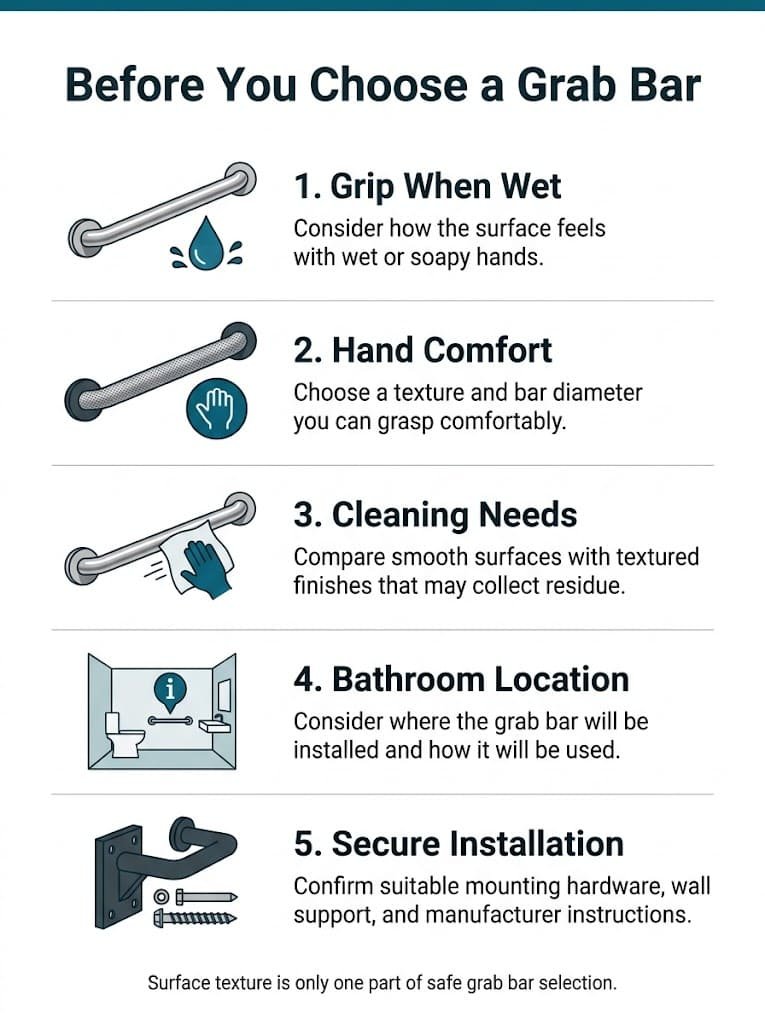
Use this table as a starting point rather than a universal ranking of finishes. Two products in the same category can have different characteristics, so compare the manufacturer’s specifications and assess whether the bar suits the intended user.
Before making a final decision, check the following:
- Identify the exact surface finish.
- Consider whether the bar will be exposed to water or soap.
- Review any relevant grip-performance test information.
- Evaluate the surface’s comfort and the bar’s diameter.
- Check cleaning instructions and finish limitations.
- Confirm that the product is suitable for its intended use and can be securely installed.
Ultimately, the choice between smooth vs. textured grab bars should be based on the actual gripping surface, the user’s needs, and the bathroom conditions. Neither a smooth finish nor a pronounced texture guarantees a secure grip on its own.
9. FAQs
Are smooth grab bars slippery when wet?
Not necessarily. A smooth grab bar can provide adequate grip when wet, but traction depends on the surface finish, material, and hand conditions. Soap residue can reduce friction, so choose a grab bar designed for bathroom use and test whether its grip feels comfortable and secure.
Are textured grab bars always safer than smooth grab bars?
No. Textured grab bars can improve grip in some conditions, particularly when hands are soapy, but texture alone does not guarantee greater safety. The bar’s finish, diameter, installation, structural support, and the user’s ability to grasp it all matter.
What is the difference between peened and knurled grab bars?
A peened grab bar has a textured surface created by repeatedly striking the material, producing small indentations or raised points. A knurled grab bar has a patterned surface formed by cutting or pressing intersecting lines or ridges into the material. Both can add texture, but their grip and comfort vary by design.
Are smooth or textured grab bars easier to clean?
Smooth grab bars are generally easier to wipe clean because they have fewer surface grooves where residue can collect. Textured grab bars may need extra attention during cleaning, depending on the depth and pattern of the texture. For either finish, follow the manufacturer’s cleaning instructions and avoid abrasive products that could damage the surface.
10. Conclusion
When comparing smooth vs. textured grab bars, look beyond appearance and consider how the surface performs in everyday use. Smooth finishes can offer an even feel and straightforward cleaning, while textured finishes provide a more pronounced tactile surface. However, neither option is automatically better for every person or bathroom.
Pay particular attention to the difference between polished, satin, peened, and knurled finishes. Consider wet- and soapy-hand conditions, evaluate comfort, and review the manufacturer’s specifications before purchasing. Most importantly, choose a product that suits the intended user’s gripping needs and ensure it is securely installed according to the manufacturer’s instructions.
A well-informed choice considers grip performance, comfort, cleanability, and secure mounting together rather than relying on the label smooth or textured alone.