
1. Introduction
Bathroom grab bars provide a handhold to help people maintain balance and move more safely around showers, bathtubs, and toilets. Knowing how to choose bathroom grab bars starts with identifying the movement that needs support, then matching the bar’s type, size, grip, and mounting system to the bathroom and the person using it.
The right choice is not necessarily the longest bar, the most expensive model, or the one with the highest advertised weight capacity. You need a product designed for the intended use, a comfortable grip, compatible mounting hardware, and an installation that can safely support the expected load.
This guide explains the main factors to consider before buying, how different grab bar designs compare, and what to verify before relying on an installed bar.
Before comparing individual features, read our complete guide to bathroom grab bars to understand the different types, placement options, and installation requirements.
Table of Contents
2. Identify Where and Why You Need a Bathroom Grab Bar
The best grab bar for bathroom safety depends on what the person needs help doing and where that movement takes place. A bar that works well beside a toilet may not provide the right support for entering a bathtub or turning in a shower.
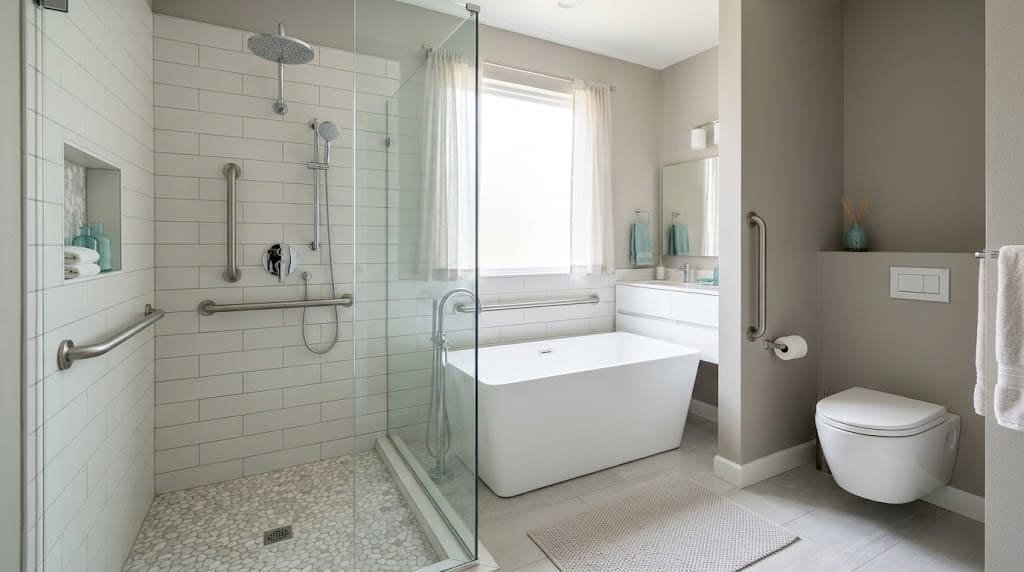
Consider the user’s reach, balance, grip, movement, and available space before selecting a product. The bathroom layout matters, but the movement that needs support should guide the initial decision.
Choosing a Grab Bar for a Shower
A shower grab bar may help someone maintain balance while standing, turning, or moving between different positions. The right configuration depends on the shower’s dimensions, the location of the controls, the user’s reach, and whether a shower chair or bench is also used.
Before choosing a bar, consider:
- Movement: Identify when support is needed, such as stepping into the shower, turning, or standing during bathing.
- Reach: Make sure the intended gripping area is accessible without excessive stretching or twisting.
- Available space: Check that the bar will not obstruct the shower controls, door, or other fixtures.
- Wet-hand grip: Look for a grip surface and diameter that the intended user can hold comfortably.
- Mounting: Confirm that the wall and mounting system can support the selected product when installed according to its instructions.
A shower chair may reduce the need to stand throughout bathing, but it does not eliminate every need for hand support. The bar and any additional equipment should work together for the user’s particular movements.
Choosing a Grab Bar for a Bathtub
Entering and exiting a bathtub can require different movements from those involved in standing under a shower. A person may need to step over a high tub wall, lower themselves into the tub, or rise from a seated position.
Identify the stage of the movement that is most difficult before selecting a bar. A wall-mounted bar may provide a useful handhold when appropriately positioned, while a compatible bathtub-mounted rail may be an option for some tubs.
Check the tub’s construction, surrounding walls, available gripping space, and the manufacturer’s installation requirements. A clamp-on rail, for example, must be compatible with the particular tub and securely installed according to its instructions.
If the person has difficulty lifting their legs over the tub wall or transferring safely, a transfer bench or other bathing equipment may also be worth assessing. A grab bar alone may not address every mobility challenge.
Choosing a Grab Bar for a Toilet
A grab bar beside a toilet can provide a handhold when sitting down or standing up. The appropriate arrangement depends on the user’s movement, the toilet’s location, the available wall space, and whether support is needed on one side or both.
A fixed wall-mounted bar may be suitable when the wall can support it and the user can reach it comfortably. Where a suitable wall-mounted installation is not practical, a properly selected toilet safety frame may be another option.
Before buying, consider:
- Whether the user needs support when lowering onto the seat, rising, or both.
- Whether the bar can be reached without leaning or twisting excessively.
- Whether the toilet, nearby fixtures, and walking path leave enough clearance.
- Whether a wall-mounted grab bar or a freestanding support system is more suitable for the user’s specific needs.
Choose based on the person’s actual movement and the bathroom’s layout together. Do not assume that one universal bar type or position will work equally well for every user.
3. Compare Grab Bar Types and Mounting Styles
Grab bars differ in how they attach, how they move, and what they are designed to support. When comparing options, distinguish the product’s intended use from its appearance: two bars that look similar may have very different mounting requirements and limitations.
| Grab bar type | Potential use | What to verify |
|---|---|---|
| Fixed wall-mounted bar | Long-term support in a shower, bathtub area, or beside a toilet | Wall backing, compatible fasteners, product rating, and installation instructions |
| Fold-down or swing-up bar | Support where a movable bar can improve access or clearance | Locking or support mechanism, load rating, wall reinforcement, and required clearance |
| Suction-cup handle | Temporary assistance only within the product’s stated limitations | Intended use, compatible surface, seal-check procedure, and manufacturer warnings |
| Clamp-on bathtub rail | Assistance around a compatible bathtub edge | Tub compatibility, secure attachment, and product-specific restrictions |
| Toilet safety frame | Support when sitting down or standing up | Stability, floor contact, toilet clearance, and rated capacity |
| Floor-to-ceiling support pole | A potential support option where compatible with the room and user’s needs | Structural suitability, mounting method, installation instructions, and intended load |
These options are not interchangeable. Select a product according to the kind of support required, rather than assuming every handle marketed for bathroom safety is suitable for bearing body weight.
Fixed Wall-Mounted Grab Bars
Fixed wall-mounted grab bars are commonly considered when a person needs a dependable handhold in a consistent location. They are available in different lengths, shapes, finishes, and orientations.
Their suitability depends on more than the bar itself. The wall structure, mounting hardware, installation method, and product specifications must work together as a complete assembly.
Before purchasing a fixed bar, confirm that the proposed installation location can accommodate its mounting points. In a tiled bathroom, for example, the installer must account for the tile and the supporting structure behind it. A visually solid surface does not automatically establish that the mounting arrangement can safely support the intended load.
Choose a model with clear installation instructions and specifications for its intended application. If the wall’s construction is uncertain, determine the mounting requirements before buying the bar.
Fold-Down and Swing-Up Grab Bars
Fold-down and swing-up grab bars can provide support while allowing the bar to move out of the way when it is not needed. They may be useful in bathrooms where space is limited or where a fixed bar would interfere with access.
The movable design introduces additional considerations. The bar must be installed with the specified mounting system, and its movement or locking mechanism must operate as intended.
Check the following before choosing one:
- Whether the bar’s load rating and intended use match the support required.
- Whether the mounting surface and hardware are appropriate.
- Whether the bar can be moved and secured without creating an access problem.
- Whether it has enough clearance to move through its full range.
- Whether the manufacturer specifies inspection or maintenance requirements for its mechanism.
A fold-down design is not automatically better than a fixed bar. It is most appropriate when its added flexibility solves a real space or access problem without compromising the support arrangement.
Suction-Cup Grab Bars vs. Permanently Mounted Bars
Suction-cup grab bars attach to compatible smooth surfaces through suction. Permanently mounted bars use a specified mechanical mounting system. This difference is important because a temporary handle may not safely support a person’s weight like a securely installed, load-bearing bathroom grab bar.
Some suction-cup products are intended primarily for balance assistance, and their instructions may expressly prohibit using them to support body weight. Other products may have different specifications. Never infer suitability from the product’s appearance or from the fact that its suction indicator shows a secure seal.
Before using a suction-cup handle, verify:
- The manufacturer’s stated intended use and limitations.
- Whether the surface material, texture, and dimensions are compatible.
- How the product must be attached and how its seal must be checked.
- Whether the manufacturer permits the type of support the user needs.
- How frequently the attachment must be inspected.
For someone who depends on a bar to support their weight during a transfer, a suitably rated, securely mounted product is generally the more appropriate option when correctly installed. If a product’s limitations are unclear, do not rely on it for that purpose.
Bathtub-Mounted Rails and Other Support Options
Not every bathroom can accommodate a conventional wall-mounted bar in the desired location. Alternatives include clamp-on bathtub rails, toilet safety frames, and floor-to-ceiling support poles.
Each has different requirements. A clamp-on rail must be compatible with the bathtub’s shape and construction. A toilet safety frame must remain stable and provide the support its manufacturer specifies. A floor-to-ceiling pole must be installed according to its instructions and supported by suitable surfaces.
These products should not be treated as universal substitutes for fixed grab bars. Check the intended use, installation limitations, and load specifications for the exact model. If the user has difficulty transferring or needs substantial support, an appropriate professional can help assess which type of equipment fits the situation.
4. Choose the Right Grab Bar Length, Shape, and Orientation
Choosing the right grab bar size and design involves considering the bathroom layout, how comfortably the user can reach it, and the specific movement that needs extra support. A bar should provide a usable gripping area without obstructing other bathroom fixtures or requiring the user to reach uncomfortably.
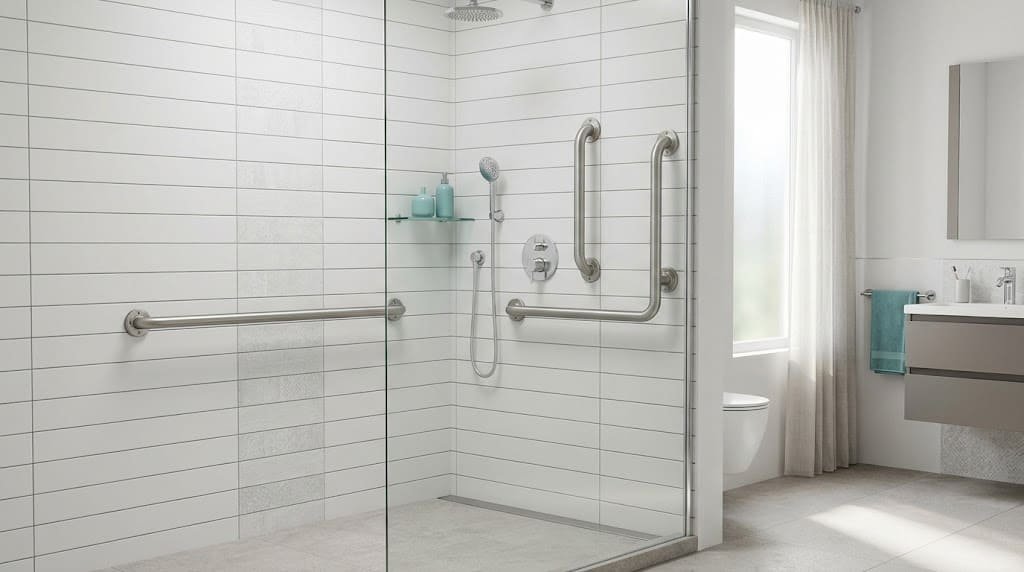
Measure the intended installation area before shopping. Also consider where the mounting points will fall and whether the selected model’s installation instructions permit the proposed configuration.
How Long Should a Bathroom Grab Bar Be?
There is no single grab bar length that suits every bathroom. The required length depends on the location, the user’s reach, the available wall space, and how much of the bar needs to be accessible during the movement.
A short bar may fit a confined space, while a longer bar may provide a more continuous gripping area along a wall. Neither option is inherently superior; the right choice depends on how it will be used and whether it can be mounted securely.
Before selecting a length:
- Measure the available installation area.
- Identify the portion of the bar the user needs to reach.
- Check the product’s overall dimensions and mounting-point spacing.
- Confirm that the planned location allows the bar to be installed as instructed.
- Consider the applicable accessibility requirements if the installation is subject to them.
Remember that the overall length is not necessarily the same as the usable gripping length. Brackets, end caps, and the shape of the bar can affect how much space is available for the hand.
For detailed measurements and positioning considerations, see the bathroom grab bar height and positioning guide.
Should You Choose a Vertical, Horizontal, or Angled Grab Bar?
Vertical, horizontal, and angled grab bars offer different gripping arrangements. The most appropriate orientation depends on the person’s movement and the location where the bar will be installed.
| Orientation | Potential benefit | Important consideration |
|---|---|---|
| Vertical | May provide a handhold during entry or exit and accommodate a range of hand positions | The user must be able to reach and grip it comfortably throughout the movement |
| Horizontal | May provide a continuous handhold along a wall | Its position and length must suit the user’s reach and intended support |
| Angled | May accommodate a particular reach or movement between positions | The angle must suit the individual and comply with applicable installation requirements |
These are general considerations, not universal placement rules. A vertical bar is not always best for entering a tub, and a horizontal bar is not automatically the right choice beside a toilet.
If the person has difficulty reaching, gripping, or changing position, consider their movement in the actual bathroom rather than selecting an orientation based only on a photograph or a general recommendation.
Where formal accessibility standards apply, verify the relevant provisions before deciding on the configuration.
What Grip Diameter and Clearance Should You Look For?
The grip diameter should allow the intended user to grasp the bar comfortably and securely. A bar that is too difficult for the person to wrap their hand around may be unsuitable even if its length and material are appropriate.
Consider the user’s hand size, grip strength, comfort, and ability to maintain contact with the bar. If possible, have the intended user test a comparable grip before purchasing.
Clearance between the bar and the wall also matters. There must be sufficient room for the hand to grasp the bar without being obstructed by the wall, mounting brackets, nearby fixtures, or other objects.
For projects that must comply with the 2010 ADA Standards, Section 609 specifies requirements for grab bar dimensions, wall clearance, and structural strength. The standards specify a 1½-inch clearance between the grab bar and the wall, along with other dimensional and structural requirements. Those provisions must be read in context with the applicable installation and facility requirements; they should not be treated as a blanket rule for every private residential bathroom.
The practical goal is to choose a grip that the user can reach and hold comfortably, then verify that its dimensions and clearance suit the intended installation.
5. Select a Suitable Material, Finish, and Grip Surface
Choose a bathroom grab bar that can withstand moisture, offers a secure and comfortable grip, and meets the specific support needs of the person using it. Material, finish, and texture affect these qualities, but none of them alone establishes whether a bar is safe to rely on.
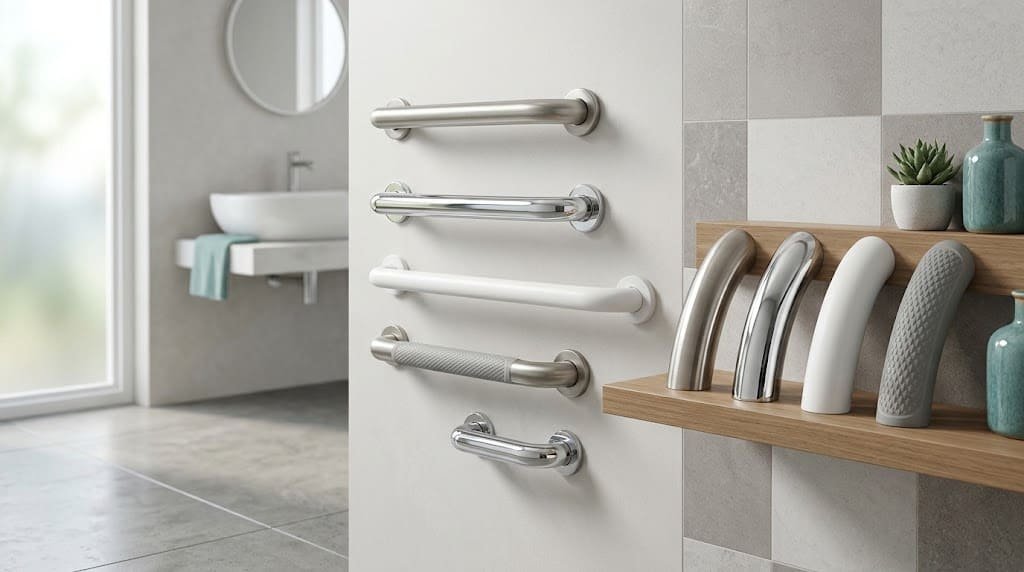
Compare the manufacturer’s specifications, the bar’s construction, its mounting method, and the care instructions rather than choosing by appearance alone.
Stainless Steel vs. Other Metal Grab Bars
Stainless steel grab bars are commonly considered for bathrooms because suitable stainless steel grades can offer corrosion resistance and durable construction. Other metal bars may also be appropriate, depending on their materials, coatings, manufacturing quality, and intended application.
When comparing metal grab bars, check:
- Material and construction: Review the manufacturer’s description and specifications.
- Corrosion resistance: Confirm that the product is intended for the conditions in which it will be used.
- Finish: Consider whether the surface is comfortable to grasp and straightforward to clean.
- Mounting hardware: Verify that the hardware is compatible with the bar and the installation environment.
- Product rating: Confirm that the complete installed arrangement is suitable for the required support.
The label “stainless steel” is not enough to determine the quality or suitability of a product. Grade, construction, finish, installation, and maintenance all matter. Similarly, a properly specified alternative metal product may be appropriate for its intended use.
Plastic and Composite Grab Bars
Plastic and composite products vary in construction and intended use. A plastic appearance does not necessarily reveal how the product is built, what load it is designed to support, or how it must be mounted.
Before buying a grab bar, check the manufacturer’s specifications to confirm its intended application, weight rating, materials, installation requirements, and any stated restrictions. Do not assume that a handle is suitable for body-weight support simply because it is described as a bathroom grab bar or is attached securely to a surface.
This distinction is especially important when comparing a decorative or temporary balance aid with a product intended to provide dependable support during a transfer.
Compare the manufacturer’s documentation rather than making a decision based on material alone.
Smooth vs. Textured Grips
A grab bar’s surface should be comfortable to hold and manageable with wet hands. Smooth and textured finishes can feel different, so the best option depends partly on the user’s hand comfort, grip strength, and preferences.
A textured surface may help some users maintain contact with the bar, but texture alone does not guarantee a secure grip. A surface that feels uncomfortable or difficult to grasp may be unsuitable for a particular person.
Consider the following when comparing grip surfaces:
- Whether the user can comfortably close their hand around the bar.
- Whether the texture remains comfortable during repeated use.
- Choose a finish that can be safely cleaned using the care and maintenance guidelines provided by the manufacturer.
- Whether the bar’s diameter and wall clearance allow a natural grip.
If grip strength or hand function is limited, an occupational therapist or other appropriate professional may help assess the most suitable configuration.
Choose a Bathroom Grab Bar Finish That Is Easy to Clean
Choose a bathroom grab bar with a finish that can withstand the room’s humidity and regular cleaning. Look for clear manufacturer guidance on cleaning, corrosion prevention, and care.
A finish that coordinates with faucets and other fixtures may be visually appealing, but appearance should remain secondary to the product’s construction, intended use, grip, and mounting suitability.
Also consider visibility. A bar that is easy for the intended user to identify against the surrounding wall may be more practical than one that blends into the background, depending on the person’s vision and preferences.
Choose a finish that balances usability, durability, and ease of care without compromising the bar’s function.
6. Check Weight Capacity, Wall Construction, and Mounting Requirements
Before buying a bathroom grab bar, verify its rated load, the supporting wall structure, and the mounting hardware required by the manufacturer. A grab bar’s advertised weight capacity does not, by itself, establish that the complete installed assembly can safely support the intended load.
The bar, fasteners, brackets, wall backing, and supporting structure must all be suitable for the application. This is one of the most important parts of choosing the right bathroom grab bars.
What Does a Bathroom Grab Bar’s Weight Rating Mean?
A bathroom grab bar’s weight rating describes a specified capacity under the conditions defined by the manufacturer or applicable standard. It should not be interpreted as a guarantee that the bar will safely support the same load when installed in any wall or with any hardware.
The installed assembly matters because a strong bar can still fail if its mounting hardware loosens, its fasteners are unsuitable, or the wall cannot support the load.
When evaluating bathroom grab bar weight capacity:
- Check the exact model’s published specifications.
- Read the installation instructions and any stated load limitations.
- Confirm that the required mounting hardware and supporting structure are suitable.
- Do not substitute unapproved anchors or fasteners for those specified by the manufacturer.
- Consider the forces involved in the intended movement, not only the person’s body weight.
A person may pull, push, or shift their weight against a bar when sitting down, standing up, or recovering their balance. A simple comparison between body weight and a product’s advertised capacity does not establish that an installation is safe for those forces.
If the product’s capacity or mounting requirements are unclear, obtain clarification from the manufacturer or a qualified installer before relying on it.
Does Your Wall Have the Right Support?
The wall must provide a suitable foundation for the selected grab bar and its mounting system. Tile, drywall, and other visible finishes do not automatically provide the structural support required for a load-bearing installation.
Depending on the bathroom and product, the mounting arrangement may require wall studs, blocking, or another specifically approved support system. The correct method depends on the wall construction and the manufacturer’s instructions.
Before choosing a product, consider:
- Wall construction: Determine what lies behind the visible wall finish.
- Studs or blocking: Establish whether suitable structural support is available at the required mounting points.
- Tile and other finishes: Make sure the installation method accounts for the finish without treating it as a substitute for structural support.
- Fasteners: Use hardware compatible with the product, wall structure, and installation method.
- Mounting location: Confirm that the required mounting points can be accommodated without interfering with other fixtures.
Do not assume that ordinary drywall anchors or adhesive alone are suitable for a grab bar intended to support body weight. Only use an installation system specifically approved for the intended application.
If you cannot identify the wall structure or confirm that the proposed mounting method is suitable, have the installation assessed before purchasing or installing the bar.
What Do ADA Grab Bar Standards Require?
The Americans with Disabilities Act (ADA) includes technical requirements for grab bars in covered accessible facilities. The 2010 ADA Standards for Accessible Design address such details as gripping surfaces, dimensions, clearance, and structural strength.
For example, Section 609 includes requirements for grab bar cross-sections, a 1½-inch clearance from the wall, and structural strength. Other provisions specify requirements for particular locations and accessible facility configurations. The applicable details depend on the type of facility and the relevant section of the standards.
It is important to distinguish a product that meets a particular specification from an installation that complies with all applicable requirements. A bar’s dimensions alone do not establish that the entire installation is compliant.
The ADA does not automatically impose every commercial accessibility requirement on every private residential bathroom. However, other applicable requirements may arise from building codes, the nature of the property, or the specific project.
Before purchasing a bar for a regulated or accessible installation:
- Identify which accessibility provisions apply.
- Check the relevant sections of the official 2010 ADA Standards.
- Verify the bar’s dimensions and specifications against those requirements.
- Check applicable state or local building requirements where relevant.
- Confirm that the complete installation meets the applicable provisions.
Do not rely on the phrase “ADA compliant” in a product listing as a substitute for checking the actual requirements for your installation.
When Should You Hire a Professional Installer?
A qualified installer can help determine whether the wall, fasteners, and selected grab bar form a suitable support system. Professional assessment is particularly useful when the wall construction is uncertain, the installation involves tile or unusual surfaces, or the user depends on the bar for essential transfers.
Consider professional help when:
- You cannot locate or verify suitable wall backing.
- The proposed installation involves unfamiliar wall construction or mounting hardware.
- Drilling through tile could damage the finish or conceal important structural issues.
- The product instructions require a mounting method you cannot confidently carry out.
- The intended user needs substantial support while entering a tub or transferring to a toilet.
If the user’s movement or grip needs are also uncertain, an occupational therapist or physical therapist may help assess the type and arrangement of support that would be most appropriate. The installer can then help determine how to implement that arrangement safely.
A professional installation does not make every product suitable for every user. The product must still match the intended use, and the finished installation must follow the relevant instructions and requirements.
7. Match the Grab Bar to the Person Using It
The right grab bar depends on the individual, not just the bathroom. Reach, grip strength, balance, movement patterns, and the ability to sit, stand, or transfer can all affect which product is suitable.
Avoid choosing a bar solely because it is marketed for seniors or people with limited mobility. Those groups have varied needs, and the same configuration will not work equally well for everyone.
Grab Bars for Older Adults Who Want to Age Safely at Home
When choosing grab bars for seniors, consider the movements that have become difficult or may require additional support. These might include stepping into a bathtub, maintaining balance while showering, or rising from a toilet.
A useful selection process includes:
- Identifying the specific movement that requires support.
- Considering whether the person can reach and grasp the proposed bar comfortably.
- Checking whether the bathroom layout leaves sufficient room to move.
- Evaluating whether a shower chair, transfer bench, or other equipment may complement the bar.
- Confirming that the bar and mounting system are appropriate for the intended use.
Aging in place does not necessarily mean choosing one particular bar style. The aim is to select equipment that suits the person’s current needs and the bathroom’s layout, while considering whether those needs may change.
If balance, reach, or transfer ability is difficult to assess, a qualified professional can help evaluate the situation before equipment is selected.
Grab Bars for People With Limited Mobility or Grip Strength
People with limited mobility may need different kinds of support depending on their abilities. Someone who needs a steady handhold while standing may have different requirements from someone who must transfer between a wheelchair and a shower seat.
Grip strength also matters. A bar may be structurally suitable but difficult for a particular person to grasp, reach, or use during a movement.
When comparing products, consider:
- The person’s comfortable reach and ability to maintain a grasp.
- Whether the bar’s diameter and texture suit their hand function.
- The movements the bar is expected to assist.
- Whether the available space allows the person to approach and use it.
- Whether additional equipment could make the movement more manageable.
A shower chair or transfer bench may complement a grab bar, but equipment should be selected according to the user’s needs rather than assumed to be necessary in every situation.
For someone who relies heavily on physical support during transfers, an individualized assessment can help identify the most appropriate combination of equipment and mounting arrangements.
Choosing Grab Bars for Shared Bathrooms
A shared bathroom can present a challenge when different people have different heights, reach, grip strength, or mobility needs. A single generic configuration may not be equally comfortable or accessible for everyone.
Start by identifying the needs of each intended user. Check whether each person can reach and grip the bar comfortably and whether the arrangement supports the movements they need to perform.
If the bathroom is being adapted for multiple people, consider the available space, the potential for one user’s needs to conflict with another’s, and whether a different configuration or additional support would be more suitable.
Do not compromise the required structural support simply to make a bar convenient for everyone. Where needs differ substantially, professional guidance can help determine whether one arrangement is appropriate or whether additional adaptations are needed.
8. Use This Bathroom Grab Bar Buying Checklist
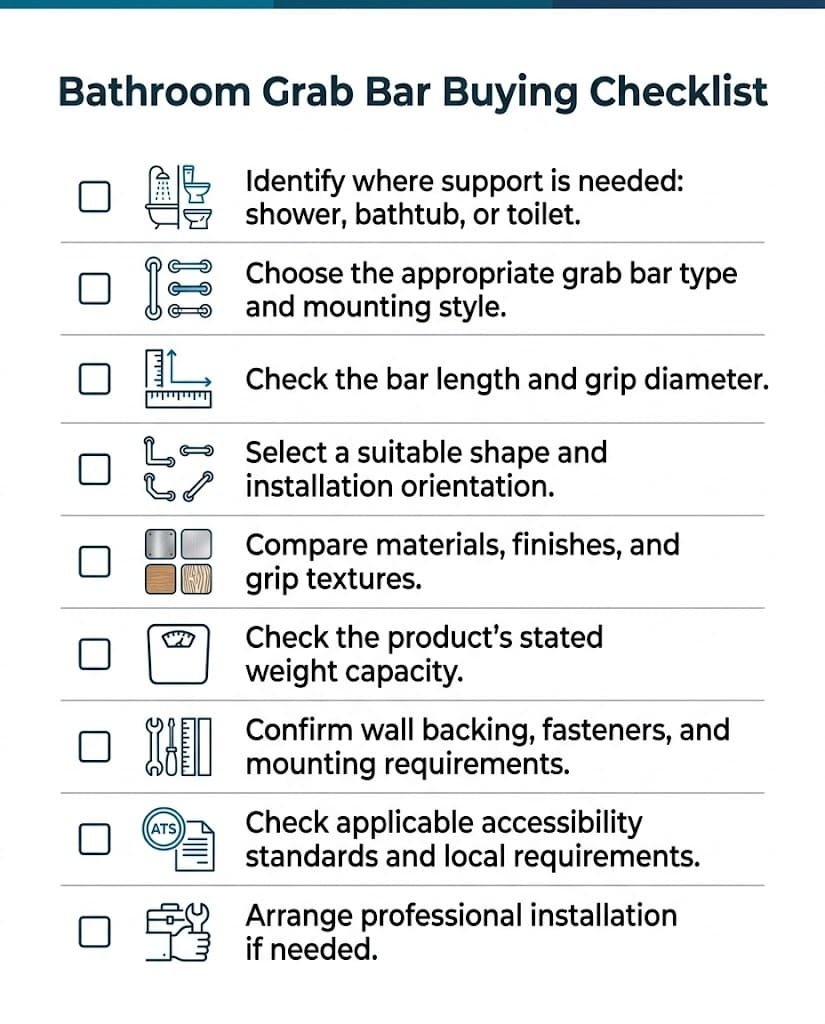
Use this checklist before purchasing a bathroom grab bar. It brings together the most important selection factors so you can compare products against the needs of the person who will use them.
[ ] Identify the movement that needs support.
[ ] Select the intended location: shower, bathtub, or toilet.
[ ] Compare appropriate bar types and orientations.
[ ] Measure the available space and required gripping length.
[ ] Check grip diameter, texture, and comfort.
[ ] Verify material suitability and cleaning requirements.
[ ] Confirm the manufacturer’s intended use and rated load.
[ ] Check the wall structure and compatible mounting system.
[ ] Verify applicable accessibility standards and local requirements.
[ ] Determine whether professional installation or an individual assessment is needed.
[ ] Confirm the finished installation follows the product instructions before relying on the bar.
The most important final check is that the selected bar, its mounting hardware, and the supporting wall are suitable for the intended use. A bar that fits the bathroom but cannot be installed appropriately is not the right choice.
9. FAQs
What factors should you consider before purchasing bathroom grab bars?
Look for a grab bar designed for the intended use, with a comfortable grip, appropriate dimensions, a verified load rating, and mounting requirements that can be met in your bathroom. Consider the person’s reach and movement, the available space, the wall construction, and the manufacturer’s installation instructions. Do not choose based on appearance or advertised weight capacity alone.
Are suction-cup grab bars safe to use?
Whether a suction-cup grab bar is suitable depends on the model and what it is designed to do. Some provide limited help with balance but are not made to bear a person’s full weight. Before using one, review the manufacturer’s guidance on compatible surfaces, proper attachment, seal checks, and usage restrictions. If someone needs a grab bar to support their weight while transferring, use a suction-cup model only if the manufacturer explicitly rates it for that purpose and it is installed and used exactly as directed.
Which material should you choose for a bathroom grab bar?
There is no single best material for every bathroom grab bar. Suitable stainless steel and other metal products may offer durability and corrosion resistance, while other materials have different construction and performance characteristics. Compare the exact product’s specifications, finish, grip, intended use, and mounting requirements. Material alone does not establish whether a bar is suitable for body-weight support.
How much weight should a bathroom grab bar support?
There is no single advertised capacity that makes every grab bar installation safe. Check the manufacturer’s rated capacity and installation instructions, including requirements for wall backing, fasteners, and mounting hardware. The complete grab bar installation must be strong enough to safely handle the expected load. A product’s rating should not be treated as a guarantee that it will safely support the same load when installed in an unsuitable wall.
Do bathroom grab bars need to be ADA compliant?
Not every private residential bathroom is automatically subject to all ADA grab bar requirements. The applicable rules depend on the facility, installation, and relevant accessibility and building requirements. Where ADA standards apply, check the specific provisions for the location and configuration. A product label alone does not establish that the completed installation complies with every applicable requirement.
Can I install a bathroom grab bar without drilling?
Some bathroom support products use alternative attachment methods, but not every product is suitable for every wall or support need. Adhesive or suction-cup attachment should not be assumed to provide dependable body-weight support. If drilling is not possible, investigate products specifically designed for the situation and verify their limitations, stability, and intended use. When the person depends on the bar for support, consult a qualified professional before choosing an alternative mounting method.
10. Conclusion
Choosing the right bathroom grab bars starts with understanding the movement that needs support, whether that is entering a bathtub, standing in a shower, or getting up from a toilet. From there, compare the bar’s type, length, orientation, grip, and material to find a product that fits the person and the bathroom.
Before buying, verify the manufacturer’s load rating, wall construction, compatible mounting hardware, and installation requirements. Consider professional guidance if the user’s support needs or the wall’s suitability are uncertain. Remember that a well-designed bar is only as suitable as its complete installation.
The best choice is not simply the bar with the most features or the highest advertised capacity. The best bathroom grab bar is one that suits the user’s specific needs, is appropriate for the intended installation area, and can be mounted securely in line with the manufacturer’s instructions and applicable requirements.
1 Comment