
1. Introduction
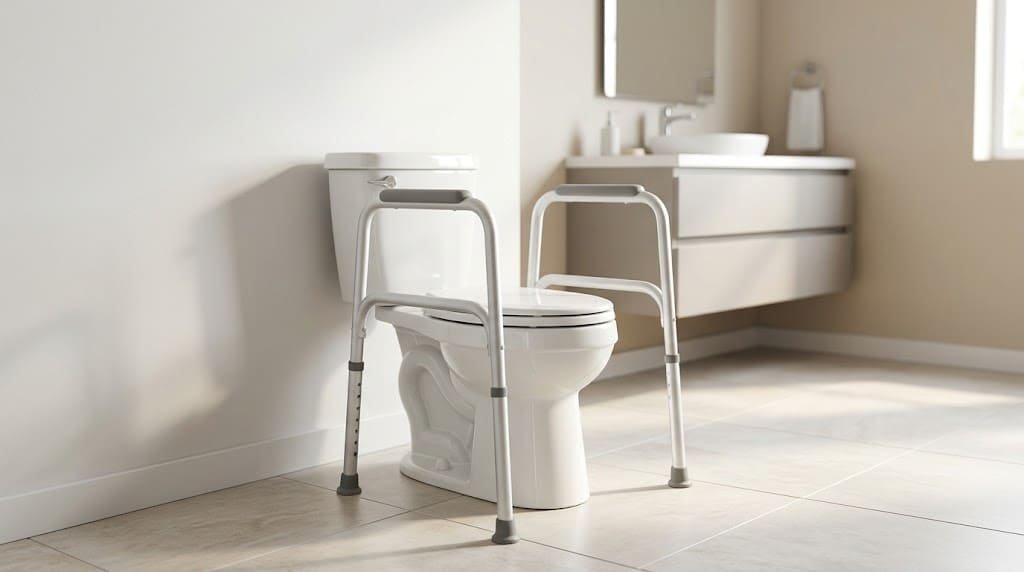
Sitting down and standing up from a toilet can become difficult when someone experiences limited mobility, reduced leg strength, balance problems, or difficulty bending their knees. Toilet safety rails provide hand support on either side of the toilet, helping users maintain balance and control during these movements.
These bathroom support devices come in several designs, including freestanding frames, toilet-mounted rails, adjustable models, and raised toilet seats with integrated handles. Each design has different installation requirements, space considerations, and compatibility limitations.
Choosing the right toilet safety rails involves more than checking their appearance or advertised weight capacity. You also need to consider your toilet’s shape, available bathroom space, handle height, mounting arrangement, and the level of support required.
This guide explains the different types of toilet safety rails, how they compare with grab bars and raised toilet seats, what to measure before purchasing, and how to install, use, and maintain them safely.
Table of Contents
2. What Are Toilet Safety Rails and How Do They Work?
Toilet safety rails are assistive bathroom devices that provide handholds beside a toilet to help people sit down and stand up more comfortably. They typically have two handles positioned on either side of the toilet seat, allowing users to hold onto a stable support structure during toilet transfers.
Depending on the design, the rails may attach to the toilet using its seat-mounting hardware or stand independently on the bathroom floor.
How Do Toilet Support Rails Work?
Toilet support rails provide a place to hold while lowering onto or rising from a toilet. Instead of relying entirely on leg strength and balance, users can use the handles for additional support during the movement.
A typical toilet safety rail has the following components:
- Support handles: Positioned on either side of the toilet to provide gripping surfaces.
- Frame: Connects and supports the handles.
- Mounting brackets: Secure toilet-mounted models to the toilet-seat attachment points.
- Adjustable legs: Allow certain freestanding frames to accommodate different toilet heights.
- Rubber feet: Provide floor contact and help limit unwanted movement.
- Locking mechanisms: Keep adjustable components in their intended positions.
When a user approaches the toilet, the handles provide support while positioning themselves in front of the seat. They can then use the designated handholds to help control the descent. The same handles provide support when rising.
However, the amount of support depends on the device’s construction, installation, condition, and the user’s physical abilities.
Who Can Benefit from Toilet Safety Rails?
Toilet assist rails may be useful for people who have difficulty completing toilet transfers independently.
Potential users include:
- Older adults experiencing reduced strength or balance.
- People with limited mobility or joint stiffness.
- Individuals recovering from certain surgeries or injuries.
- People who find it difficult to bend their knees or lower themselves onto a toilet.
- Individuals who need additional hand support during everyday bathroom activities.
- Caregivers arranging a bathroom to accommodate someone’s mobility needs.
The appropriate design depends on the person’s ability to grip, balance, and use their arms during transfers. Someone who needs substantial physical assistance may require a different mobility aid or an individualized assessment from an occupational therapist.
Are toilet safety rails designed to support full body weight?
Not necessarily. A manufacturer’s weight capacity specifies the limit for the product under its stated conditions. It should not be interpreted as a guarantee that every model can safely support any movement, pulling force, or transfer technique. Always follow the manufacturer’s instructions and use the device as intended.
3. What Are the Different Types of Toilet Safety Rails?
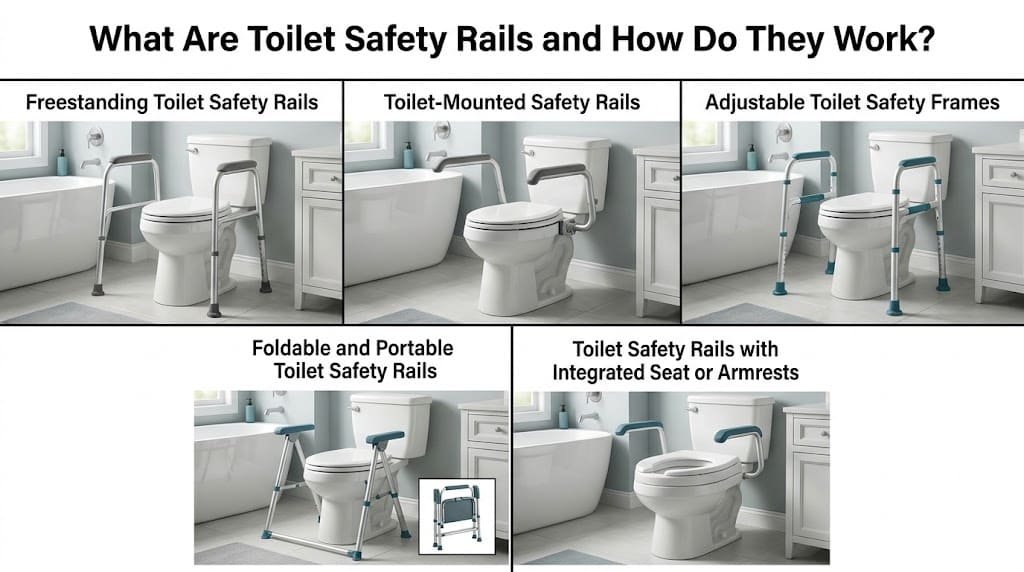
Toilet safety rails are available in several configurations, and their main differences involve how they are supported, attached, adjusted, and stored. Understanding these designs helps you identify which type may work with your toilet and bathroom layout.
Freestanding Toilet Safety Rails
Freestanding toilet safety rails are independent support frames that stand on the bathroom floor around the toilet. They usually have two side handles connected by a frame, with adjustable legs that rest on the floor.
Unlike toilet-mounted models, these frames generally do not attach to the toilet-seat bolts. Their stability depends on their construction, correct assembly, leg adjustment, and contact with the floor.
Common features include:
- Adjustable legs for accommodating different toilet heights.
- Rubber feet that contact the bathroom floor.
- Padded or non-padded armrests.
- Metal frames, commonly made from aluminum or steel.
- Different handle widths to accommodate different users and toilet arrangements.
Main advantage: Freestanding frames can provide side support without requiring modifications to the toilet-seat mounting arrangement.
Main consideration: They occupy floor space around the toilet. Before choosing one, check whether the legs will interfere with nearby walls, cabinets, doors, or comfortable access.
These models may be particularly useful when a toilet-mounted bracket is unsuitable, provided the bathroom has enough space for the frame.
Toilet-Mounted Safety Rails
Toilet-mounted safety rails attach to the toilet using the seat-mounting hardware or a compatible mounting bracket. Their support handles extend along the sides of the toilet, creating handholds close to the seat.
These models are often more compact than freestanding frames because they do not need separate floor-standing legs.
Common features include:
- Attachment through existing toilet-seat mounting points.
- Side handles for sitting and standing support.
- Adjustable handle width on certain models.
- Metal or molded frame components.
- Mounting brackets designed for particular toilet configurations.
Main advantage: Their compact construction can preserve more floor space around the toilet.
Main consideration: Compatibility with the toilet and existing seat hardware is essential. A model that fits one toilet configuration may not fit another, particularly when additional attachments or unusual mounting arrangements are present.
Check the manufacturer’s measurements and installation instructions before purchasing.
Adjustable Toilet Safety Frames
Adjustable toilet safety frames allow certain dimensions to be changed to accommodate the toilet and user’s positioning requirements.
Depending on the model, adjustments may include:
- Overall frame height.
- Distance between the handles.
- Leg length.
- Armrest positioning.
Some adjustable toilet safety frames use push-button locking mechanisms or removable pins to secure their settings.
Adjustability can make a frame more adaptable, but it does not automatically make it suitable for every toilet. The adjustment range must match the actual measurements, and all locking components must be properly engaged before use.
It is also important to distinguish adjustability from mounting type. A frame can be adjustable and still be either freestanding or toilet-mounted.
Foldable and Portable Toilet Safety Rails
Foldable toilet safety rails are designed to collapse or fold when they are not needed, depending on the manufacturer’s design.
They may be useful in bathrooms where permanent floor space is limited or where the equipment needs to be stored between uses.
Consider the following features:
- Folding mechanism and available storage space.
- Whether the frame can be folded without removing other components.
- Locking mechanisms that prevent accidental folding.
- Ease of carrying and repositioning.
- Manufacturer instructions for assembly and use.
A portable design should not be assumed to be less secure or more secure than a fixed design. Its safety depends on the actual construction and whether the folding components lock correctly.
Always confirm that the frame is fully assembled and locked in its intended position before use.
Toilet Safety Rails with Integrated Seat or Armrests
Some toilet support products combine a raised toilet seat with handles or armrests. Rather than providing only side handholds, these devices also increase the height of the sitting surface.
This combination can be useful when someone has difficulty both lowering onto a standard-height toilet and standing back up.
These products may include:
- An elevated seating surface.
- Integrated side handles.
- Toilet-bowl attachment mechanisms.
- Removable or adjustable armrests on certain models.
- Different seat heights and mounting configurations.
The main difference is that a separate safety rail generally provides hand support without changing the toilet-seat height, while an integrated raised seat also changes the sitting position.
Before choosing one, check its toilet compatibility, attachment system, seat dimensions, and manufacturer-rated capacity.
Comparison of Toilet Safety Rail Types
| Type | Mounting method | Main advantage | Main consideration |
|---|---|---|---|
| Freestanding | Supported by floor legs | Does not require toilet-bolt attachment | Requires floor space |
| Toilet-mounted | Toilet-seat mounting hardware | Compact arrangement | Requires compatible mounting |
| Adjustable frame | Depends on model | Customizable dimensions | Settings must be secured |
| Foldable | Depends on model | Easier storage | Folding locks must be checked |
| Integrated seat and arms | Toilet-seat or bowl attachment | Combines added seat height and hand support | Requires compatible toilet and seat |
The best design depends on the available space, toilet configuration, desired handle position, and the amount of assistance the user needs.
4. Toilet Safety Rails vs. Toilet Safety Frames vs. Grab Bars
The terms toilet safety rails, toilet safety frames, toilet assist rails, and toilet grab rails are sometimes used interchangeably in product descriptions. However, products with these names can have different construction and mounting arrangements.
The most reliable way to distinguish them is to examine how the device is supported and where its handles are positioned.
Toilet Safety Rails vs. Toilet Safety Frames
Toilet safety rails and toilet safety frames often serve the same purpose: providing hand support during toilet transfers. The difference is frequently related to product design rather than a universally recognized technical classification.
A toilet safety rail may refer to a pair of support handles attached to the toilet or incorporated into a surrounding frame. A toilet safety frame often describes a more complete structure with side arms and floor-supporting legs.
| Feature | Toilet safety rails | Toilet safety frames |
|---|---|---|
| Construction | Handles or a support structure | Usually a surrounding frame |
| Floor legs | Model-dependent | Commonly included |
| Toilet attachment | Model-dependent | Model-dependent |
| Main purpose | Support during toilet transfers | Support during toilet transfers |
| Space requirements | Depends on design | Often needs additional floor space |
These terms can overlap, so do not rely on the product name alone. Look at the mounting method, frame dimensions, number of legs, and manufacturer’s specifications.
Toilet Safety Rails vs. Wall-Mounted Grab Bars
Toilet safety rails and wall-mounted grab bars both provide hand support, but they differ in how they are installed and supported.
Toilet safety rails generally attach to the toilet or stand independently on the floor. Their handles are positioned close to the toilet seat.
Wall-mounted grab bars attach to a structurally suitable wall using an appropriate mounting system. They provide fixed support at the installed location.
Key differences include:
| Feature | Toilet safety rails | Wall-mounted grab bars |
|---|---|---|
| Mounting | Toilet or floor | Wall |
| Support structure | Device frame or toilet attachment | Wall and mounting hardware |
| Position | Around the toilet | Installed on a suitable wall |
| Installation | Depends on model | Requires appropriate wall anchoring |
| Floor space | May require space for legs | Does not normally occupy floor space |
A toilet safety frame may be a practical option when a suitable wall mounting location is unavailable. Wall-mounted grab bars may be appropriate when permanent, fixed hand support is needed and the wall can support the installation.
Neither arrangement should be selected solely because it looks stronger. The installation must be suitable for the expected use.
Toilet Safety Rails vs. Raised Toilet Seats with Handles
Toilet safety rails provide hand support, while raised toilet seats increase the height of the sitting surface. Raised seats with integrated handles combine both functions.
The distinction matters because someone may struggle with standing due to insufficient hand support, difficulty bending their knees, or a combination of both.
| Feature | Toilet safety rails | Raised toilet seats with handles |
|---|---|---|
| Hand support | Yes | Yes, when handles are included |
| Changes toilet seat height | Usually no | Yes |
| Main function | Provides transfer support | Adds seat height and support |
| Installation | Toilet-mounted or freestanding | Usually attaches to toilet |
| Compatibility | Depends on rail design | Depends on seat and toilet design |
A separate rail may be sufficient when the existing toilet height is comfortable but additional hand support is needed.
A raised seat with handles may be worth considering when lowering onto a standard-height toilet is also difficult.
Some users may benefit from both functions, but the complete arrangement must be compatible and installed according to the manufacturers’ instructions.
5. What to Consider Before Choosing Toilet Safety Rails
Choosing toilet safety rails requires evaluating the toilet, bathroom layout, user’s physical needs, and the device’s specifications. A model that looks suitable may still be uncomfortable or incompatible if its handles are too close together, its legs obstruct movement, or its mounting bracket does not fit the toilet.
Toilet support equipment is only one part of a safer bathroom setup; explore our guide to essential bathroom safety products to learn about other options for improving traction, bathing support, nighttime visibility, and bathroom accessibility.
Use the following factors to compare available options before purchasing.
Check Your Toilet Shape and Mounting Compatibility
Toilet safety rails are available for different toilet configurations, but not every model fits every toilet.
Start by identifying your toilet type:
- Standard round toilets: These have a shorter, more rounded bowl shape.
- Elongated toilets: These have a longer, oval-shaped bowl.
- Specialty toilet configurations: Some toilets have unusual mounting arrangements, integrated designs, or additional attachments that can affect compatibility.
For toilet-mounted rails, examine the seat-bolt locations and mounting bracket dimensions. The bracket must align with the toilet’s mounting points without interfering with the seat or other components.
For freestanding frames, check the width between the legs, the available clearance around the bowl, and the manufacturer’s stated compatibility requirements.
Pay particular attention to bidet attachments and electronic toilet seats. These accessories may use the same mounting area needed by a toilet safety rail.
Do not assume that a product advertised as fitting most toilets will fit yours. Compare your measurements with the manufacturer’s specifications before ordering.
Measure the Available Space Around Your Toilet
Bathroom space affects which support frame can be installed and used comfortably.
Freestanding toilet safety rails generally occupy more floor space because their legs extend around the toilet. A toilet-mounted model may require less floor space, but its mounting hardware still needs sufficient clearance.
Before choosing a model, consider:
- Side clearance: Measure the space between the toilet and nearby walls, cabinets, or fixtures.
- Front access: Make sure the device does not obstruct the user’s approach to the toilet.
- Frame width: Check how far the support legs extend beyond the toilet bowl.
- Door movement: Confirm that the frame does not interfere with the bathroom door.
- Movement space: Allow enough room for the user to position themselves and use the handles comfortably.
- Caregiver access: If someone provides assistance, consider whether the frame leaves enough room for them to help.
For small bathrooms, a compact toilet-mounted design may be easier to accommodate. However, a freestanding frame may still be appropriate if the floor layout provides enough space.
Choose the Correct Armrest Height and Width
Armrest height and spacing influence how comfortably a person can use toilet safety rails.
If the handles are too low, the user may need to bend farther than is comfortable. If they are too high, the handles may not provide a natural position for controlled sitting and standing.
Consider these measurements:
Armrest height: Check the distance between the bathroom floor and the top of each handle. Compare it with the user’s comfortable hand position while seated and preparing to stand.
Handle spacing: Measure the distance between the two handles. The available width should provide enough room for comfortable positioning without making the handles difficult to reach.
Grip position: Consider whether the user can comfortably reach and hold both handles without twisting or stretching.
Adjustment range: If choosing an adjustable toilet safety frame, check its minimum and maximum height and width. Do not assume that the maximum adjustment setting is the most comfortable.
The correct positioning should allow the user to reach the handles naturally while maintaining a comfortable posture.
Check the Weight Capacity
Toilet safety rails have manufacturer-specified weight capacities that vary by model. Always check the exact product rating rather than relying on a general figure for the entire product category.
For example, manufacturer documentation illustrates why model-specific verification matters:
- Carex lists a 300-pound capacity for its Toilet Safety Frame.
- Medline’s G30300 toilet safety frame manual specifies a 300-pound maximum capacity and instructs users to distribute weight evenly between the armrests.
These are examples of individual products, not universal ratings.
Before buying, verify:
- The manufacturer’s stated maximum weight capacity.
- Whether the rating applies to the complete assembled product.
- Whether the model has additional use restrictions.
- Whether the frame is compatible with the intended toilet.
- Whether all components can be assembled and secured correctly.
Never exceed the stated capacity. Also, remember that weight capacity alone does not establish whether a device is appropriate for a particular transfer technique or level of physical assistance.
Evaluate the Frame Material and Handle Design
The frame material affects the device’s construction, while handle design influences grip comfort and maintenance.
Common materials include:
Aluminum: Aluminum frames are generally lightweight, making them easier to reposition or handle during assembly. Check the manufacturer’s construction and finish specifications rather than assuming all aluminum models have identical strength.
Steel: Steel frames are commonly used in toilet safety equipment. Their weight, finish, and construction vary by product. A protective coating can help protect the surface, but damaged finishes should be inspected.
Corrosion-resistant finishes: Bathroom equipment is exposed to moisture and cleaning products. A suitable finish can help protect metal surfaces, although cleaning and maintenance instructions still need to be followed.
Handle designs also vary:
- Padded handles may provide a softer gripping surface.
- Molded handles may be easier to wipe clean.
- Textured grips may offer a different hand feel.
- Wider handles may suit users who prefer a broader gripping surface.
Choose a design that the intended user can comfortably grasp. If hand strength, dexterity, or joint movement is limited, an occupational therapist can help assess suitable handle characteristics.
Consider Bathroom Size and Installation Requirements
The installation method can influence whether a product is suitable for your bathroom.
For example, freestanding toilet safety rails generally do not require attachment to the toilet or wall, but they need a suitable, level floor area.
Toilet-mounted models may avoid wall drilling, but they require compatible seat-mounting hardware and correct installation.
Consider the following situations:
- Small bathrooms: Compare the overall frame width and leg placement before selecting a model.
- Shared bathrooms: Consider whether the frame allows other household members to use the toilet comfortably.
- Temporary support needs: A removable or adjustable model may be convenient when the manufacturer’s instructions permit removal.
- Rental properties: Freestanding or toilet-mounted equipment may avoid permanent wall modifications, depending on the model.
- Tool-free assembly: Check whether the product requires tools, hardware adjustments, or a secure toilet-seat attachment.
Remember that tool-free assembly does not automatically mean the product is securely installed. Every adjustment and mounting connection must still be completed according to the instructions.
Toilet Safety Rail Buying Checklist
Before purchasing, review these points:
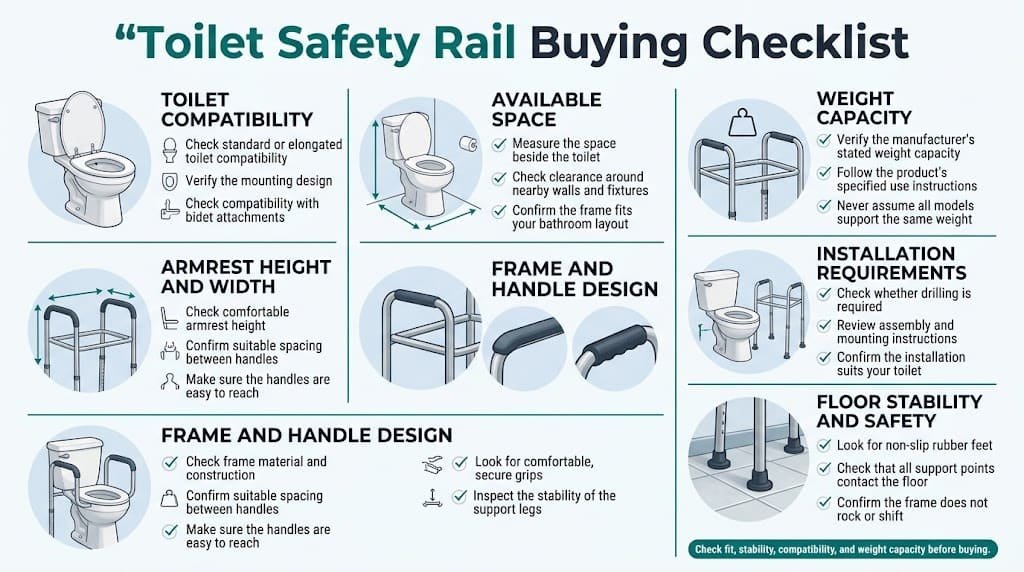
- Confirm compatibility with your toilet.
- Measure the available width around the toilet.
- Check the required armrest height.
- Verify the manufacturer’s weight capacity.
- Review the mounting and assembly requirements.
- Inspect the condition and design of floor-contact points.
- Check handle comfort and spacing.
- Confirm that the device will not obstruct bathroom access.
- Check whether bidet or electronic seat attachments create conflicts.
- Review the manufacturer’s maintenance and replacement-part information.
A suitable toilet safety rail should fit the physical space, match the user’s support needs, and be capable of being installed and maintained as instructed.
6. How to Measure Your Toilet Before Buying Safety Rails
Measuring your toilet before buying safety rails helps reduce the risk of ordering an incompatible product. The most important measurements depend on whether the device attaches to the toilet or stands independently.
For toilet-mounted models, pay particular attention to the seat-mounting arrangement. For freestanding models, focus more on frame width, leg placement, and available floor space.
Measure the Toilet Seat Mounting Holes
Toilet-mounted safety rails often use the existing toilet-seat attachment points.
Before purchasing, identify where the seat bolts are located and compare their arrangement with the mounting bracket supplied with the rail.
Follow these steps:
- Locate the two toilet-seat mounting bolts at the back of the toilet.
- Check the distance between their centers.
- Examine the available space around the mounting points.
- Review the rail’s bracket dimensions and installation requirements.
- Check whether the existing seat hardware can be reused or whether the product includes replacement hardware.
Do not remove the toilet seat simply to take measurements unless necessary. You can often inspect the mounting points from above or behind the seat.
If the toilet has a quick-release seat, bidet attachment, or unusual mounting system, check the compatibility instructions before purchasing.
Measure Toilet Width and Bowl Shape
Toilet bowl shape can influence which safety rail designs fit comfortably.
Most residential toilets have either a round or elongated bowl, but manufacturers may use different product dimensions and mounting arrangements.
To check compatibility:
- Identify whether the bowl is round or elongated.
- Measure the bowl width at the location relevant to the rail’s mounting or positioning.
- Compare the mounting area with the product’s stated dimensions.
- Check the required distance between the support arms.
- Review any model-specific restrictions.
For freestanding frames, also measure the distance available outside the bowl because the legs may extend beyond the toilet itself.
A product that accommodates the bowl may still be too wide for the surrounding bathroom space.
Measure Toilet Height and Armrest Clearance
Toilet height and handle positioning affect how easily someone can use the support rails.
Start by measuring the distance from the bathroom floor to the top of the existing toilet seat.
Next, review the manufacturer’s adjustable armrest-height range. The handles should be positioned where the user can reach them comfortably while seated and preparing to stand.
Also consider:
- The space between the handles.
- Whether the frame legs can be adjusted evenly.
- Clearance between the handles and the toilet seat.
- Whether the handles interfere with the user’s natural sitting position.
If the product has adjustable legs, check that its adjustment range accommodates the existing toilet height without placing the frame in an unstable position.
Check for Bidet Seats and Other Attachments
Bidet attachments and electronic toilet seats can affect the installation of toilet safety rails, particularly models that attach beneath the existing toilet seat.
Some attachments change the mounting hardware or require additional clearance behind the bowl.
Before purchasing, check:
- Whether the bidet uses the toilet-seat mounting bolts.
- Whether the rail bracket can fit alongside the attachment.
- Whether the electronic seat has a quick-release mechanism.
- Whether the toilet seat can still be removed for cleaning or servicing.
- Whether the manufacturer permits the rail and attachment to be installed together.
Never force a mounting bracket into a space that does not accommodate it properly.
If the attachment and safety rail are incompatible, consider another support design rather than modifying the hardware.
7. How to Install Toilet Safety Rails
Toilet safety rails installation varies according to the mounting design. Toilet-mounted rails typically attach near the toilet-seat bolts, while freestanding frames require assembly and correct positioning on the bathroom floor.
Always use the instructions supplied with the exact product. The following steps explain the general process, not a replacement for a model-specific installation manual.
Prepare the Toilet and Check the Instructions
Before beginning, identify the product type and review its installation requirements.
Prepare the following:
- The manufacturer’s instruction manual.
- All supplied frame components.
- Mounting brackets and hardware.
- Any required tools.
- A clear area around the toilet.
Inspect the components before assembly. Look for bent metal, cracks, damaged threads, missing locking pins, or worn rubber feet.
If any essential component is missing or damaged, contact the manufacturer or supplier before proceeding.
Also check the toilet itself. Loose seat bolts, damaged mounting points, or an unstable seat should be addressed before installing a support device that relies on the same hardware.
Install Toilet-Mounted Safety Rails
Toilet-mounted safety rails commonly use a bracket positioned between the toilet fixture and the seat assembly.
Although the exact procedure varies, installation may involve the following stages:
- Remove the toilet seat: Follow the product instructions for removing the existing seat and its mounting hardware.
- Position the bracket: Place the supplied mounting bracket in the specified position.
- Align the mounting holes: Ensure that the bracket and toilet mounting points line up correctly.
- Reinstall the seat hardware: Use the specified bolts, washers, and nuts according to the manufacturer’s instructions.
- Secure the support arms: Attach the handles or side-frame components to their designated mounting points.
- Check the locking mechanisms: Confirm that adjustment pins, locking collars, or other securing components are correctly engaged.
Do not substitute random bolts or hardware simply because they appear to fit. Incorrect fasteners can compromise the attachment.
If the mounting bracket does not sit correctly or the seat becomes unstable, stop and review the instructions before using the equipment.
Assemble Freestanding Toilet Safety Frames
Freestanding toilet safety frames are assembled separately and positioned around the toilet.
The general assembly process may include:
- Connect the side-frame sections and crosspieces according to the supplied instructions.
- Attach the adjustable legs to the designated frame openings.
- Engage all push buttons, locking pins, or adjustment mechanisms.
- Adjust the legs to the required height, ensuring both sides are set evenly.
- Position the frame around the toilet without obstructing access.
- Check that all rubber feet make appropriate contact with the floor.
Some models have a bracket that also attaches to the toilet. Do not assume that every frame described as freestanding is completely independent of the toilet.
Check the manufacturer’s instructions to determine whether the model requires an additional attachment.
Complete the Installation Safety Check
Before using the newly installed device, inspect the complete assembly.
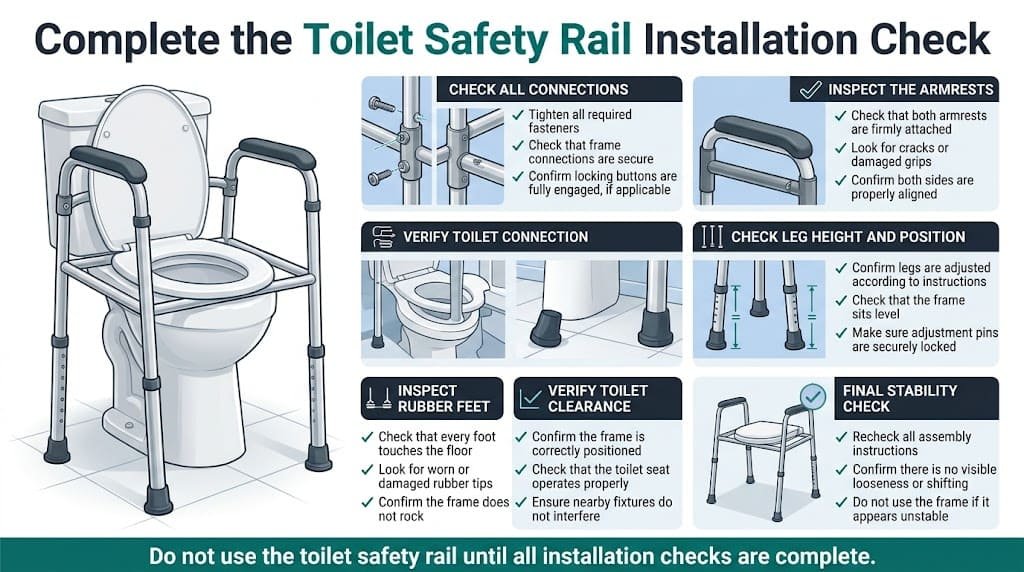
Toilet safety rail installation inspection
- All mounting hardware is tightened as instructed.
- Every locking pin is fully engaged.
- Adjustable legs are set to equal heights where required.
- Rubber feet are intact and positioned correctly.
- The toilet seat is secure.
- The handles are properly attached.
- The frame does not obstruct normal access.
- The product is positioned according to its manual.
Follow the manufacturer’s specified testing procedure before use. Do not test a newly installed frame by placing your full body weight on it or pulling aggressively on the handles.
Manufacturer instructions can contain important warnings about weight distribution, locking pins, and installation. For example, Medline’s safety-frame manual specifically requires users to confirm that push buttons are engaged and that weight is distributed evenly between the armrests.
If you cannot achieve a secure installation, seek help from a qualified installer or the equipment manufacturer.
8. How to Use Toilet Safety Rails Safely
Correct use is just as important as choosing the right toilet safety rails. Even a properly installed device may be unsuitable if the user cannot reach the handles comfortably or requires more assistance than the equipment provides.
The handles should be used as intended by the manufacturer, without sudden movements or unsupported transfers.
Position Yourself Before Sitting Down
Before sitting, approach the toilet carefully and position yourself in front of the seat.
Keep the following points in mind:
- Move close enough to the toilet to sit without reaching backward excessively.
- Make sure the handles are within comfortable reach.
- Use the intended gripping surfaces.
- Lower yourself in a controlled manner.
- Avoid leaning heavily to one side.
The user should not need to twist or stretch awkwardly to reach the support handles.
If the device feels too narrow, too wide, or too low, stop and check whether its adjustments can be changed safely.
Use the Handles When Standing Up
When rising from the toilet, use the designated handles to provide support during the movement.
Consider these practical points:
- Position your hands on the intended gripping surfaces.
- Use balanced support rather than relying on one handle unnecessarily.
- Avoid sudden pulling or twisting.
- Keep your movements controlled.
- Follow any transfer instructions provided by a healthcare professional.
Do not assume that all toilet safety frames are designed to withstand the same forces. Some manufacturers specifically instruct users to distribute weight between both armrests.
For example, Medline’s G30300 manual includes this instruction alongside its stated weight limit.
Understand the Limitations of Toilet Safety Rails
Toilet safety rails provide additional hand support, but they are not a complete solution for every mobility difficulty.
Their limitations include:
- Limited support for severe mobility problems: A user who cannot safely stand or transfer may need a different assistive device.
- Dependence on grip strength: Some users may not be able to hold the handles securely.
- Installation requirements: Toilet-mounted models depend on appropriate mounting hardware and compatibility.
- Floor stability: Freestanding models depend on correctly adjusted legs and suitable floor contact.
- Individual transfer needs: A device that works for one person may be unsuitable for another.
The Centers for Disease Control and Prevention recommends installing grab bars next to the toilet as part of home fall-prevention measures. Its guidance also emphasizes addressing other fall hazards around the home.
If someone has repeated difficulty standing, poor balance, or needs substantial physical assistance, an occupational therapist or other qualified healthcare professional can help assess appropriate bathroom equipment.
To make the entire toilet area safer beyond installing support equipment, read our guide to practical toilet safety tips, including fall prevention, proper toilet transfers, lighting, and reducing common bathroom hazards.
9. Common Toilet Safety Rail Problems and How to Address Them
Toilet safety rails can develop problems through regular use, incorrect assembly, loose hardware, or worn components. Recognizing these issues early helps prevent the device from becoming unreliable.
The following table explains common problems and what to inspect.
| Problem | Possible cause | What to check |
|---|---|---|
| Loose toilet-mounted rails | Loose seat bolts or mounting hardware | Check brackets, bolts, and connections |
| Wobbly freestanding frame | Uneven leg adjustment or loose locking pins | Inspect leg settings and locking mechanisms |
| Uneven armrests | Different leg heights | Recheck adjustment settings |
| Slipping rubber feet | Worn or damaged foot caps | Inspect and replace compatible feet |
| Uncomfortable handles | Unsuitable grip shape or spacing | Review handle dimensions and adjustment options |
| Rails obstruct toilet access | Incorrect frame dimensions or positioning | Check frame width and bathroom clearance |
| Seat movement after installation | Incorrect mounting or incompatible hardware | Inspect seat attachment and bracket alignment |
When Should You Stop Using a Toilet Safety Rail?
Stop using a toilet safety rail if it shows signs of structural damage, cannot be secured correctly, or moves unexpectedly during normal use.
Important warning signs include:
- Cracked frame components.
- Bent support arms.
- Loose or damaged mounting hardware.
- Missing or malfunctioning locking pins.
- Worn, detached, or damaged rubber feet.
- Corrosion that affects the structural components.
- Movement that cannot be corrected using the manufacturer’s adjustment instructions.
Do not attempt to compensate for damaged components by tightening unrelated parts, adding makeshift supports, or using incompatible replacement hardware.
Contact the manufacturer or supplier to identify suitable replacement components. If the frame cannot be restored to its intended condition, replace it before using it again.
10. How to Clean and Maintain Toilet Safety Rails
Regular cleaning and inspection help keep toilet safety rails in suitable working condition. Bathroom equipment is exposed to moisture, cleaning products, and frequent handling, so both the frame and its moving components need attention.
Follow the manufacturer’s maintenance instructions because different materials and finishes may require different cleaning methods.
Clean Handles and Frame Surfaces
Clean the handles and frame regularly, particularly the surfaces that users touch.
For routine care:
- Use a cleaning product compatible with the frame material.
- Wipe handles to remove dirt, soap residue, and other buildup.
- Clean metal surfaces without damaging their protective finish.
- Avoid abrasive materials that may scratch or damage coatings.
- Dry surfaces as recommended by the manufacturer.
Pay particular attention to padded or textured grips because cleaning residue can accumulate around their surfaces.
Do not use harsh chemicals unless the manufacturer confirms they are suitable for the product.
Inspect Hardware and Moving Parts
Check the device periodically for loose connections, damaged adjustment mechanisms, and signs of deterioration.
Inspect:
- Mounting bolts and brackets.
- Locking pins and push buttons.
- Adjustable leg connections.
- Handle attachments.
- Folding joints, where applicable.
- Metal surfaces for corrosion or damage.
If a component becomes loose, correct it only according to the manufacturer’s instructions.
Never use the equipment while an essential locking mechanism is malfunctioning.
Check Rubber Feet and Floor Contact
Rubber feet are important components of many freestanding toilet safety frames. They help maintain contact with the bathroom floor and reduce unwanted movement.
Inspect them for:
- Cracks or splits.
- Excessive wear.
- Missing rubber caps.
- Loose attachments.
- Uneven contact with the floor.
Replace damaged feet with manufacturer-approved or otherwise compatible components.
Also check the floor underneath the frame. Uneven surfaces, debris, and moisture can affect how the feet contact the floor.
The frame should sit evenly in its intended position before use.
11. FAQs
Are Toilet Safety Rails Suitable for Standard and Elongated Toilets?
Some toilet safety rails are designed to accommodate both standard round and elongated toilets, but compatibility depends on the individual model.
Check the mounting bracket dimensions, seat-bolt arrangement, and available clearance before purchasing. Freestanding frames also require sufficient space around the toilet.
Can You Install Toilet Safety Rails Without Drilling?
Yes. Many toilet safety rails can be installed without drilling into bathroom walls.
Freestanding models typically stand on floor-supported legs, while some toilet-mounted models attach using existing toilet-seat mounting points.
However, no-drill installation does not mean that the device requires no securing hardware. Follow the manufacturer’s assembly and mounting instructions.
How Much Weight Can Toilet Safety Rails Support?
Weight capacity varies by product and manufacturer.
For example, certain Carex and Medline toilet safety frames have published capacities of 300 pounds, while other models have different ratings.
Always check the exact model’s specifications, follow its weight limit, and observe any additional restrictions regarding use and weight distribution.
Are Toilet Safety Rails Better Than Raised Toilet Seats with Handles?
Neither option is universally better because they address different needs.
Toilet safety rails provide hand support without usually changing the toilet’s existing seat height. Raised toilet seats with handles provide both additional seating height and hand support.
If someone is comfortable with the existing toilet height but needs help holding onto something while standing, separate rails may be appropriate. If lowering onto a standard-height toilet is also difficult, a raised seat with handles may be worth considering.
Do Toilet Safety Rails Fit Around Every Toilet?
No. Toilet safety rails do not have universal compatibility.
Some models require specific toilet-seat mounting arrangements, while freestanding frames need sufficient space around the toilet.
Check the manufacturer’s dimensions, installation instructions, and compatibility information before buying.
Can Toilet Safety Rails Be Used with Bidet Attachments?
Sometimes, but compatibility depends on the rail and bidet designs.
Toilet-mounted rails may require access to the same mounting points used by a bidet attachment or electronic toilet seat.
Check both manufacturers’ installation instructions to determine whether the products can be installed together without interfering with their mounting systems or operation.
Are Freestanding Toilet Safety Frames Stable?
Freestanding toilet safety frames can provide support when correctly assembled, adjusted, and positioned on a suitable floor.
Their stability depends on several factors:
Correctly installed frame components.
Properly engaged locking pins.
Evenly adjusted legs.
Intact rubber feet.
Appropriate floor contact.
Use within the manufacturer’s stated limits.
A frame that wobbles or shifts unexpectedly should not be used until the problem has been identified and corrected.
Do Toilet Safety Rails Need Professional Installation?
Not always. Some toilet safety rails are designed for straightforward user assembly and installation using the supplied instructions.
However, professional assistance may be appropriate when the toilet has unusual mounting hardware, the installation cannot be completed securely, or the intended user requires an individualized mobility assessment.
If you are uncertain about compatibility or safe installation, contact the manufacturer, a qualified installer, or an occupational therapist as appropriate.
12. Conclusion: Choosing the Right Toilet Safety Rails
Choosing the right toilet safety rails involves more than selecting a frame with comfortable handles. You need to consider how the device attaches to the toilet or floor, whether it fits your bathroom, how its armrests can be positioned, and whether its weight capacity meets the manufacturer’s requirements.
Freestanding frames may work well when sufficient floor space is available, while toilet-mounted models can provide a more compact arrangement. Raised toilet seats with handles are another option when additional seat height and hand support are both needed.
Before purchasing, measure your toilet, check the mounting arrangement, review the product specifications, and make sure the device can be installed and maintained according to its instructions.
Most importantly, choose a design that matches the user’s mobility and transfer needs rather than relying on appearance or advertised capacity alone.
For a broader approach to improving bathroom accessibility, explore our complete guide to bathroom safety, which covers practical ways to identify hazards and make everyday bathroom activities safer.
2 Comments