
1. Introduction
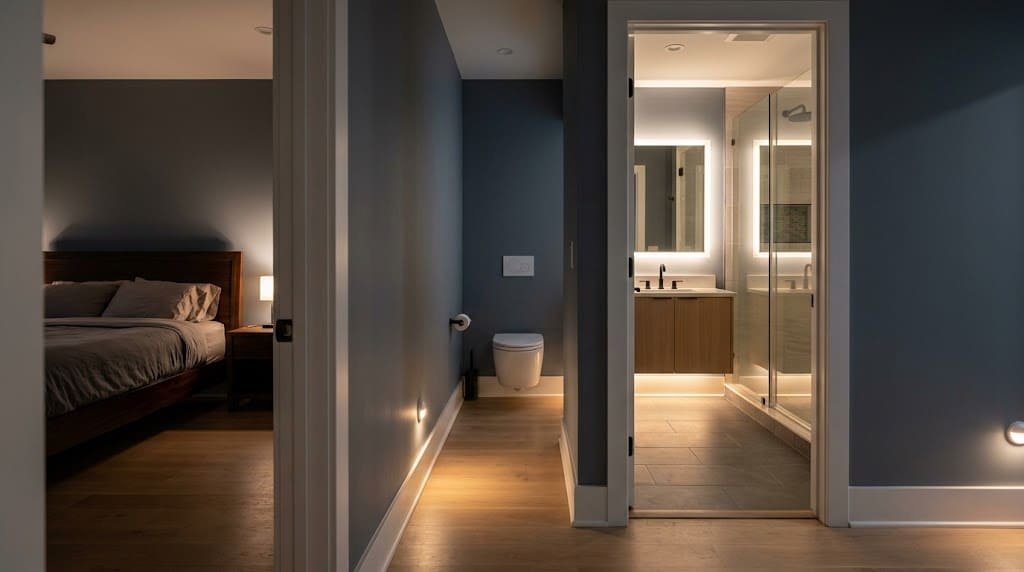
Nighttime bathroom trips can become less safe when darkness, sleepiness, clutter, wet surfaces, balance problems, or limited mobility all come into play at once. Nighttime bathroom safety is not only about making the bathroom safer—it also includes the entire route from the bed to the bathroom and back again.
A safer setup starts with four basics: make the route easy to see, remove obstacles, move carefully when getting up, and provide stable support where you sit, stand, or transfer. These steps are especially important for older adults and anyone with balance, vision, mobility, or other conditions that make nighttime movement more difficult.
The good news is that many improvements are simple. A reachable light, a clear pathway, properly installed grab bars, dry floors, and a predictable nighttime routine can make the trip easier to navigate. The goal is not to eliminate every possible risk, but to remove avoidable hazards and make the safest choice the easiest one.
Table of Contents
2. Why Are Bathroom Trips More Risky at Night?
Bathroom trips can be more challenging at night because the person is moving through a familiar environment under different conditions. Reduced visibility, sleepiness, urgency, dizziness, and changes in balance or vision can make ordinary obstacles harder to recognize or navigate.
For older adults, fall prevention deserves particular attention. The National Institute on Aging recommends measures such as nightlights, bathroom grab bars, slowly changing position to reduce dizziness, regular vision checks, and using a cane or walker when additional stability is needed.
Darkness and reduced visibility
Darkness makes it harder to identify changes in the floor, furniture, cords, rugs, thresholds, and other obstacles. A hallway that is easy to navigate during the day may look very different when only a small amount of light is available.
Shadows can also make objects and edges harder to distinguish. A bathroom doorway, raised threshold, bath mat, or piece of furniture may not be obvious until the person is already close to it.
Poor contrast can add another problem. Someone with reduced vision may have more difficulty distinguishing the bathroom floor from the walls, identifying the toilet, or seeing where a walking surface changes.
For this reason, nighttime safety should begin before entering the bathroom. The route from the bed to the bathroom should have enough consistent illumination for the person to see where they are going without having to search for hazards in the dark.
Sleepiness, rushing, and getting up too quickly
A person who wakes suddenly may be disoriented or still sleepy. If the bathroom is urgently needed, there can also be a temptation to get out of bed and walk quickly.
A safer approach is to pause before walking. Sit at the edge of the bed, turn on or activate the available lighting, and make sure you feel steady before standing. If you experience dizziness or lightheadedness when standing, talk with a healthcare professional rather than simply trying to move faster through the problem.
The CDC also recommends discussing medications with a doctor or pharmacist when they may contribute to dizziness or sleepiness and recommends making the home safer by removing trip hazards, improving lighting, and adding appropriate grab bars.
Nocturia, dizziness, medications, and mobility changes
Frequent nighttime urination can mean making the trip to the bathroom several times in one night. Each trip creates another opportunity to encounter a dark pathway, wet floor, obstacle, or balance challenge.
Dizziness, medication side effects, weakness, balance problems, vision changes, and limited mobility can make nighttime navigation more difficult. These factors do not affect everyone in the same way, so the right safety changes depend on the individual.
If nighttime trips have become noticeably harder, or if you are experiencing repeated dizziness, near-falls, or falls, discuss the problem with a healthcare professional. Do not assume that repeatedly struggling through the same route is simply part of getting older.
3. Make the Entire Bedroom-to-Bathroom Path Safer
One of the most important principles of bathroom safety for nighttime trips is to treat the entire route as one safety zone. A perfectly equipped bathroom cannot compensate for a dark hallway, loose rug, or cluttered bedroom floor.
Think about the route in order: bed, bedside area, bedroom floor, hallway, doorway, bathroom entrance, bathroom floor, toilet or shower area, and the return trip.
Start beside the bed
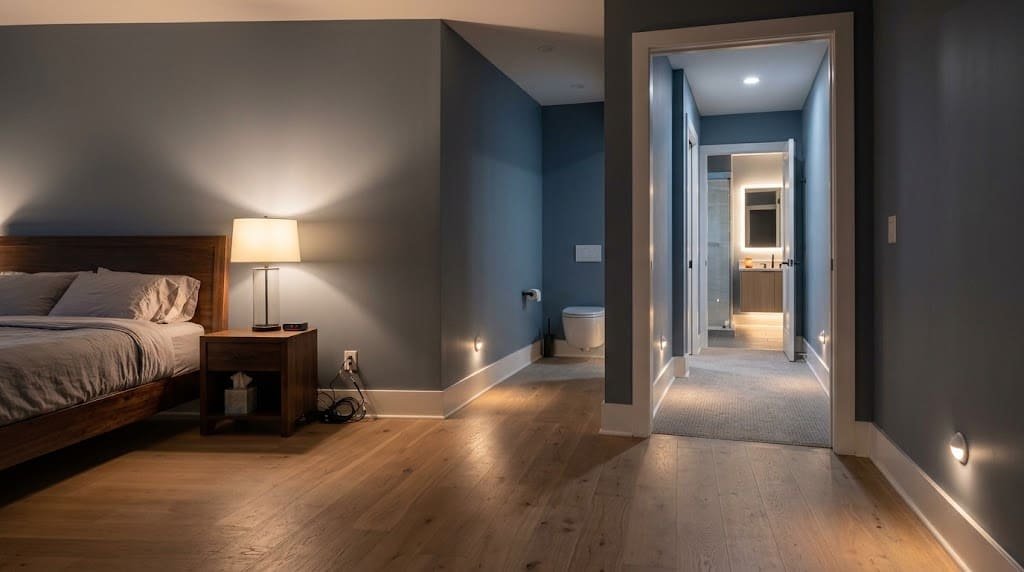
Make the first few steps as predictable as possible.
Keep a lamp, bedside light, or other suitable light source within easy reach. NIA recommends keeping nightlights and light switches close to the bed and having a flashlight available in case of a power outage.
If you use a cane, walker, or other mobility aid, keep it where you can reach it safely before standing. Avoid placing it so far away that you have to stretch, twist, or walk without it to retrieve it.
Glasses should also be accessible if you normally need them to see clearly. A charged phone or appropriate emergency communication device can be kept nearby when needed, particularly for someone who has a history of falls or is at higher risk.
Finally, keep the floor around the bed free of shoes, clothing, bags, charging cables, and other objects.
Clear the walking route
Walk the route during the day and look for anything that could become a problem at night.
Remove or properly secure loose rugs, move electrical cords away from walking areas, and keep clothing, shoes, laundry baskets, and other objects out of the path. Avoid arranging furniture so tightly that a person using a walker or cane has to turn sideways or make awkward movements.
Pay attention to changes in flooring and thresholds. A transition that seems insignificant during the day can become harder to see at night, especially when someone is tired or has reduced vision.
NIA recommends keeping walking areas tidy, securing carpets, avoiding throw rugs, keeping electrical cords away from walking paths, and using motion-activated lighting to illuminate pathways.
Make the bathroom entrance easy to see
The bathroom entrance should be recognizable without requiring the person to search for the doorway in darkness.
Use enough lighting to make the doorway and surrounding floor visible. Avoid creating a strong contrast between a bright room and a completely dark hallway, or lighting conditions that leave deep shadows around the entrance.
Keep the area immediately inside and outside the doorway clear. If there is a threshold or change in floor level, make sure it is visible and does not create an unnecessary tripping point.
A predictable route is particularly useful for older adults or people with vision or cognitive changes because it reduces the need to make decisions while moving through a dark space.
4. Choose Safe Bathroom Lighting for Nighttime Use
Good nighttime lighting should make hazards visible without creating unnecessary glare or forcing someone to search for a switch in the dark. The best setup is usually one that provides enough consistent illumination from the bed through the bathroom.
Use low-level pathway lighting
Nightlights can provide basic illumination along the route, while motion-activated lights can turn on automatically when someone begins walking.
Useful locations may include:
- Beside the bed
- Along a dark bedroom or hallway
- Near the bathroom entrance
- Inside or near the bathroom
- Along a route where a standard wall switch is difficult to reach
NIA recommends leaving a bathroom light on at night or using an automatic nightlight, and it recommends nightlights near the bed as well.
The CDC likewise recommends good lighting in rooms and hallways and notes that easily accessible switches or motion-sensor lights can improve home safety.
The goal is not to illuminate every part of the home as brightly as possible. It is to provide enough visibility that the person can identify the route, footing, and important fixtures.
Reduce glare and deep shadows
Brighter does not automatically mean safer.
A harsh light aimed directly toward the eyes can create glare and make it harder to see surrounding details. At the same time, a very dim light may leave shadows where obstacles are difficult to distinguish.
Look for lighting that provides useful illumination across the walking surface rather than creating a bright spot surrounded by darkness. The needs of someone with low vision may be different from those of someone with normal vision, so lighting should be adjusted to the individual’s ability to see comfortably and safely.
Keep lighting easy to activate
A light is less useful if the person must cross a dark room to reach the switch.
Consider accessible wall switches, motion sensors, bedside controls, or other arrangements that allow the route to be illuminated before walking. Consistent lighting from the bedroom through the hallway and into the bathroom can also reduce sudden changes in visibility.
For someone who wakes frequently during the night, automatic lighting can be particularly practical because it reduces the number of steps required before the person begins walking.
5. Reduce Bathroom Fall Hazards Before Bed
Once the route is illuminated and clear, look at the bathroom itself. Before going to bed, check the areas where you are most likely to step, turn, sit, stand, or transfer.
Keep floors dry and traction predictable
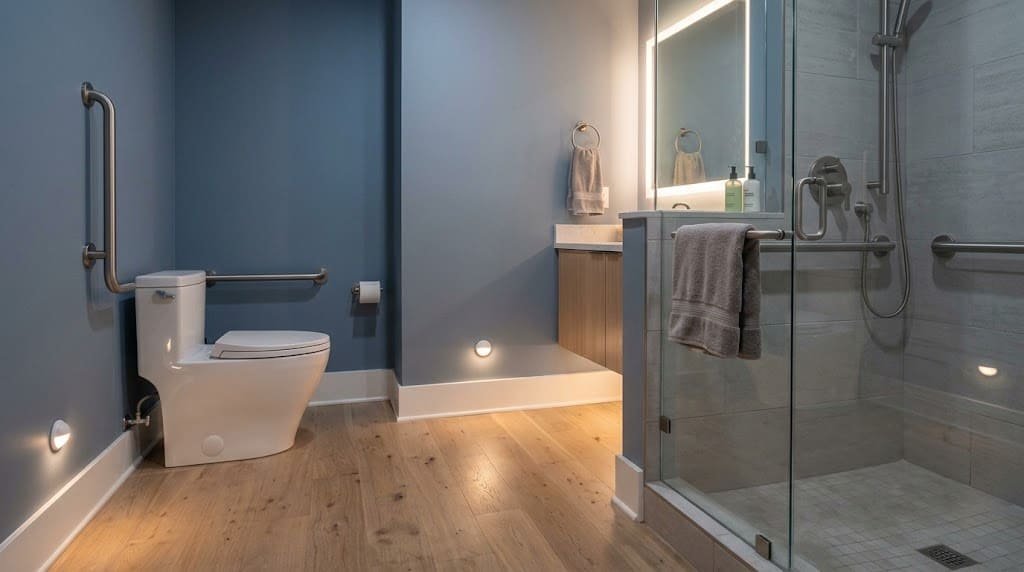
Water on the floor can create a slipping hazard, particularly when someone is moving quickly or has limited balance.
Keep the floor outside the tub or shower dry and address standing water before going to bed. Use appropriate nonslip surfaces in areas that commonly become wet, and make sure bath mats do not create a loose or unstable edge.
MedlinePlus recommends keeping the floor outside the tub or shower dry and using nonslip mats or strips in areas that may become wet.
The important distinction is that a safety mat should not become a new tripping hazard. If a mat moves, curls, or creates an unexpected edge, it needs to be secured appropriately or reconsidered.
Add stable support where transfers happen
Transfers are the moments when you move between standing and sitting or move into or out of a tub or shower. These movements can require more balance and strength than ordinary walking.
Properly installed grab bars can provide support near the toilet and around the tub or shower. Their placement should match the person’s actual movement pattern and needs.
Do not use towel racks, shower doors, or other fixtures that are not designed to support body weight as makeshift grab bars. MedlinePlus specifically warns that towel racks should not be used as grab bars because they cannot support a person’s weight.
If someone has difficulty getting on or off the toilet, a raised toilet seat or other appropriate equipment may be worth discussing with a healthcare professional. The right setup depends on the person’s strength, mobility, bathroom layout, and transfer technique.
Keep frequently used items within easy reach
Nighttime safety also involves reducing unnecessary movements.
Keep commonly used bathroom items where they can be reached without climbing, stretching excessively, twisting, or walking across a wet floor. This may include toilet paper, personal-care items, towels, and other essentials.
The objective is simple: a person should not have to create an additional balance challenge just to reach something that is needed during the bathroom trip.
For a broader look at preventing slip and fall throughout the bathroom, see our complete guide to Bathroom Slip and Fall Prevention before focusing on nighttime risks.
6. Follow a Safer Nighttime Bathroom Routine
A safer environment works best when it is paired with a predictable routine. The goal is to slow down the parts of the trip where rushing or sudden movement can create problems.
Before getting out of bed
Start with the first few seconds after waking.
- Turn on or activate the light. Make the route visible before you begin walking.
- Sit at the edge of the bed. Give yourself a moment to become oriented.
- Pause if you feel dizzy or unsteady. Do not rush into walking if you do not feel stable.
- Use your prescribed mobility aid if applicable. If you normally use a cane or walker, have it accessible before standing.
- Walk rather than rush. Urgency does not make an unsafe route safer.
NIA specifically recommends standing up slowly to avoid dizziness and using a cane or walker when greater stability is needed.
Inside the bathroom
Once inside, continue using the same deliberate approach.
Use stable support when transferring, particularly if you already know that getting onto or off the toilet is difficult. Avoid grabbing towel racks, shower doors, or other fixtures that are not intended to bear your weight.
Be alert for wet flooring around the tub, shower, or sink. If the floor becomes wet during use, address it rather than assuming it will be safe to walk across later.
For people who have difficulty with toilet transfers, equipment such as an appropriately selected raised toilet seat may reduce the physical challenge, but it should be chosen based on individual needs rather than simply added because it is marketed as a safety product.
On the way back to bed
The return journey deserves the same attention as the trip to the bathroom.
After using the toilet, you may be more tired, your feet may be wet, or you may be tempted to turn off the bathroom light immediately and walk back in darkness.
Keep the route back to bed clear and adequately illuminated. Move at a controlled pace, use your mobility aid if appropriate, and pay attention to the same hazards you checked on the way in.
Nighttime bathroom safety should cover the complete round trip, not just reaching the toilet.
7. Nighttime Bathroom Safety for Seniors and People With Limited Mobility
Older adults and people with limited mobility may face several overlapping challenges during nighttime bathroom trips. Balance, strength, vision, reaction time, mobility aids, and the physical demands of bathroom transfers can all influence how safely someone can move through the space.
For older adults
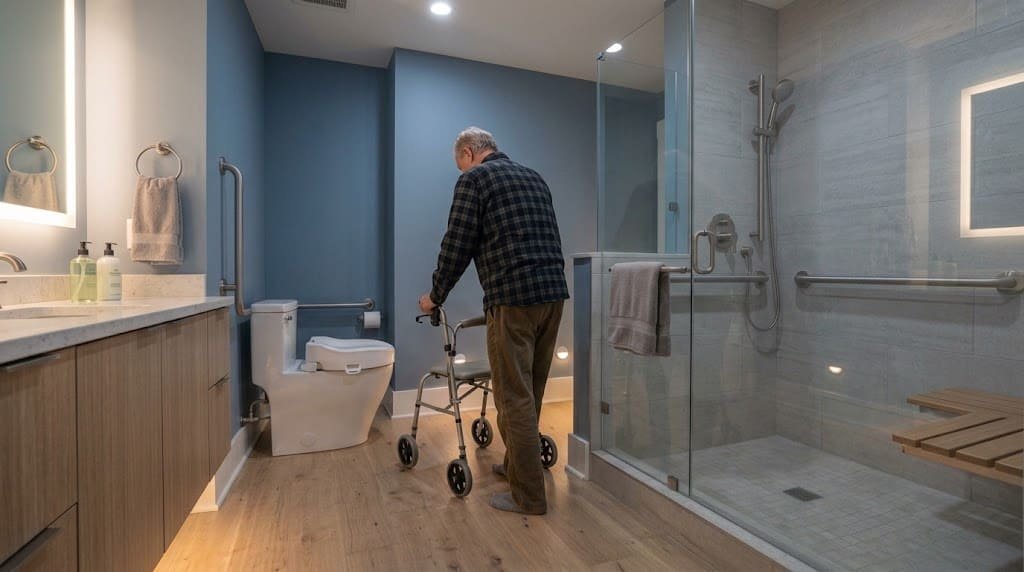
For seniors, nighttime bathroom safety should be approached as part of overall fall prevention rather than as a single lighting problem.
Check whether the person can:
- See the route clearly
- Get out of bed without becoming unsteady
- Walk safely to the bathroom
- Turn and position themselves near the toilet
- Sit and stand without losing balance
- Navigate back to bed
The CDC recommends removing trip hazards, improving lighting, installing appropriate bathroom grab bars, reviewing medications that may cause dizziness or sleepiness, and having vision checked as part of older-adult fall prevention.
If a person who previously managed nighttime trips independently begins needing furniture for support, falling, or struggling with transfers, that change deserves attention rather than simply adding more lights.
For People Who Rely on Canes, Walkers, or Mobility Devices
A mobility aid only helps when it can be used safely along the entire route.
Keep the cane or walker accessible before standing, and make sure there is enough space to maneuver it through the bedroom, hallway, doorway, and bathroom.
Do not create a lighting or furniture arrangement that forces the person to leave the mobility aid behind or squeeze through a narrow opening.
If someone is repeatedly having difficulty maneuvering a walker, cane, or other aid in the bathroom, an occupational or physical therapy assessment can help identify environmental or movement problems.
For people with vision or cognitive changes
People with reduced vision may benefit from consistent lighting, clear pathways, and easily recognizable transitions. The route should be simple rather than requiring the person to navigate around unnecessary objects.
For someone with cognitive impairment, a predictable bathroom location and consistent environmental cues can also be helpful. NIA recommends environmental safety changes and clear visual cues for people with Alzheimer’s disease and related cognitive changes.
Avoid frequently rearranging furniture or moving important bathroom items. A familiar route can reduce confusion during a nighttime trip.
8. Nighttime Bathroom Safety Checklist
Before settling in for the night, take a moment to run through these essential safety checks.
Before bedtime
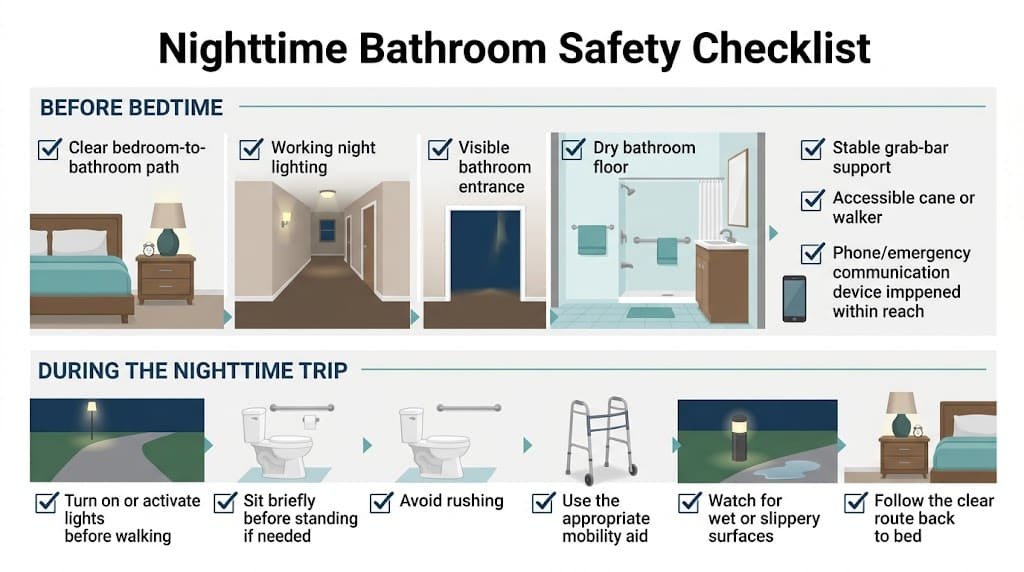
- ☐ The route between the bed and bathroom is free of obstacles.
- ☐ Loose rugs and unnecessary floor coverings have been removed or appropriately secured.
- ☐ Cords are kept away from walking areas.
- ☐ Night lighting is working.
- ☐ The bathroom doorway is clearly visible in low light.
- ☐ The bathroom floor is dry.
- ☐ Stable support is available where transfers occur.
- ☐ A cane, walker, or other needed mobility aid is within safe reach.
- ☐ A phone or appropriate emergency communication device is accessible when needed.
During the nighttime trip
- ☐ Turn on or activate lighting before walking.
- ☐ Sit briefly before standing if you need to make sure you feel steady.
- ☐ Do not rush because you need to use the bathroom.
- ☐ Use your appropriate mobility support.
- ☐ Watch for wet or slippery surfaces.
- ☐ Follow the same clear route back to bed.
This checklist is based on the same core principles recommended by NIA, CDC, and MedlinePlus: adequate lighting, clear walking paths, appropriate bathroom support, and attention to individual fall risks.
9. When Nighttime Bathroom Safety Needs More Than Home Modifications
Home changes can reduce environmental hazards, but they cannot address every reason someone may be having unsafe nighttime trips.
Talk with a healthcare professional if there are repeated nighttime falls or near-falls, new dizziness or lightheadedness, increasing balance problems, significant vision changes, or growing difficulty getting on or off the toilet.
Medication concerns are another reason to ask for professional guidance. Some medicines can contribute to dizziness or sleepiness, and the CDC recommends asking a doctor or pharmacist to review medications when fall risk is a concern.
A sudden or significant change in nighttime urination should also be discussed with a healthcare professional rather than treated only as a bathroom-safety problem.
If someone is having increasing difficulty moving safely with a cane or walker, relying on furniture for balance, or getting on and off the toilet safely, an occupational or physical therapist can evaluate how the bathroom and surrounding route are being used. They can identify environmental problems and suggest practical modifications that may help reduce fall risk.
10. Quick 4-Zone Nighttime Bathroom Safety Check
A simple way to evaluate nighttime bathroom safety is to divide the trip into four zones.
| Zone | What to check | Priority |
|---|---|---|
| Bedside | Light, phone or emergency device, and mobility aid are accessible | First |
| Pathway | Floor is clear and the route is adequately illuminated | First |
| Bathroom entrance | Doorway and threshold are visible and uncluttered | First |
| Bathroom | Floor is dry and transfers have appropriate stable support | First |
This four-zone approach helps identify problems in the order they occur. Start at the bed, follow the route into the bathroom, inspect the areas where you transfer, and then walk the same route back.
If one zone is unsafe, fixing that problem may be more useful than adding another safety product somewhere else.
11. FAQs
What is the safest way to walk to the bathroom at night?
The safest approach is to illuminate the route before walking, get up slowly, pause if you feel dizzy or unsteady, use an appropriate mobility aid when needed, and keep the bedroom-to-bathroom pathway free of obstacles. NIA and CDC both recommend adequate lighting and removing home hazards as part of fall prevention.
What type of lighting is best for nighttime bathroom safety?
There is no single lighting arrangement that is best for everyone. A useful setup provides enough consistent illumination to see the walking surface and obstacles without excessive glare. Nightlights, motion-activated lights, accessible switches, and bedside lighting can all be useful depending on the layout and the person’s vision and mobility needs.
How can I prevent bathroom falls at night?
Start with the entire route rather than the bathroom alone. Clear clutter and cords, remove or secure loose floor coverings, provide adequate pathway lighting, keep bathroom floors dry, and make sure transfers have appropriate stable support. Also address personal factors such as dizziness, vision changes, medication effects, or mobility problems.
Should seniors use a nightlight in the bathroom?
A nightlight can make nighttime bathroom trips easier to navigate by providing illumination without requiring a person to find a switch in complete darkness. NIA specifically recommends leaving a bathroom light on at night or using an automatic nightlight.
When should someone get professional help for nighttime bathroom safety?
Professional advice is appropriate when nighttime trips involve repeated falls or near-falls, dizziness, new balance problems, significant vision changes, medication concerns, or increasing difficulty with toilet or shower transfers. A healthcare professional can also help determine whether a home-safety assessment or occupational or physical therapy evaluation would be useful.
12. Conclusion
Effective nighttime bathroom safety is about more than installing a nightlight. The safest setup combines a clear route, adequate lighting, careful movement, dry and predictable surfaces, and stable support where transfers occur.
Start at the bedside and follow the entire route to the bathroom and back. Clear obstacles, make the path visible, keep needed mobility equipment accessible, and address any area where you have to rush, reach, twist, or use an unstable fixture for support.
If nighttime trips are becoming harder or you are experiencing falls, near-falls, dizziness, or new mobility problems, do not rely on home modifications alone. Ask a healthcare professional for guidance.
For a practical first check, walk the bedroom-to-bathroom route and identify every place where visibility, footing, or support could fail. Fix the highest-risk problems first.
For a broader look at preventing hazards throughout the bathroom, see our complete guide to bathroom safety before focusing on nighttime risks.
1 Comment